SEO Copywriting Checklist: 27 Checks Before You Publish

Artificial Intelligence
October 11, 2026
You ran the plugin and every light turned green. Keyword in the title, keyword in the first paragraph, readability in the safe zone, 1,800 words, meta description filled in. Two months later the page is stuck on page four, and a competitor's afternoon draft sits above it.
A green dashboard measures box-ticking. It doesn't measure whether the page matches the query, earns the click, or says something the other nine results don't. A proper SEO copywriting checklist closes that gap by auditing intent, structure, on-page signals, language and originality in a fixed order, so every post clears the same bar before it goes live.
Below are 27 checks across six phases, a cluster of narrower alternatives for when you need less, and a copy-paste template. Treat it as a gate: nothing publishes until it passes.
What a Real SEO Copywriting Checklist Covers
Most checklists you'll find are really on-page audits. They tell you where to put the keyword, how long the meta description should be and how many images to add. That's useful, but it's the last 30% of the job.
SEO copywriting is writing that has to satisfy two readers at once: a person who wants an answer fast, and a search system deciding whether your page deserves to be shown. A checklist that only serves the second reader produces pages that are technically tidy and quietly boring.
Google says this plainly in its guidance on creating helpful, reliable, people-first content: start from what the reader needs, then check whether the page shows real expertise and adds value beyond what already exists. The rest of the mechanics follow from that.
That's why the checklist below starts with intent and ends with a review date. Mechanics sit in the middle, where they belong.
Treating the checklist as a pass/fail on the keyword alone. A page can contain the keyword in every "right" spot and still fail checks 1, 3 and 22, which are the ones that decide whether it ranks.
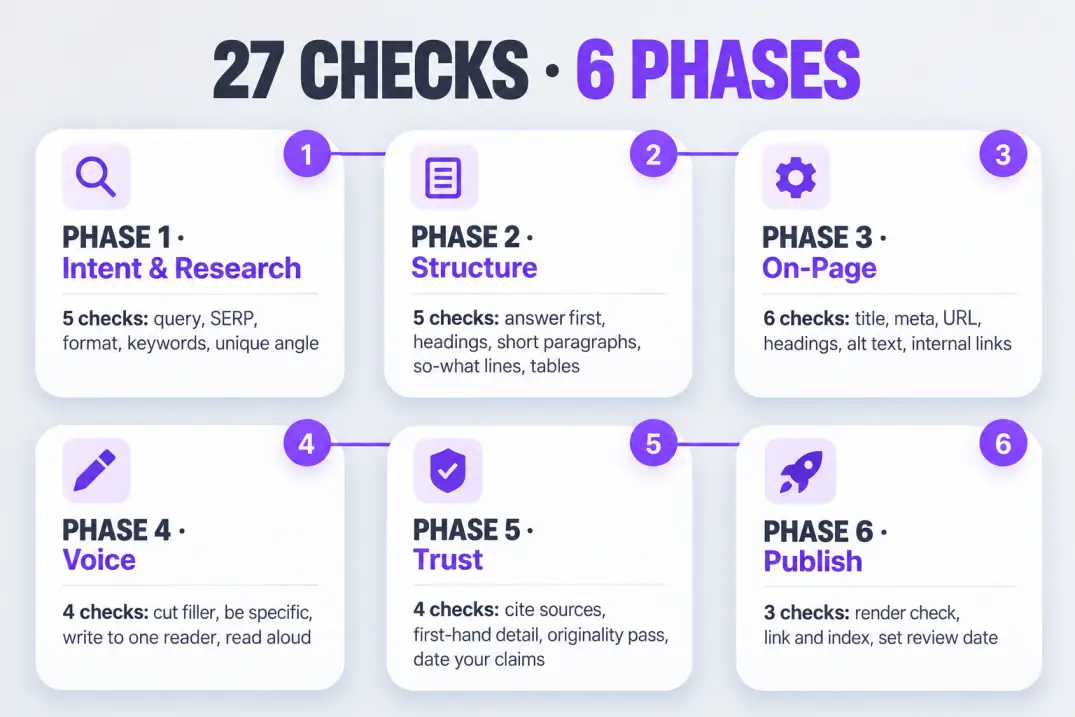
How the 27 Checks Are Organized
Each phase answers one question. If a draft fails a phase, fix that phase before moving on, because later checks can't rescue an earlier miss.
| Phase | Checks | The question it answers |
|---|---|---|
| 1. Intent and Research | 5 | Should this page exist, and what must it prove? |
| 2. Structure | 5 | Can a skimmer get the answer in ten seconds? |
| 3. On-Page Signals | 6 | Can search engines and readers understand the page at a glance? |
| 4. Voice and Quality | 4 | Does every sentence earn its place? |
| 5. Trust and Originality | 4 | Is there a reason to cite or rank this over the rest? |
| 6. Publish and Review | 3 | Does it keep working after launch? |
Phase 1: Intent and Research (Checks 1-5)
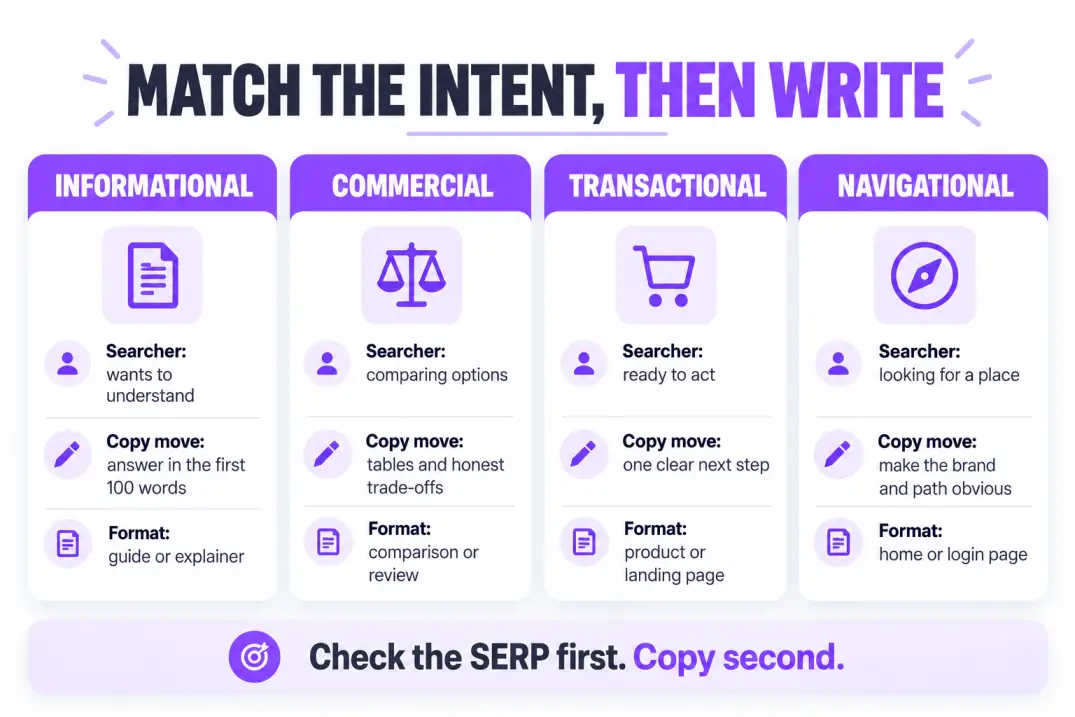
Every ranking problem that looks like a writing problem is usually an intent problem. This phase takes ten minutes and prevents hours of rewriting.
1. Name the one query the page answers
Write the target query in one sentence: "Someone searching X wants to Y." If you can't finish that sentence, the page has no job yet.
One page, one primary query. A second query that deserves its own page belongs on its own page, otherwise you invite keyword cannibalization and split your own signals.
2. Read the SERP before you write a word
Open the first page of results in a private window and note what you see: formats, headline patterns, the questions answered in "People also ask" and anything Google adds above the links.
This takes five minutes and tells you more than any tool score. The results are Google's current answer to "what does this searcher want?"
Capture four things in a scratch note: the dominant format, the average depth (skim the headings, don't count words), the questions that show up repeatedly, and the gap nobody fills. That last item usually becomes your unique contribution in check 5.
3. Confirm the format Google is rewarding
If page one is all step-by-step guides, a persuasive essay will struggle. If it's all comparison tables, a narrative post won't fit. Match the dominant format, then beat it on depth or clarity.
Intent also moves over time. A query that wanted a definition last year can want a tool or a template today, which is the pattern behind search intent drift.
4. Map secondary keywords to sections
List 5-10 closely related phrases and assign each to the section that answers it. This is how one page ends up ranking for dozens of variations without repeating itself, the approach covered in secondary keywords and how to rank for hundreds of queries.
The test: if a phrase doesn't fit a section naturally, it probably belongs on a different page.
5. Define the unique contribution
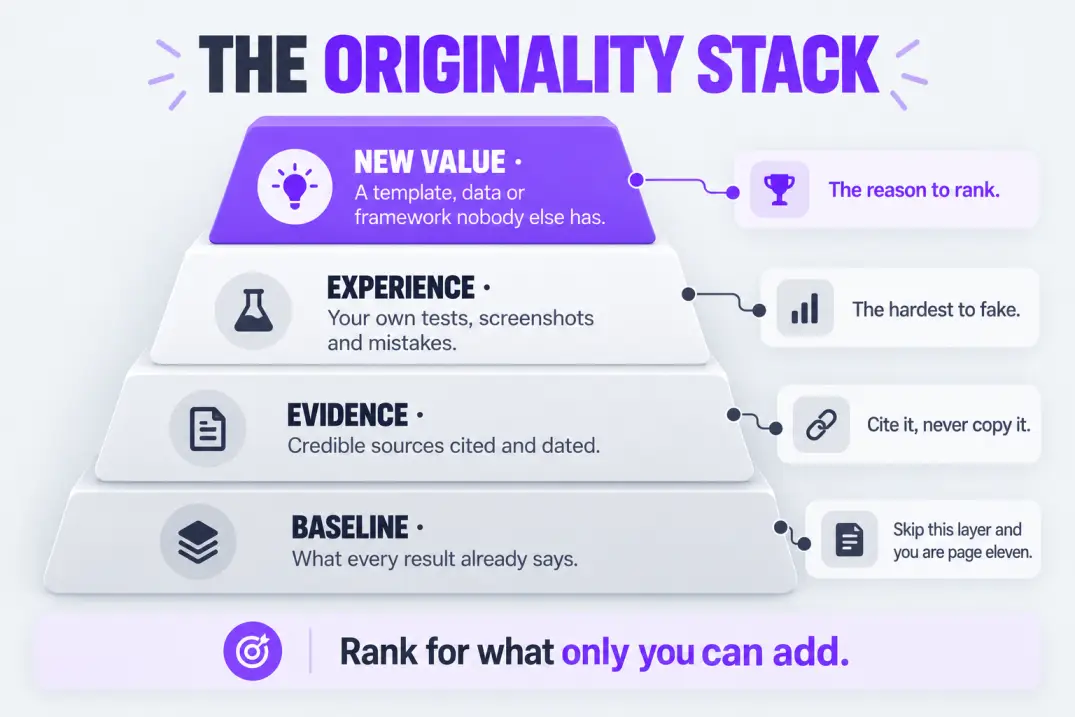
Write one sentence that starts "Unlike the top results, this page..." and finish it with something real: original data, a template, a worked example, a decision framework, first-hand testing.
If the sentence is empty, you're about to publish the eleventh copy of the same article. That's the core idea behind information gain, and it's the single most skipped item on every checklist.
Phase 2: Structure and Scannability (Checks 6-10)
Most visitors skim before they read. Structure decides whether they stay long enough to be persuaded by your actual writing.
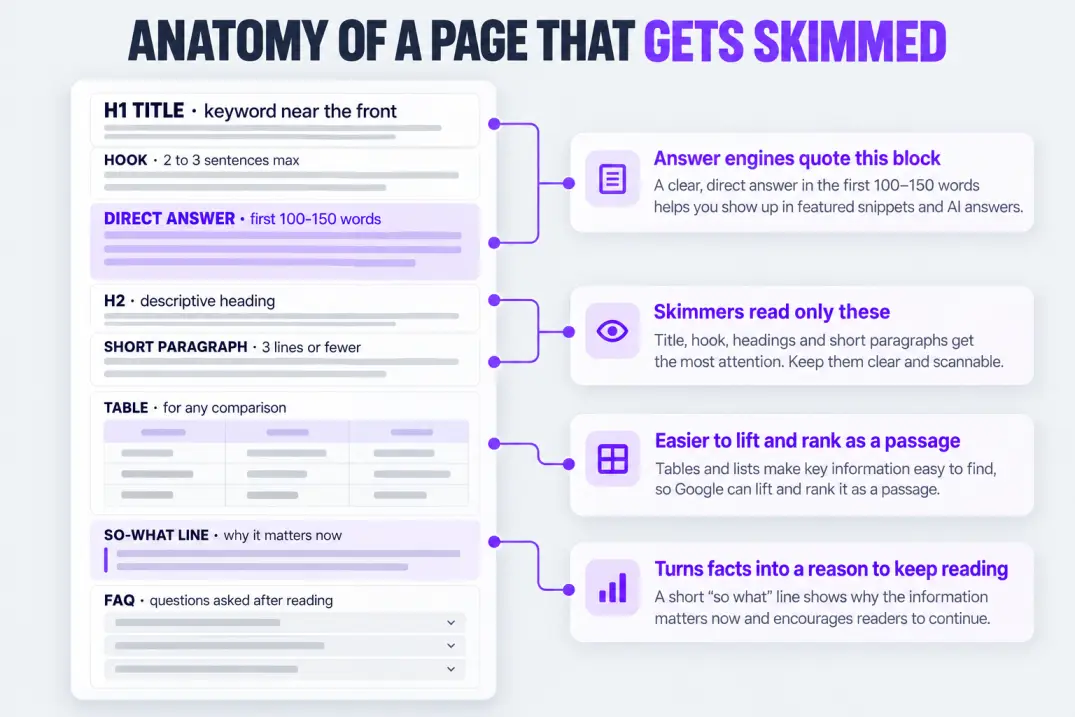
6. Put the answer in the first 100-150 words
Open with a short hook if you like, then answer the query in plain language before the first heading. Readers get what they came for, and answer engines get a clean passage to quote.
If you have to scroll to find the answer to your own title, rewrite the opening.
7. Use descriptive headings that work as a table of contents
Read only your H2s. They should tell the whole story of the page. "Introduction" and "Final Thoughts" say nothing; "What a Real Checklist Covers" and "How to Score a Draft" do.
One H1 (the title), H2s for main sections, H3s for sub-points, and nothing deeper. Headings are navigation first and keyword placement second.
8. Keep paragraphs to three lines or fewer
Short paragraphs aren't a stylistic quirk. On a phone, a five-line paragraph is a wall. Break at every new idea and let the white space do some of the work.
This also helps search systems that evaluate individual passages. A tight paragraph is easier to lift, quote and rank, which is the idea behind passage indexing.
9. Add a "so what" line to every section
After you explain a concept, tell the reader why it matters right now. One sentence is enough: "This is why your internal links quietly stop passing value." It turns information into a reason to keep reading.
Don't overdo it. If every paragraph ends with a moral, none of them land. Aim for the major sections, not the minor ones.
10. Use a table or list wherever you compare two or more things
Tables are the cheapest way to add scannable value. If you've written "A is cheaper but B is faster" in prose, that's a table waiting to happen.
Lists work for steps and checks. Tables work for trade-offs. Paragraphs work for reasoning. Pick the shape that fits the content, not the one that's easiest to type.
Phase 3: On-Page Signals (Checks 11-16)
This is the part every checklist includes, and it matters, but it works best after the first two phases. Perfect meta tags on a page with the wrong intent are polish on the wrong target.
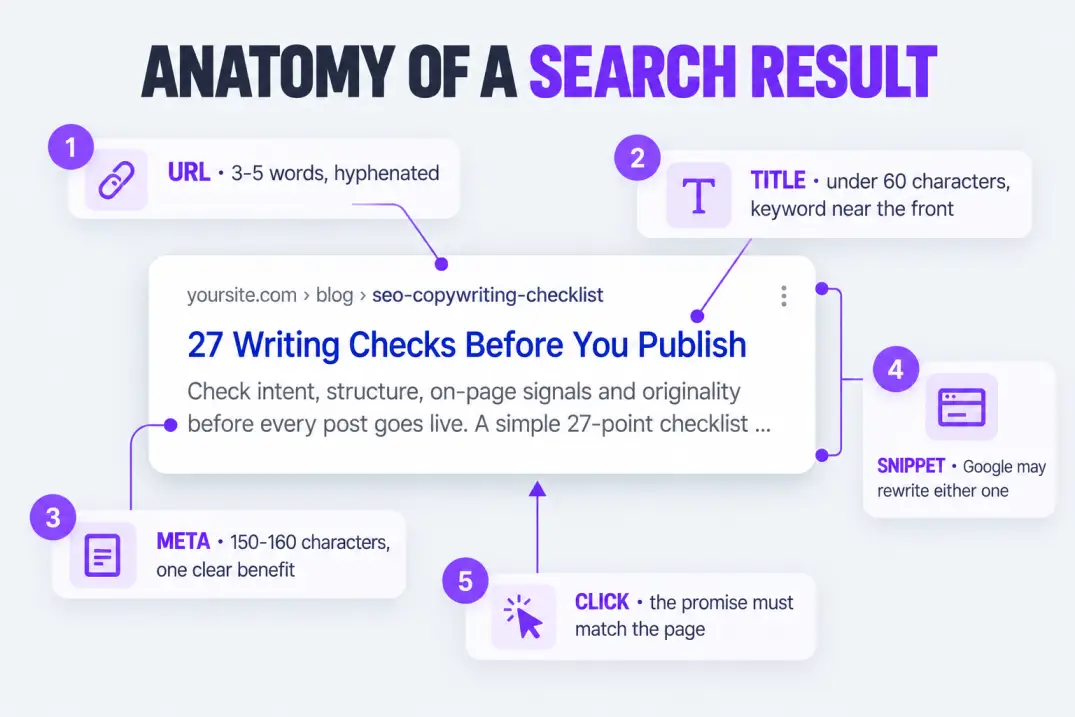
11. Write a title under 60 characters with the keyword near the front
Titles get truncated in results, and Google may rewrite titles it considers weak or mismatched with the page, as its documentation on title links explains.
Make the title match the H1 closely, keep it specific, and avoid stuffing. If you see rewrites in the wild, the fixes are laid out in why Google changes your SERP titles.
12. Write a 150-160 character meta description a human would click
Meta descriptions don't directly rank pages, but they shape the snippet and the click. Google often builds its own snippet from the page content, so treat the description as your best suggestion rather than a guarantee, per its notes on snippets and meta descriptions.
Lead with the benefit, include the primary phrase once, and promise only what the page delivers. The case for still writing them is made in meta descriptions in AI search.
13. Keep the URL short, readable and permanent
Three to five meaningful words, hyphens between them, no dates, no parameters. A slug like /seo-copywriting-checklist still makes sense in two years. A slug with the year in it doesn't.
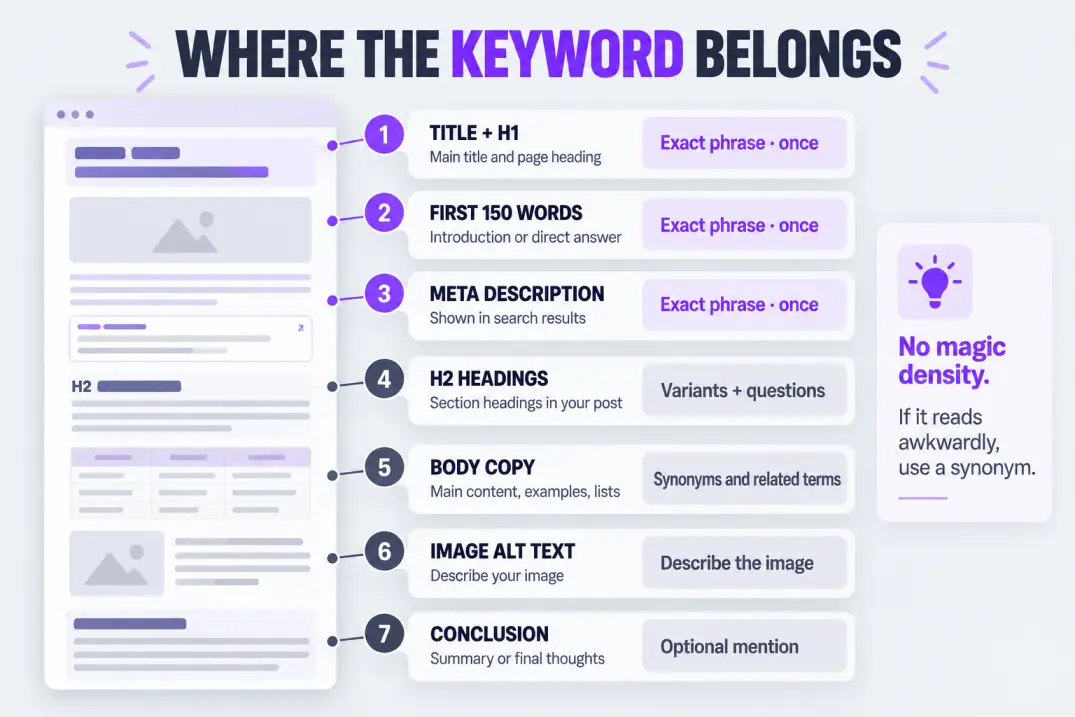
14. Use the keyword in the H1 and one or two headings, then vary the rest
Variation is the rule, not repetition. Use the exact phrase in the title and a natural handful of places, then lean on synonyms, related terms and questions everywhere else.
There's no magic density to hit. Google's spam policies call out keyword stuffing directly, so if a sentence reads awkwardly with the phrase in it, use a synonym.
15. Write alt text that describes the image
Alt text exists for people who can't see the image. Describe what's in it in under about 125 characters, and include the topic phrase only when it reads naturally. Never stack keywords in alt attributes.
16. Link to related pages with descriptive anchor text
Every new post should link out to two or three relevant existing pages and receive links from them. Use anchors that describe the destination ("internal linking strategy"), never "click here".
If you skip this, the page launches orphaned. A fuller treatment is in the internal linking strategy guide.
| On-page element | Target | Most common mistake |
|---|---|---|
| Title tag | Under 60 characters, keyword near the front | Brand name first, keyword truncated |
| Meta description | 150-160 characters, one clear benefit | Copying the first paragraph |
| URL slug | 3-5 words, hyphenated | Dates, IDs, stop-word chains |
| H2/H3 headings | Descriptive, varied wording | Repeating the exact keyword in every heading |
| Alt text | Under ~125 characters, descriptive | Keyword lists |
| Internal links | 2-3 outbound, 2-3 inbound, descriptive anchors | "Read more" anchors or none at all |
Write the title and meta description last, after the draft is done. By then you know what the page truly delivers, and the snippet can promise exactly that. Titles written first tend to oversell.
Where the Keyword Should (and Shouldn't) Appear
Keyword placement is the most over-engineered part of SEO writing. Here's the short version: put the phrase where a human would expect it, and describe everything else in other words.
| Placement | Exact phrase? | Better approach |
|---|---|---|
| Title and H1 | Yes | Near the front, once |
| First 150 words | Yes, once | Natural mention in the direct answer |
| Meta description | Yes, once | Lead with the benefit |
| Two or three headings | Sometimes | Use variants and questions |
| Body paragraphs | Rarely | Synonyms, related terms, specifics |
| Image alt text | Only if it fits | Describe what the image shows |
| Conclusion | Optional | A closing mention is fine |
Phase 4: Writing Quality and Voice (Checks 17-20)
Phases 1-3 get the page found. This phase decides whether the visit turns into trust. It's also where most AI-assisted drafts lose points, which is why editing for voice matters as much as editing for facts.
17. Cut the throat-clearing
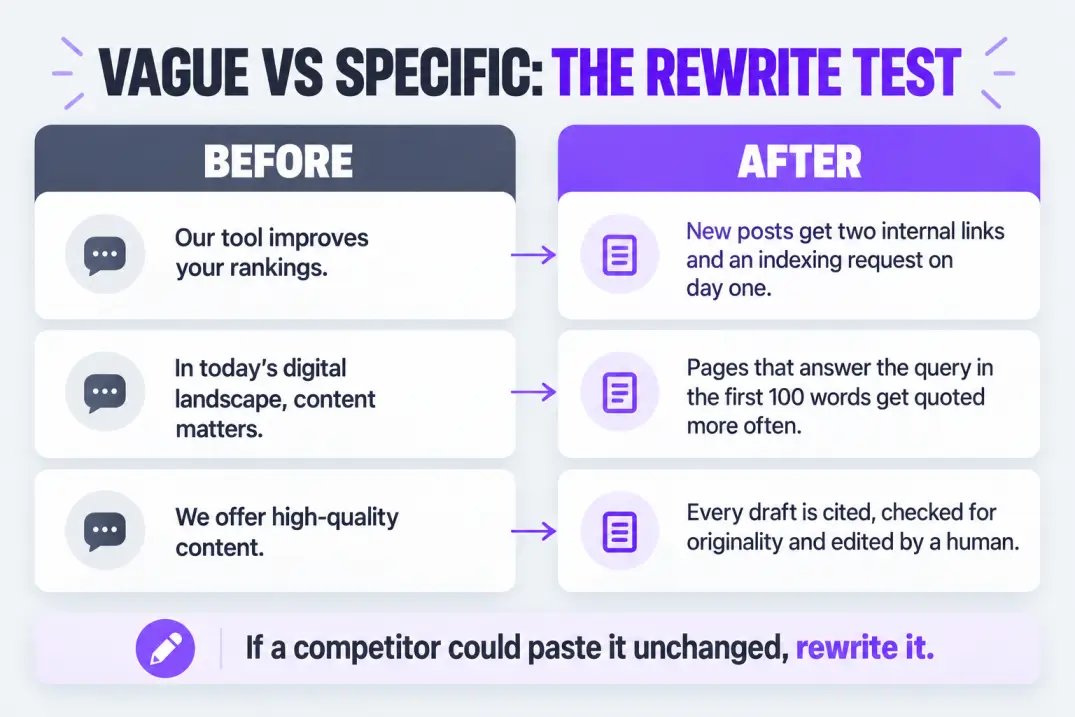
Delete any opener that could sit on a thousand other pages: "In today's digital landscape," "It goes without saying," "Content is king." If the first sentence works without a context-setting warm-up, the warm-up goes.
18. Replace every vague claim with something specific
"Improves your rankings" says nothing. "Gets a new post indexed with a link from two existing pages" says something. Hunt for adjectives doing a number's job and swap them out.
A fast test: could a competitor paste the sentence into their article unchanged? If so, it's filler.
19. Write to one reader
Use "you." Picture a specific person, such as a marketer with a blog that publishes weekly and a boss who wants to see traffic. Specific readers produce specific writing; "audiences" produce mush.
20. Do a read-aloud edit pass
Read the draft out loud, or use a text-to-speech tool. You'll hear repeated words, breathless sentences and the places where you were writing for an algorithm instead of a person.
If you stumble, the reader will too. Fix those spots before touching anything else.
- Phases 1-3 make a page eligible to rank; phases 4-6 make it worth ranking.
- Specific beats vague in every sentence, every time.
- Read it aloud before you publish it.
Phase 5: Trust and Originality (Checks 21-24)
This phase matters most for pages that cover topics where bad information has a cost, but it helps everywhere. Search systems and readers are both looking for a reason to believe you.
21. Cite two to five credible sources
Link to primary documentation, original studies, official data or recognized publications, and name what each source supports. Cite a source for a claim that needs one, not for decoration.
Two rules. Only link to pages you've confirmed are live and stable, and never lift a source's wording, even while citing it.
22. Add something only you could add
First-hand detail is the cheapest differentiator you have: a screenshot from your own account, a result from your own test, a mistake you made and what it cost. One concrete example from experience outweighs three paragraphs of general advice.
If you're writing outside your direct experience, interview someone who has it and quote them with permission.
23. Run an originality and AI-pattern pass
Check the draft for copied phrasing, and if AI helped draft it, check for the telltale patterns: generic openers, symmetrical lists, hedged non-answers. A good editing pass for AI content goes beyond swapping a few words.
This is also the stage where a structured AI content brief pays off, because a clear brief prevents most of what you'd otherwise be fixing.
Teams that publish at volume often build these checks into the pipeline itself, and Qoreta, for example, runs citation, internal-linking and originality passes on each draft before it's published.
24. Date-check every claim
Search for anything that can expire: prices, features, "latest" anything, years, legal rules. Replace stale items or add a visible "last updated" note.
A page with one outdated stat teaches the reader to distrust the rest.
Phase 6: Publish and Review (Checks 25-27)
Publishing isn't the finish line. It's where the page starts collecting the data that tells you whether the first five phases worked.
25. Preview on mobile before it goes live
Check heading hierarchy, table rendering, code blocks and image placement on a phone-sized screen. Tables that look fine on desktop often overflow on mobile.
26. Link in, then request indexing
Add links from two or three relevant existing pages to the new one, confirm the page is in your sitemap, and request indexing in Search Console. A new page with no inbound links is invisible to your own site.
27. Set a review date
Put a calendar reminder 30, 60 and 90 days out. At each one, look at impressions, clicks and the queries the page actually ranks for. Update the sections that miss the mark and add the questions you didn't anticipate.
A checklist that stops at "publish" misses half of what SEO copywriting is for.
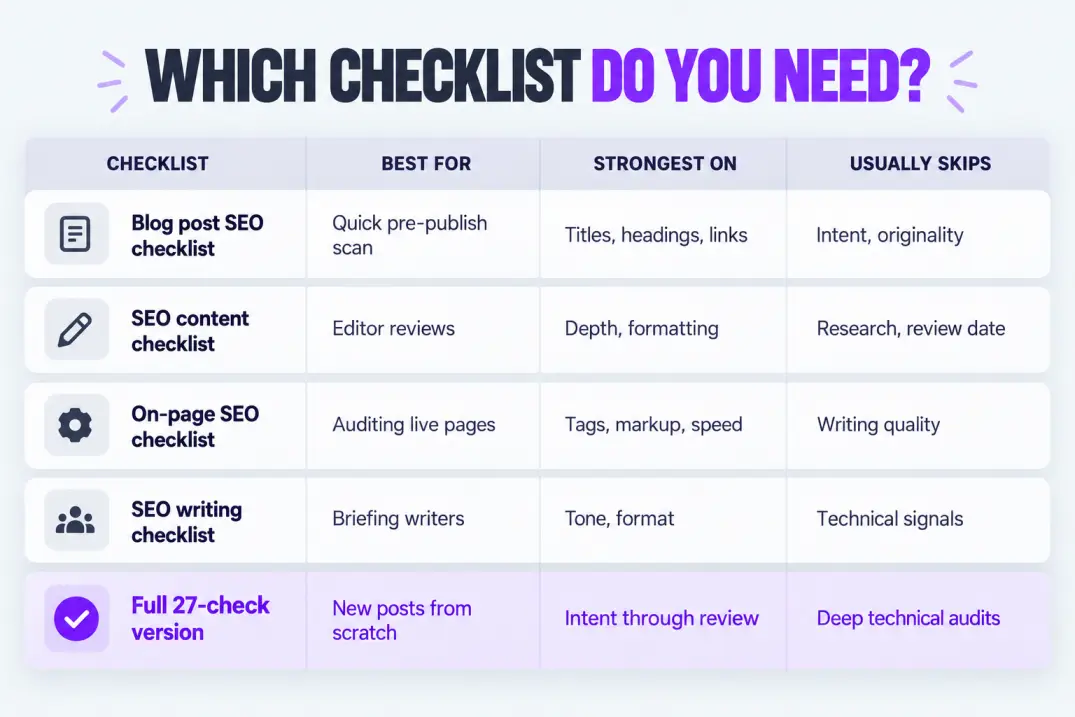
SEO Copywriting Checklist Alternatives and Related Checklists
Sometimes 27 checks is too many, or the job calls for a narrower view. These are the closest relatives, and when each one fits.
- Blog post SEO checklist: best for a quick pre-publish scan of a standard article. It focuses on title, headings, links and images, and skips intent and originality.
- SEO content checklist: best for editors reviewing someone else's draft. It covers depth, formatting and keyword coverage but not research.
- On-page SEO checklist: best for auditing existing pages. It's heavy on tags, markup and speed, and light on writing quality.
- SEO writing checklist for freelancers: best when you're handing briefs to writers. It's strongest on format and tone, weakest on technical signals.
- SEO copywriting examples and templates: best for learning by imitation. They show the finished product but not the reasoning.
| Checklist type | Best for | Strongest on | What it usually skips |
|---|---|---|---|
| Blog post SEO checklist | Quick pre-publish scan | Titles, headings, links, images | Intent, originality |
| SEO content checklist | Editor reviews | Depth, formatting, coverage | Research, post-publish |
| On-page SEO checklist | Auditing live pages | Tags, markup, speed | Writing quality |
| SEO writing checklist | Briefing writers | Tone, format | Technical signals |
| Full 27-check version | New posts from scratch | Intent through review | Deep technical audits |
If you publish more than a couple of posts a month, use the full version and trim it into a short "pre-publish" card the team can scan in two minutes.
A Worked Example: Running the Checklist on a Weak Draft
Consider a draft titled "Email Marketing Tips" for a small software company's blog. It has 1,600 words, a keyword in the title and a green score in the plugin. Here is how it fares against the checklist.
Phase 1. The target query is vague, so check 1 fails. Reading the SERP shows page one is dominated by comparison-style listicles with named tools and screenshots, so check 3 fails too, because the draft is a generic essay. The fix is to pick a narrower query, such as "email subject line tests for SaaS onboarding," and reshape the page around tested examples.
Phase 2. The answer to the query doesn't appear until paragraph six. The headings are "Introduction," "Tip 1," "Tip 2" and "Conclusion." Checks 6 and 7 fail. The fix is to move a two-sentence answer to the top and rename the headings to describe the payoff of each section.
Phase 3. The title is 71 characters with the brand name first, and the meta description is the first paragraph pasted in. Checks 11 and 12 fail. Both take two minutes to fix, which is why this phase feels productive while saving the least.
Phase 4 and 5. The copy is clean but generic, with no first-hand results and no cited sources. Checks 18, 21 and 22 fail.
Score before fixes: 17 of 27. After a focused rewrite of phases 1, 2 and 5, the draft scores 25, and the on-page fixes are a coffee-break job. Notice where the effort went: the biggest gains came from the earliest phases, not from touching the meta tags.
How to Score a Draft Before You Publish
Give each of the 27 checks one point. Don't award half points; a check either passes or it doesn't.
| Score | Verdict | What to do |
|---|---|---|
| 24-27 | Ready | Publish and set the review date |
| 20-23 | Close | Fix the failed checks, starting with the earliest phase |
| 15-19 | Weak | Revisit intent and the unique contribution before editing sentences |
| Under 15 | Rewrite | The brief is wrong, so start from Phase 1 |
Notice the rule about the earliest phase. A page that fails check 3 (format) and check 12 (meta description) should be fixed in that order, because rewriting the snippet won't help a page that has the wrong shape.
A Copy-Paste Checklist Template
Paste this into your CMS notes, a doc or your editorial tool and work down it for each post.
COPYWRITING CHECKLIST (27 CHECKS)

PHASE 1 - INTENT & RESEARCH
[ ] 1  One target query, written as "Searcher wants to..."
[ ] 2  SERP reviewed (formats, PAA, features)
[ ] 3  Format matches what ranks
[ ] 4  5-10 secondary phrases mapped to sections
[ ] 5  "Unlike the top results..." sentence is filled in

PHASE 2 - STRUCTURE
[ ] 6  Answer within first 100-150 words
[ ] 7  H2s tell the whole story alone
[ ] 8  Paragraphs 3 lines or fewer
[ ] 9  So-what line on every major section
[ ] 10 Tables/lists used for comparisons and steps

PHASE 3 - ON-PAGE
[ ] 11 Title under 60 chars, keyword near front
[ ] 12 Meta description 150-160 chars
[ ] 13 Short, permanent URL slug
[ ] 14 Keyword in H1 + 1-2 headings, variants elsewhere
[ ] 15 Descriptive alt text
[ ] 16 2-3 internal links out, 2-3 in

PHASE 4 - VOICE
[ ] 17 Throat-clearing removed
[ ] 18 Vague claims replaced with specifics
[ ] 19 Written to one reader
[ ] 20 Read-aloud pass done

PHASE 5 - TRUST
[ ] 21 2-5 credible sources cited
[ ] 22 First-hand detail added
[ ] 23 Originality / AI-pattern pass done
[ ] 24 Time-sensitive claims checked

PHASE 6 - PUBLISH
[ ] 25 Mobile preview checked
[ ] 26 Inbound links added, indexing requested
[ ] 27 30/60/90-day review set
Save the template once, then duplicate it per post. The value isn't the 27 items. It's the habit of never publishing without running them.
Common Ways This Checklist Gets Misused
- Using it as a keyword audit. If you only run Phase 3, you've bought the cheapest 20% of the value.
- Never trimming it. A checklist nobody finishes is worse than a short one people use. Cut it to what your team will actually do.
- Running it after the draft is final. Phases 1 and 2 are cheapest before you write. Doing them last means rewriting.
- Treating the score as the goal. The goal is a page worth ranking. The score is only a smoke detector.
- Skipping the review date. Rankings are earned over weeks. The post-publish check is where you find the missing questions.
Adapting the Checklist for Teams and Freelancers
A checklist only works if someone owns each part. Without owners, everyone assumes someone else ran Phase 5.
| Role | Owns | Hands off when |
|---|---|---|
| Strategist or editor | Phase 1 (intent and research) | The brief names the query, format and unique angle |
| Writer | Phases 2 and 4 (structure and voice) | The draft passes the read-aloud test |
| Editor or SEO lead | Phases 3 and 5 (on-page and trust) | Sources, links and tags are confirmed |
| Publisher | Phase 6 (publish and review) | Review dates are set |
For freelancers, put Phase 1 inside the brief itself. A brief that already contains the target query, the format to match, the secondary phrases and the "unlike the top results" sentence removes most of the back-and-forth that makes freelance content slow.
For solo bloggers, collapse the roles into two passes: a pre-write pass (Phase 1) and a pre-publish pass (Phases 2 through 6). Two sittings with a gap between them also give you the distance to edit your own work honestly.
If you manage a content calendar, add the score to your tracker as a column. After a quarter you'll have enough data to see whether higher-scoring posts earn more impressions, and which checks correlate most strongly with performance on your site.
Final Thoughts
An SEO copywriting checklist works because it forces decisions in the right order: decide who the page is for, shape it so they can skim it, tag it so machines can read it, write it so people trust it, then keep checking after it ships.
You don't need all 27 checks on every page, but you do need the first five. Start there, add the rest as the habit sticks, and score your next draft before you publish it. The posts that clear the bar are the ones worth building on.
- A good checklist starts with intent and ends with a review date, with mechanics in the middle.
- Fix failed checks in phase order. Earlier phases decide whether later ones matter.
- Use the exact keyword in a handful of high-value spots and use synonyms everywhere else.
- Add one thing only you can add, whether data, experience or a template.
- Narrower alternatives like a blog post SEO checklist are fine for quick scans, but not a replacement for the full version on new posts.
Artificial Intelligence
Intelligence without limits.
We believe great content deserves honest authorship—even when it's AI.
Frequently Asked Questions
It's a repeatable list of checks you run on a draft before publishing, covering search intent, structure, on-page elements, writing quality, originality and post-publish review. Unlike a plain on-page audit, it also checks whether the writing itself earns trust and answers the query.
Phases 1 and 2 take about 15 minutes before you write. The on-page and voice checks take another 15 to 20 minutes after the draft is done. With the template pasted into your notes, most editors finish the full 27 checks in under an hour.
No. Google's spam policies target keyword stuffing, not low density. Use the exact phrase in the title, the first 150 words and the meta description, then rely on synonyms, related terms and questions for the rest of the page.
Yes, arguably more. AI drafts tend to be competent but generic, so checks 5, 18, 22 and 23 (unique angle, specific claims, first-hand detail and the originality pass) are the ones that separate a rankable page from a forgettable one.
Run checks 1, 3, 5, 6 and 11. They confirm the page has a clear query, matches the dominant format, adds something new, answers early and has a title worth clicking. Skipping these hurts rankings more than skipping any on-page tweak.
Aim for two to three links out to relevant existing pages and two to three links in from older posts. Quality and relevance matter more than the count, and anchor text should describe the destination.
Length isn't a ranking factor on its own. Match the depth the top results show for that query, then add what they miss. A thorough 1,200-word answer beats a padded 3,000-word one.
The two overlap heavily. Copywriting usually implies persuasion and conversion, such as landing pages and product copy, while content writing leans toward informational posts. A good checklist works for both if you adjust the intent checks.
Review at 30, 60 and 90 days, then every six months for pages that matter. Update earlier if rankings drop, a competitor publishes something stronger, or a claim on the page goes out of date.
Include it once if it reads naturally, since Google may bold matching terms. The bigger job is writing a benefit-led description that earns the click. Google can also replace it with text from the page, so the page itself must be clear.
Mostly. Keep the intent, on-page, voice and trust phases, and swap the long-form structure checks for product-specific ones: unique descriptions, specs in a table, reviews and clear next steps.
A blog post SEO checklist works for quick scans, an on-page SEO checklist suits auditing live pages, and an SEO content checklist is good for editor reviews. They're narrower and usually skip intent and originality, so use them as supplements on new posts.
Track impressions, clicks and the number of queries each new page ranks for at 30, 60 and 90 days. Compare pages that scored 24 or higher against those that didn't. If high scorers aren't performing better, your checks need recalibrating.
You can, but know what you're trading. Low scores in phases 1 and 5 usually predict a page that doesn't rank at all, while low scores in phase 3 are cheaper to fix after publishing.
Keep it under roughly 125 characters and describe what the image shows. Include the topic phrase only when it reads naturally. Google's image guidance recommends useful, descriptive alt text over keyword lists.
Check 1 prevents most of it: one page, one primary query. Before writing, search your site for the phrase and see which page already targets it. If one exists, update that page instead of publishing a competitor to it.