How to Write AI Content Briefs That Actually Work (Step-by-Step Guide)

Artificial Intelligence
September 5, 2026
Imagine hiring a world-class chef for a crucial dinner party. You hand them a credit card and a post-it note that just says: "Make dinner. Make it tasty."

The chef will cook something technically edible. It might even be good. But if you were expecting a five-course Italian feast for vegetarian guests with gluten allergies, you’re going to be deeply disappointed with the steak tartare they serve.
This is exactly how most teams currently treat AI content generation. They paste a generic prompt into an LLM and hope for a rankable, on-brand masterpiece. When they get generic fluff instead, they blame the AI.
The problem isn’t the model’s capability; it’s the lack of constraints. If you want high-quality output, you need high-quality input. You don’t need better prompt engineering; you need better AI content briefs.
An effective brief bridges the gap between your strategy and the AI's execution. It stops being a slot machine you pull hoping for a jackpot, and starts being a predictable publishing workflow. If your current AI-written blogs are invisible in search, the issue almost certainly starts with the instructions you provided.
Here is how to move beyond basic prompting and build briefs that force AI to produce usable, rankable content.
Why the Brief Matters More Than the Prompt
There is a fundamental misconception in content marketing right now that a "perfect prompt" exists—some magical combination of words that unlocks flawless writing from ChatGPT or Claude.
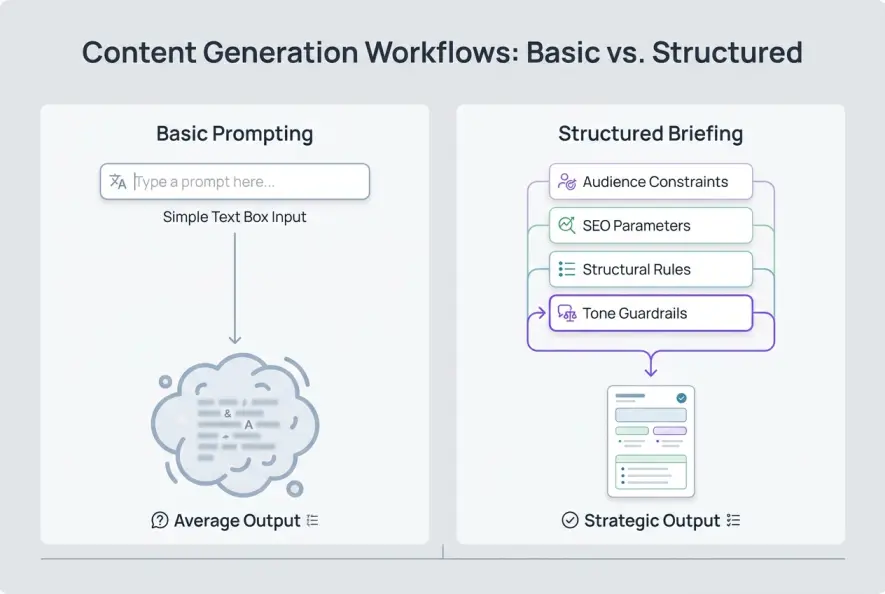
This is false. A prompt is just an instruction: "Write a blog post about X." A brief is the entire context surrounding that instruction.
If you skip the brief, the AI has to guess everything that isn't explicitly stated. It has to guess the target audience's sophistication level. It has to guess which semantic keywords are important. It has to guess your brand's stance on controversial topics.
AI models are trained on the average of the internet, so when they guess, they regress to the mean. They produce average, consensus content that doesn't offend anyone but also doesn't provide unique value. A robust AI content brief acts as a set of guardrails, forcing the model off the path of least resistance and toward your specific editorial goals.
The 5 Essential Pillars of an AI Brief
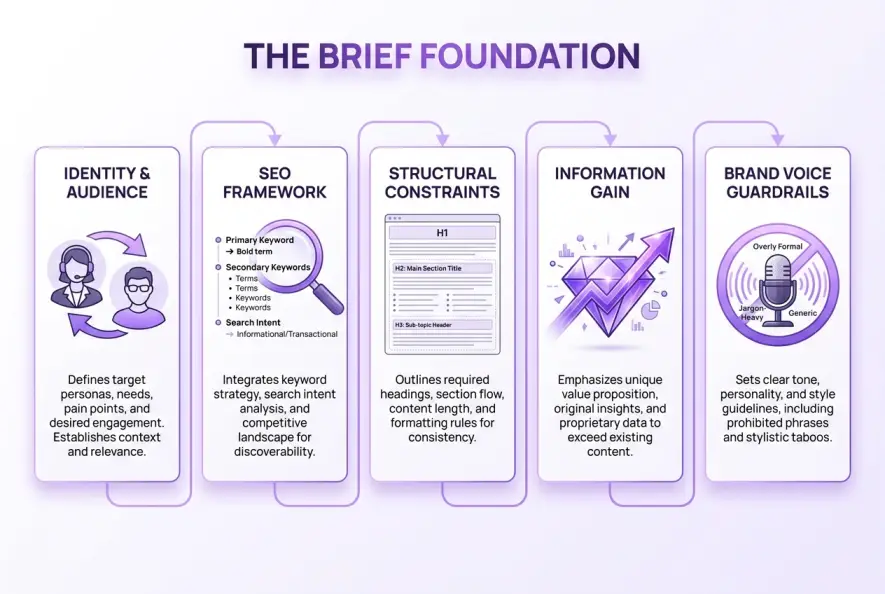
A great brief doesn't need to be a novel, but it must contain non-negotiable constraints. If you leave any of these five pillars out, you are essentially asking the AI to hallucinate that part of your strategy.
1. The Core Identity (Who and To Whom)
You must define the relationship between the writer and the reader immediately. If you don't, the AI defaults to a helpful but bland assistant tone.
- The Persona: Is the writer an industry veteran, a curious data scientist, or an empathetic peer? Define the expertise level. A blog about heart surgery written by a "medical researcher" needs a different vocabulary than one written by a "health blogger."
- The Audience: Be painfully specific. "Small business owners" is too broad. Try: "Bootstrapped SaaS founders doing 50k MRR who are frustrated with high churn rates."
This constraint alone solves 50% of tone issues.
**Don't just list demographic data.** Knowing the audience's age and location helps very little. Knowing their current biggest headache and what they are skeptical about changes everything about how the AI frames the solution.
2. The SEO Framework (Intent over Keywords)
AI is notoriously bad at keyword optimization if left unsupervised. It either ignores keywords entirely or "stuffs" them in unnaturally in the first paragraph.
The brief must provide the hard data:
- Primary Keyword: The single main topic.
- Search Intent: Is the user trying to buy something (transactional), learn how to do something (informational), or find a specific website (navigational)? You must explicitly tell the AI: "The reader wants a quick answer first, then deep details," or "The reader wants to compare three software options side-by-side."
- Semantic Vocabulary: Provide 5–10 secondary keywords or entities that must appear naturally in the text to prove topical relevance to search engines.
3. Structural Constraints (The Outline)
Never, ever let an AI generate its own blog outline from scratch. It will almost always choose a generic structure: Introduction → What is X? → Benefits of X → Conclusion.
Your brief must include a mandatory heading structure based on SERP research. You need to dictate:
- The exact H2s and H3s required.
- Approximate word counts for different sections (e.g., "Keep the intro under 150 words").
- Required formatting elements, such as "include a comparison table here" or "use a bulleted list for these features."
Controlling structure is the best way to ensure the final piece actually covers the topic comprehensively.
4. Information Gain Requirements (Unique Value)
This is the most critical step for modern SEO. Google is actively looking for information gain—content that adds something new to the conversation rather than just rehashing the top 10 results.
AI cannot invent new facts. You must feed them into the brief. You must explicitly state: "This article must include our proprietary data showing X," or "You must counter the common industry advice that Y is true."
If your brief doesn't contain unique inputs, you cannot expect unique outputs.
5. Brand Voice Guardrails (Negative Constraints)
It is often easier to tell an AI what not to do than what to do. Negative constraints are powerful tools for shaping tone.
Instead of just saying "be professional," add guardrails to the brief:
- "Do not use the words: crucial, paramount, delve, leverage, or tapestry."
- "Do not start sentences with 'In conclusion' or 'It's important to note'."
- "Never use metaphors relating to sports."
These negative constraints chip away at the robotic "AI accent" that plagues generic content.
Step-by-Step: Building Your Workflow
Knowing the pillars is one thing; executing them consistently is another. You cannot rely on remembering to type these constraints every time. You need a repeatable process.
Phase 1: The Pre-Brief Research
Before writing the brief, a human (or a specialized research agent) needs to look at the SERPs for the target keyword. You need to identify what the current top-ranking pages are covering, what they are missing, and what structure Google seems to prefer.
Gather your semantic keywords, decide on your unique angle (information gain), and sketch the rough outline. This usually takes a skilled SEO specialist 20–30 minutes per topic.
Phase 2: The Brief Assembly
Take your research and plug it into a standardized template. This template should have dedicated fields for all five pillars mentioned above. This ensures nothing gets skipped during busy publishing cycles.
Instead of manually writing briefs for every post, advanced setups automate this phase. For instance, Qoreta generates detailed briefs based on real-time SERP data and semantic analysis before the writing AI even begins draft generation, ensuring structural alignment with ranking content from minute one.
Phase 3: The "Human-in-the-Loop" Review
The brief isn't just instructions for the AI; it's a grading rubric for the human editor.
When the draft comes back, the editor shouldn't just be spellchecking. They should be holding the output against the brief. Did it use the required H2s? Did it adopt the specified persona? Did it adhere to the negative tone constraints?
If the output failed, the fault lies with the brief. Adjust the constraints in your template and try again. This feedback loop is how you dial in your process over time.
**Create different brief templates for different content types.** A brief for a "Best X vs Y" comparison post needs very different structural constraints than a brief for a "How-to" tutorial post. Don't use a one-size-fits-all template.
Moving From Prompt Engineering to Brief Engineering
The future of AI content isn't about who can write the cleverest 50-word prompt. It's about who can build the most robust, repeatable systems for directing AI effort.
An AI content brief is a constraint mechanism. By limiting the AI's choices regarding structure, tone, and facts, you paradoxically free it to do what it does best: turning loose ideas into coherent prose at scale. Stop hoping for good content and start engineering it.
Artificial Intelligence
Intelligence without limits.
We believe great content deserves honest authorship—even when it's AI.
Frequently Asked Questions
Length matters less than density. A 300-word brief packed with specific constraints, negative keywords, and a detailed outline is better than a 1000-word rambling document. Typically, a strong brief is 1–2 pages long.
You can use AI to assist with research, but a human must make the final strategic decisions in the brief. If you ask AI to define the strategy AND execute the strategy, you are removing human oversight from the most critical part of the process.
The structural outline and information gain requirements are crucial. If the structure is wrong, the post won't satisfy search intent. If there is no unique information gain, the post won't rank long-term.
Avoid vague adjectives like 'professional' or 'witty.' Use negative constraints (e.g., 'do not use exclamation points,' 'do not use slang') and provide examples of existing content that matches the desired tone.
Yes, absolutely. Even for rewrites, you need a brief to define what needs to be improved, what new data needs to be added, and what specific brand voice needs to be applied to the new version.