How to Scale Content Velocity Without Tanking SEO

Artificial Intelligence
September 9, 2026
According to comprehensive search data analyzed by Ahrefs, roughly 96.55% of all newly published pages on the internet receive zero organic search traffic from Google. For growth teams attempting to scale their editorial output, this statistic reveals a harsh reality: publishing more content does not automatically yield more search visibility. In fact, ramping up production without an architectural plan often leads to indexation drops, wasted crawl resources, and stagnating traffic.

Scaling your content velocity—the speed and volume at which you publish new pages—only damages your SEO when output outpaces your domain's crawl budget or dilutes your site's overall information gain. To safely publish at high volume, you must balance crawl capacity limits with structured internal linking, comprehensive topical depth, and genuine original value per URL. When executed correctly, high publishing output speeds up topical authority acquisition; when executed poorly, it signals low-quality site bloat to search engine algorithms.
The Mechanics of Search Engine Crawl Budgets
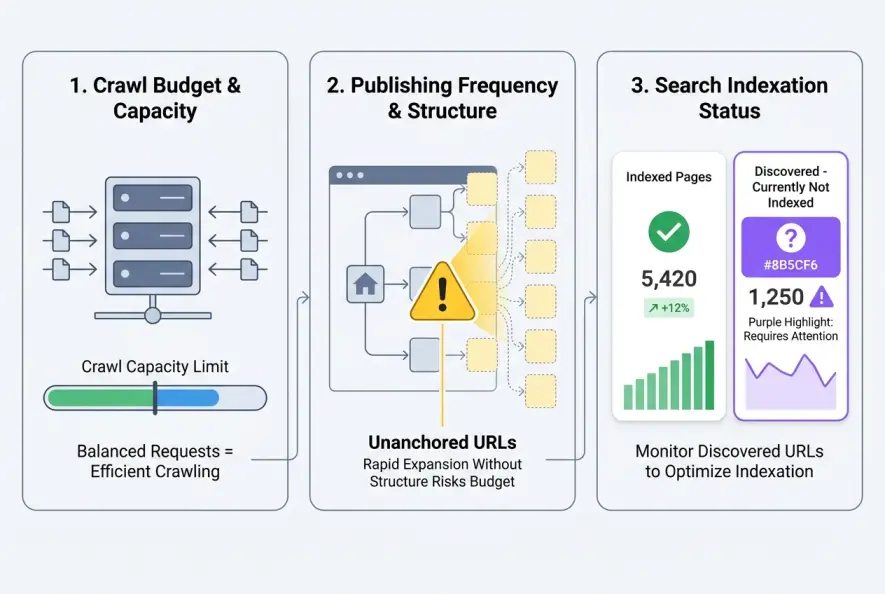
To understand why rapid publishing can hurt search performance, you must first understand how search engines allocate attention to your website. Google does not possess infinite compute resources to discover, fetch, render, and index every webpage created daily. Instead, it assigns every site a distinct crawl allowance based on two main variables: crawl capacity limit and crawl demand.
According to Google Search Central's technical documentation, the crawl capacity limit represents the maximum number of simultaneous connections Googlebot can establish with your web host without degrading server performance. If your server response time slows down or returns 5xx error codes, Googlebot immediately reduces its crawling speed to avoid crashing your site.
On the other side of the equation is crawl demand. Search engines measure demand based on domain popularity, backlink frequency, and how often existing content changes. If an established domain publishes fresh, high-value pages that users interact with, crawl demand rises. However, if a site suddenly floods its XML sitemap with hundreds of thin or repetitive articles, crawl demand fails to keep pace with the surge in published URLs.
Assuming that submitting a sitemap guarantees instant indexation. Googlebot still evaluates crawl demand and server responsiveness before spending resources to render and index new URLs.
Why Unchecked Output Triggers Indexation Penalties
When teams try to boost content velocity overnight, they usually encounter a specific pattern inside Google Search Console: a sharp spike in pages classified under "Discovered — currently not indexed".
This status means Googlebot discovered the URL (typically through an XML sitemap or feed), but evaluated that fetching and rendering the page was not worth its current crawl budget allocation. This scenario usually stems from three distinct structural bottlenecks:
1. Information Dilution and Thin Rehashes
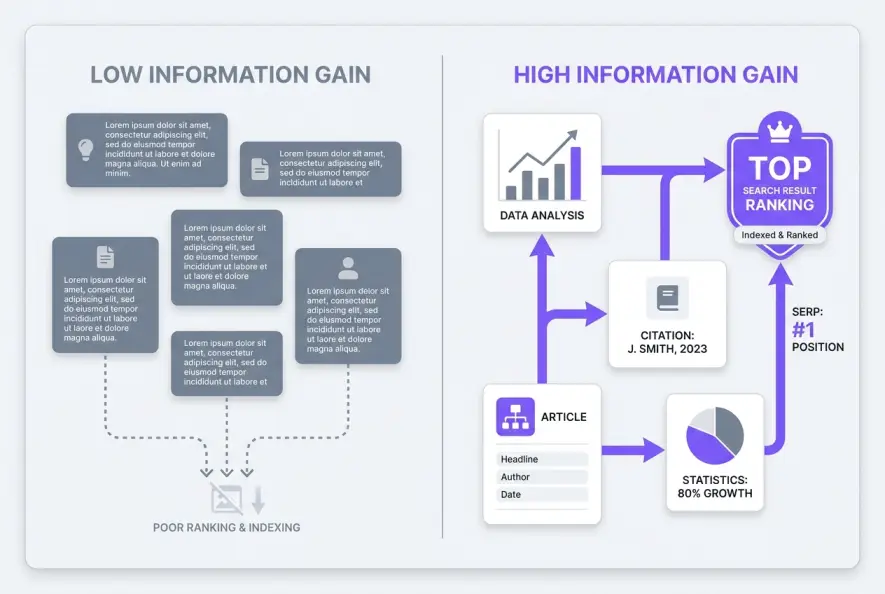
When content output increases tenfold without a corresponding increase in unique insights, overall site quality drops. Algorithms evaluate site-level quality signals across clusters of content. If half of your newly published pages merely reword existing articles already available on the web, search engine Quality Raters and automated classifiers flag the pattern as thin or low-value automation.
2. Cannibalization and Near-Duplicate Intent
Publishing faster often leads content managers to create multiple articles covering nearly identical search queries. When three separate posts target minor variations of the same core topic, search engines struggle to pick a canonical ranking candidate. Rather than ranking all three, search engines may demote or ignore the entire cluster.
3. Isolated Content Islands
Rapid publishing workflows frequently publish articles that lack contextual links from established, high-authority pages on the site. A brand-new URL sitting five clicks deep in your site architecture without contextual internal links signals to search crawlers that the page holds low editorial priority.
This friction between publishing volume and search engine evaluation is precisely why understanding what Google actually ranks in automated content is critical before increasing production targets.
The 4 Pillars of Safe Content Scaling
Scaling editorial output without risking search performance requires a technical framework designed around algorithm expectations. By establishing clear structural guardrails, you ensure that every new page adds cumulative search equity to your domain.
Before doubling your weekly publishing volume, check your average server response time in Search Console Settings under Crawl Stats. Keep response times strictly under 200 milliseconds to give Googlebot maximum capacity.
Pillar 1: Enforcing Information Gain Thresholds
Information gain refers to the unique data, perspective, or original insights a page provides compared to existing search results. Google holds patents specifically focused on scoring information gain to reward original reporting over derivative rewrites.
To maintain high standards at scale, every published article must pass an information gain audit:
- Unique Data or Frameworks: Include proprietary metrics, unique survey findings, or named step-by-step frameworks.
- Expert Citations: Incorporate direct quotes, technical documentation references, or primary research links.
- Actionable Counter-Perspectives: Offer specific, practical solutions rather than high-level generic advice.
Pillar 2: Architectural Anchoring via Topic Hubs
Never publish a new post into a vacuum. Modern search engines evaluate topical authority by examining how pages interlock within specific topic clusters. Every newly published article should instantly connect to a high-authority pillar page and share bidirectional links with related child posts.
Maintaining a clear internal linking architecture acts as an explicit roadmap for search bots, passing page rank from established pages directly to fresh URLs and signaling immediate indexing priority.
Pillar 3: Precise Search Intent Mapping
To prevent self-cannibalization as your site grows, maintain a centralized master keyword architecture. Map every target keyword to an explicit search intent (Informational, Commercial, Navigational, Transactional) and assign it to a single dedicated URL.
If two keyword concepts overlap by more than 60% in current search result pages (SERPs), consolidate them into a comprehensive guide rather than splitting them into separate short posts. Diagnosing and resolving keyword cannibalization risks beforehand protects your existing ranking footprint as you scale.
Pillar 4: Technical Crawl Efficiency
Optimizing technical performance allows search engines to process your site faster with less computing effort. Eliminate redirect chains, fix 404 error codes immediately, compress site images, and ensure clean XML sitemaps that list only 200-status canonical URLs.
| Performance Metric | Low-Velocity Site Standard | Scaled Publishing Standard | Impact on Indexing |
|---|---|---|---|
| Server Response Time | < 600 ms | < 200 ms | Prevents crawl rate throttles |
| Crawl Depth | 4-5 clicks max | 2-3 clicks max | Ensures fast discovery of new posts |
| Internal Link Density | 1-2 per post | 3-5 contextual links | Distributes page rank to new URLs |
| Indexation Velocity | Days or weeks | Minutes to hours | Immediate organic traffic acquisition |
Maintaining Quality Control at Scale
Maintaining high content velocity without sacrificing unique value comes down to systematic quality assurance. The goal is not merely generating words faster; it is assembling structured, authoritative resources efficiently.
High-Volume Editorial Pipeline:
[Niche Research] ➔ [Intent Mapping] ➔ [Entity Analysis] ➔ [Drafting] ➔ [Information Gain Audit] ➔ [Internal Link Insertion] ➔ [Indexing Check]
When managing high production, workflows must automate mechanical tasks (like code formatting, image placement, and schema markup) while keeping human or programmatic quality filters focused on accuracy and topical depth.
Step-by-Step Blueprint to Double Publishing Output
If you are ready to scale your publishing operations safely, follow this structured four-step implementation plan.
Step 1: Baseline Your Search Console Crawl Stats
Navigate to your Google Search Console account, open Settings, and select Crawl Stats. Review the following metrics over the past 90 days:
- Total Crawl Requests: Look for stable or upward trends in daily crawler activity.
- Average Response Time: Ensure server latency stays consistently low.
- Crawl Request Breakdown: Verify that 80%+ of crawl requests go to HTML page fetches rather than images, scripts, or redirected parameters.
Step 2: Establish Modular Content Clusters
Organize upcoming topics into distinct 5-to-10 article clusters surrounding a single core topic. Draft the main pillar post first, then schedule child articles to publish in rapid succession. As each child post goes live, ensure it links back to the main pillar with descriptive, contextual anchor text.
Step 3: Automate Contextual Link Insertion
Manual internal linking quickly becomes a bottleneck as your content velocity increases over time. Build an internal database of target keywords and corresponding URLs. Whenever a new post goes live, reference this database to automatically embed links to relevant existing posts on your site.
Step 4: Track Indexing Velocity Metrics
Monitor how quickly new URLs move from published status to fully indexed in search engine results. Track this metric weekly:
- Healthy Indexing Velocity: 80%+ of new URLs indexed within 48 hours of sitemap submission.
- Lagging Indexing Velocity: Less than 50% indexed after 7 days.
If indexing slows down, temporarily pause new publishing, prune or merge low-performing pages, and focus on improving server performance and internal link density across existing content clusters.
- Content velocity accelerates search growth only when supported by a fast server and healthy crawl budget.
- Avoid publishing thin or repetitive posts that dilute your site's information gain score.
- Connect every new URL directly into established topic hubs with contextual internal links.
- Monitor Crawl Stats in Google Search Console to detect server bottlenecks before scaling output.
Summary: Speed and Quality Can Coexist
Scaling publishing output is not a gamble if you build the right technical and architectural foundations. By respecting crawl budget limits, enforcing strict search intent mapping, and embedding genuine information gain into every page, you transform increased publishing speed into a sustainable SEO growth engine. Focus on structural authority first, and search engine visibility will follow naturally.
Artificial Intelligence
Intelligence without limits.
We believe great content deserves honest authorship—even when it's AI.
Frequently Asked Questions
Publishing high volumes of content rarely triggers a manual action unless the content violates Google's search spam policies—such as scraped content, scaled autogenerated content without value, or obvious keyword stuffing. However, unmanaged high volume can cause algorithmic demotions or indexation drops if the content is flagged as low quality.
Check Google Search Console under Settings > Crawl Stats. If your average daily crawl requests comfortably exceed your weekly published page count and your average server response time is under 200–300 milliseconds, your domain generally has sufficient crawl capacity for increased publishing volume.
First, improve internal linking to those pages from high-authority existing posts. Second, review the content to ensure it provides strong information gain compared to competing articles. Finally, inspect your server response times and verify your XML sitemap only lists canonical, high-value pages.
Updating existing pages actually increases crawl demand favorably because search crawlers prioritize re-crawling frequently updated, high-performing content. Combining regular content updates with new page publishing is one of the safest ways to expand your overall crawl capacity.
A standard architectural ratio is 1 comprehensive pillar guide for every 5 to 10 supporting cluster posts. The supporting posts address specific long-tail questions and pass equity back to the main pillar through contextual internal links.