Editing AI Content: The "Uncanny Valley" & How to Fix It

Artificial Intelligence
August 28, 2026
You know the feeling. You’re reading a blog post, and suddenly you hit a wall of text that feels… off. It’s grammatically flawless, yet completely strangely empty. It uses words like "delve," "crucial," and "landscape" three times in one paragraph, exuding a weirdly generic enthusiasm for a mundane topic.

Welcome to the text-based "uncanny valley."
Editing AI content isn't just about fixing typos or fact-checking; it's about bridging the gap between statistical probability and human nuance. To fix robotic text, you need to stop treating AI drafts like work from a junior copywriter and start treating them like raw data that needs intense refining to become valuable. If you publish raw output, you aren't publishing content; you're publishing noise.
Why Raw AI Output Feels "Wrong"
To effectively edit AI, you have to understand what it actually is. Large Language Models (LLMs) do not "know" things. They are incredibly sophisticated prediction machines. They choose the next word based on the statistical likelihood of it following the previous words in their training data.
**The Average Output Trap:** Because AI models are trained on the entirety of the internet, their default mode is to produce the most average, consensus-based response to a prompt. They gravitate toward common phrases and safe structures, resulting in text that is technically correct but stylistically flat.
This statistical approach is why AI struggles with novelty, sharp opinions, and distinct branding tones without heavy guidance. It’s also why it leans on crutch phrases—those phrases appear frequently in its training data near transitional points in text.
The 4 Pillars of Robotic Text
Before you start slashing words, you need to identify the specific markers that trigger the reader's "this is a bot" radar. While models are improving rapidly, these four issues remain pervasive in nearly all raw drafts.
1. The "Delve" Problem: Overused Transitional Phrases
If you played a drinking game for every time an AI wrote, "It is important to note," "In conclusion," "Furthermore," or "Let's delve into," you would be hospitalized before finishing an article. These are the seams in the Frankenstein monster. They are lazy connectors that humans rarely use so repetitively in natural writing.
2. Sentence Structure Monotony
Humans vary their cadence naturally. We use short, punchy sentences. Followed by longer, meandering clauses that explain complex ideas, before hitting a sharp conclusion. AI tends to output sentences of roughly similar length and structure (often Subject-Verb-Object) one after another. This creates a droning rhythm that bores the reader's brain.
3. Unearned Enthusiasm and Hype
AI loves everything. It constantly describes mundane software features as "revolutionary," "game-changing," or "crucial for unlocking potential." This unearned hype destroys trust. If everything is crucial, nothing is. A human editor knows when to be excited and when to just state the facts.
4. The Fluff-to-Insight Ratio
AI is verbose. It will frequently use an entire introductory paragraph to define a basic concept the reader already knows, just to warm up. It fills space with vague generalizations rather than specific examples, often repeating the same idea in three slightly different ways across adjacent sentences.
The 3-Pass Workflow for Editing AI Content
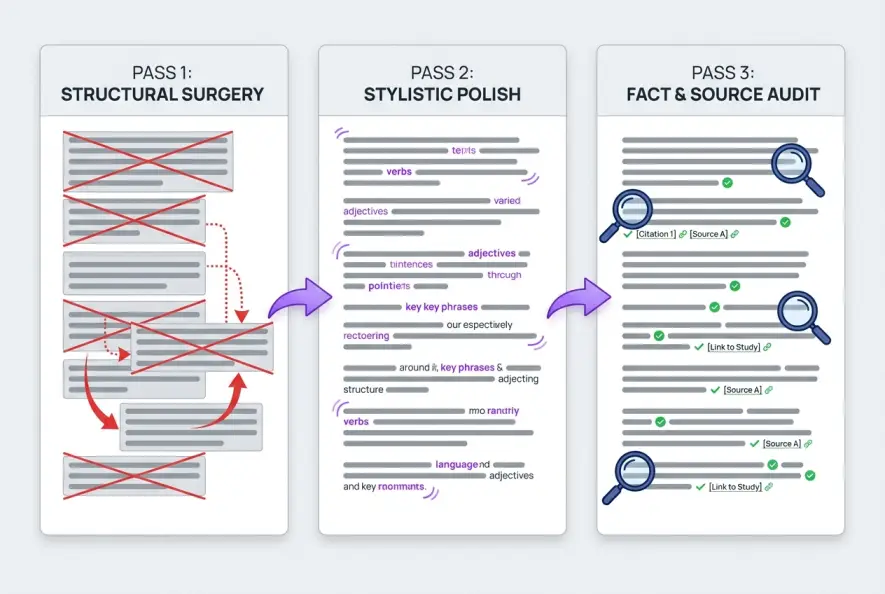
You cannot fix all these issues in a single read-through. Effective editing of AI content requires a structured approach, separating structural surgery from stylistic polish.
Pass 1: Structural Surgery (The Machete)
Do not start word-smithing yet. Look at the document as a whole. AI drafts often bury the lead or include repetitive sections. Be aggressive. Delete entire paragraphs that don’t add unique value. Move the most impactful information to the top. If the intro takes 150 words to say "SEO is important," cut it down to one sentence.
Pass 2: Stylistic Polish (The Scalpel)
This is where you humanize the text. Your goal here is to break the predictable rhythm. Vary sentence length consciously. Inject strong verbs and remove weak adverbs. Platforms that automate the drafting stage, like Qoreta, are designed to get you to this phase faster, providing a sourced foundation so you can spend your energy on this stylistic pass rather than blank-page creation. Focus on tone and voice here.
**Read It Out Loud:** The easiest way to catch robotic rhythm is to read the text aloud. If you find yourself running out of breath or stumbling over clunky transitions, mark that section for a rewrite. Your ear catches things your eye misses.
Pass 3: The Fact & Source Audit (The Microscope)
AI hallucinates. It invents statistics, quotes, and sometimes entire concepts with supreme confidence. Never publish a data point, quote, or specific claim from an AI draft without verifying it against a primary source. Google’s guidance on AI content emphasizes accuracy; failing this pass can actively harm your site's reputation.
Humanizing Tactics That Actually Work
Moving beyond the workflow, here are specific tactical shifts you can make during the second pass to inject humanity into the copy.
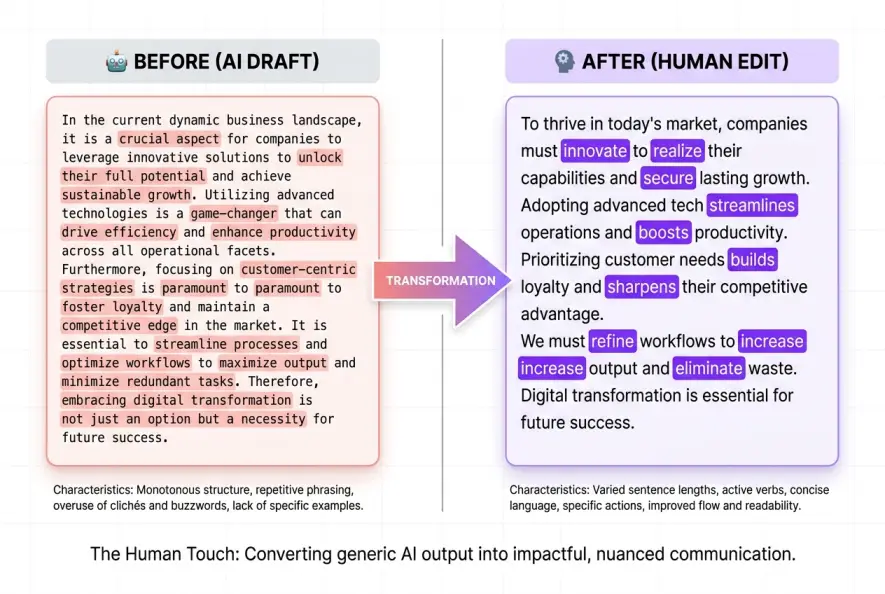
- Kill the Passive Voice: AI defaults to passive voice ("Mistakes were made"). Humans take responsibility ("We made mistakes"). Hunt down "to be" verbs and replace them with active alternatives.
- Replace Generalities with Specifics: If the AI writes, "Many businesses see improvements," change it to, "SaaS companies often see a 20% lift in engagement."
- Add Analogies and Metaphors: AI struggles to create novel analogies. Using a fresh metaphor to explain a complex topic is a strong signal of human involvement.
- Inject "Information Gain": As discussed in our guide on information gain in SEO, merely repeating existing knowledge isn't enough. Add unique data, personal experience, or a contrary viewpoint that the AI couldn't possibly possess.
Let's look at a before-and-after example of editing AI content.
The Future Role of the Editor
AI hasn't killed writing, but it has fundamentally changed the role of the writer. We are moving away from being creators of raw drafts and toward being directors and curators of information. The skill set is shifting from pure generation to high-level evaluation, fact-checking, and stylistic refinement.
The goal of editing AI content isn't to hide the fact that you used AI. It's to ensure that the final product serves the reader better than the raw draft ever could. The uncanny valley is only permanent if you refuse to build a bridge across it. By applying ruthless structural editing and injecting human nuance, you can turn robotic output into content that actually connects.
Artificial Intelligence
Intelligence without limits.
We believe great content deserves honest authorship—even when it's AI.
Frequently Asked Questions
While it varies by topic complexity, a good rule of thumb is that editing an AI draft should take about 40-50% of the time it would take to write the same piece from scratch. If you are spending just as long editing as writing, your initial prompts may need refinement.
AI detectors are currently unreliable and generate both false positives and false negatives. Instead of aiming to beat a detector, focus on editing AI content to meet high standards of quality, accuracy, and user value, which is what search engines ultimately care about.
The biggest mistake is under-editing—fixing only typos and grammar while leaving the robotic sentence structure, repetitive phrasing, and lack of unique insight intact.
Transparency standards are evolving. Currently, it is not strictly required by search engines like Google as long as the content is accurate and helpful. However, some publishers choose to add a disclosure for ethical reasons depending on their audience relationship.
You can use negative constraints in your prompts (e.g., "Do not use the words 'delve,' 'unlock,' or 'crucial'"). However, thorough human editing is still required, as the AI will often substitute those forbidden words with other equally generic synonyms.