Information Gain in SEO: How Google Ranks Unique Content

Artificial Intelligence
September 10, 2026
In 2020, Google filed patent US11354342B2, outlining a mathematical framework to evaluate how much new information a web page offers compared to documents a searcher has already viewed. Search engines evaluate web pages not merely by keyword density or backlink counts, but by calculating how much non-redundant value a document delivers relative to existing search results—a foundational concept known as information gain in SEO.

If three top-ranking articles explain the exact same steps in slightly different words, modern search algorithms recognize that the second and third articles offer zero incremental value to the user. When searchers click from the first search result to the second, they expect new insights, updated data, or an alternative perspective. If your article merely summarizes what already exists on page one, search engines gradually demote your URL in favor of sources that offer a distinct informational delta.
Compare your draft against the top 5 ranking pages before publishing. If every heading in your outline already appears in existing search results, you have zero information gain. Add at least two original data points, expert quotes, or unique frameworks.
This algorithmic evolution marks the end of traditional "skyscraper" content strategies. For years, content marketers believed that taking the top five ranking pages, combining their subheadings, and making the draft twice as long was the ultimate recipe for organic success. In reality, aggregating SERP consensus creates massive content redundancy. When every blog post repeats the same baseline definitions, search engines struggle to justify ranking multiple identical pages. Understanding how algorithms measure original value is no longer optional—it is the core requirement for sustainable organic visibility.
This is why your detailed, well-researched blog posts quietly lose organic traffic over time.
What Is Information Gain in Modern Search?
Information gain represents the quantified measure of new knowledge a document provides to a user who has already consumed other documents on the same topic. Instead of viewing every web page in isolation, search engines model the searcher's ongoing journey across multiple clicks.
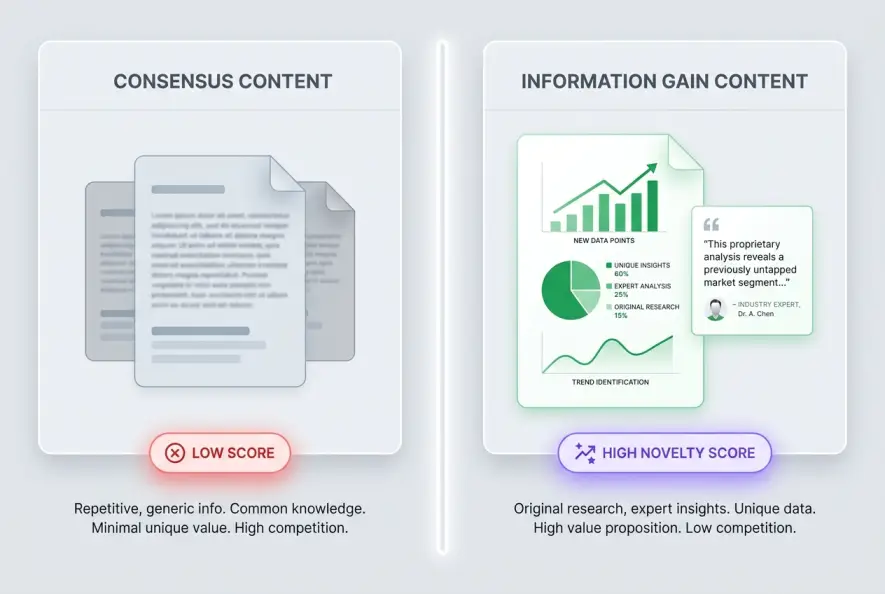
When a user clicks on the first search result, their baseline knowledge increases. If they return to the search results page and click a second link, the algorithm evaluates whether that second document answers remaining questions or simply repeats facts the user just read. Pages that deliver a high novelty score satisfy the user's search journey faster, reducing search bounce rates and securing higher long-term rankings.
To visualize how search engines differentiate between repetitive content and high-value original articles, consider how document scoring shifts when unique information is introduced:
The Mechanics of Google's Information Gain Patents
To understand how search engines calculate document novelty, we must look at how language models process vector embeddings. When search crawlers evaluate a cluster of ranking pages, natural language processing engines convert each document into a multi-dimensional vector space.
These mathematical vectors map semantic concepts, entities, and factual claims. If your draft's vector embedding lands directly in the geometric center of existing ranking documents, the algorithm recognizes high content overlap. According to Google's official helpful content guidelines, search systems prioritize original research, unique reporting, and insightful analysis over derivative summaries.
Search systems measure information gain in SEO by calculating vector distance. When a document introduces net-new entities, original data points, or novel structured tables, its vector embedding shifts away from the SERP consensus cluster into unoccupied semantic space. This geometric distance tells the algorithm that your page provides distinct value.
| Content Category | SERP Consensus Profile | Information Gain Profile |
|---|---|---|
| Data Sources | Re-quoted third-party stats | Primary surveys & internal metrics |
| Structure | Standard H2/H3 SERP outline | Unique frameworks & edge-case subtopics |
| Media Assets | Stock photos & generic charts | Original diagrams & custom UI breakdowns |
| Expertise | Generalized summaries | Direct practitioner quotes & code snippets |
When search engines calculate high information entropy across your site's core landing pages, your entire domain benefits from improved crawl efficiency and indexing priority.
Why Consensus Content Is Dropping in Rankings
The widespread adoption of generative AI tools has created an unprecedented volume of web publishing. Because standard language models synthesize existing internet text, they naturally produce consensus content that reflects the statistical average of top-ranking results.
This creates a massive indexing bottleneck. When creators publish AI drafts without manual enhancement, search indexes get flooded with redundant information. If you have noticed that why your AI-written blog is invisible in search results, the root cause is rarely syntax or grammar—it is the complete absence of unique search value.
Search engines are actively refining indexation filters to conserve server resources. Crawlers evaluate whether a newly discovered page justifies the computing power required to render and index it. If an algorithm determines that your draft offers no unique informational delta compared to already-indexed URLs, it may assign the page to "Crawled - currently not indexed" status.
Furthermore, conversational AI answer engines and retrieval systems rely heavily on distinct, citable facts. As search behavior evolves toward Generative Engine Optimization (GEO), answer engines systematically filter out derivative summaries in favor of sources that offer proprietary statistics, first-party case studies, or explicit expert credentials.
4 Concrete Ways to Add Novel Information to Your Blog
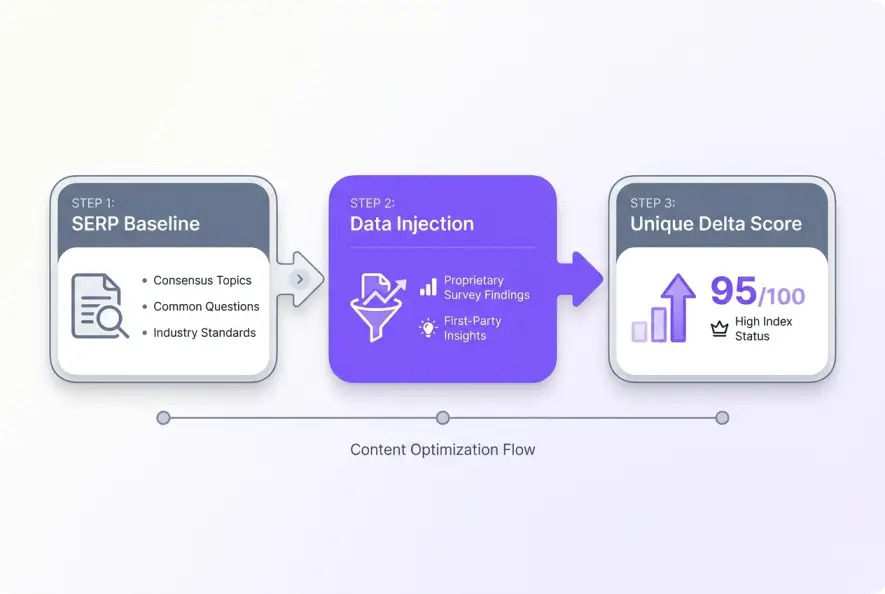
Injecting unique value into every post does not require months of laboratory research. You can build genuine information gain into your publishing workflow by applying four practical framework additions.
1. Conduct Proprietary Micro-Surveys
Instead of citing third-party statistics that every competitor already quotes, gather primary data. Polling 50 to 100 industry practitioners on social media or via email newsletters yields fresh percentages and industry benchmarks that exist nowhere else on the web.
2. Share Unfiltered First-Party Experience
Include real-world case studies, screenshots of internal analytics dashboards, or documented campaign failures. Algorithmic classifiers actively scan for first-person experience signals (E-E-A-T), such as original photography, custom workflow schematics, and actual performance figures.
Assuming that rewriting existing top-ranking articles in 'better English' or making them longer creates original value. Search engines evaluate information entropy—adding length without new facts yields zero additional information gain.
3. Challenge Industry Consensus
If every top-ranking guide recommends a specific software tool or workflow step, analyze its limitations. Providing a counter-intuitive perspective backed by logical argument or test data creates high informational contrast against standard SERP summaries.
4. Provide Custom Visual Schematics
Transform text-heavy advice into actionable visual assets. Custom process flowcharts, technical comparison charts, or downloadable spreadsheet templates give searchers immediate practical utility that derivative text cannot replicate.
This is why content strategies built purely on keyword volume quietly fail without unique value injection.
Measuring Your Unique Content Delta Before Publishing
Before publishing a new piece, you need a repeatable audit method to verify whether your draft introduces novel facts or simply echoes existing search results.
Start by conducting a SERP coverage audit. Open the top five ranking pages for your target keyword and list their primary subheadings in a spreadsheet. Identify the common themes covered by every competitor—this represents your baseline SERP consensus. To earn a high novelty score, your draft must cover these baseline elements concisely while introducing at least two or three dedicated sections that appear on none of the competing pages.
Next, evaluate topic coverage depth using industry analysis resources like Search Engine Journal. Check whether your article answers follow-up questions that competitors ignore. For example, if competing guides explain what a strategy is, your article should provide step-by-step technical implementation, code samples, or edge-case troubleshooting.
Finally, audit your visual media. Replacing generic stock images with annotated diagrams and data tables boosts engagement metrics like dwell time, while providing citable assets that search engines feature in visual search panels.
The Future of Content Strategy in the Age of AI Search
As search engines continue to integrate generative synthesis and real-time retrieval models, the bar for organic visibility will keep rising. The legacy strategy of securing rankings by rephrasing public consensus in longer articles is officially obsolete.
Modern search algorithms are explicitly engineered to reward content creators who expand the boundaries of available online knowledge. By grounding your editorial strategy in proprietary data, first-person experience, structural clarity, and original diagrams, you ensure that every article delivers measurable value to both human readers and automated crawlers.
Consistently prioritizing original insights across your publishing pipeline transforms your site from a generic content aggregator into an authoritative industry destination. In a web saturated with automated AI summaries, mastering information gain in SEO gives your site an enduring competitive moat.
Artificial Intelligence
Intelligence without limits.
We believe great content deserves honest authorship—even when it's AI.
Frequently Asked Questions
E-E-A-T (Experience, Expertise, Authoritativeness, Trustworthiness) evaluates the credibility and real-world background of the content creator. Information gain is a mathematical calculation of how much new, non-redundant factual information a specific document adds compared to existing search results.
Yes, but only if you feed the AI model proprietary data, custom interview transcripts, or original case study results during the prompting process. Standard AI outputs based solely on general training data naturally mirror existing SERP consensus.
Google's patents describe converting documents into semantic vector embeddings. The system subtracts the information vectors of pages a user has already viewed from candidate documents, measuring the remaining unique information entropy.
No. Adding word count without introducing new facts, data, or frameworks actually lowers your document's information density. Search engines penalize verbose fluff that dilutes unique insights.
Even one or two genuinely original data points, custom diagrams, or proprietary survey findings can significantly boost a document's novelty score relative to competitors who merely quote public statistics.