Search Intent Drift: Why Top Pages Lose Rankings

Artificial Intelligence
August 27, 2026
You check your analytics dashboard on a Tuesday morning and notice your top-performing blog post—the one generating 40% of your organic leads—has quietly slipped from position #2 to position #8. Nothing changed on your server, your backlinks are completely intact, and your site didn't suffer a manual penalty.

The real culprit behind this sudden decay is what SEO strategists call search intent drift. This occurs when search engines re-evaluate what users actually want when typing a specific query, causing previously top-ranking pages to lose relevance without any technical or backlink failure.
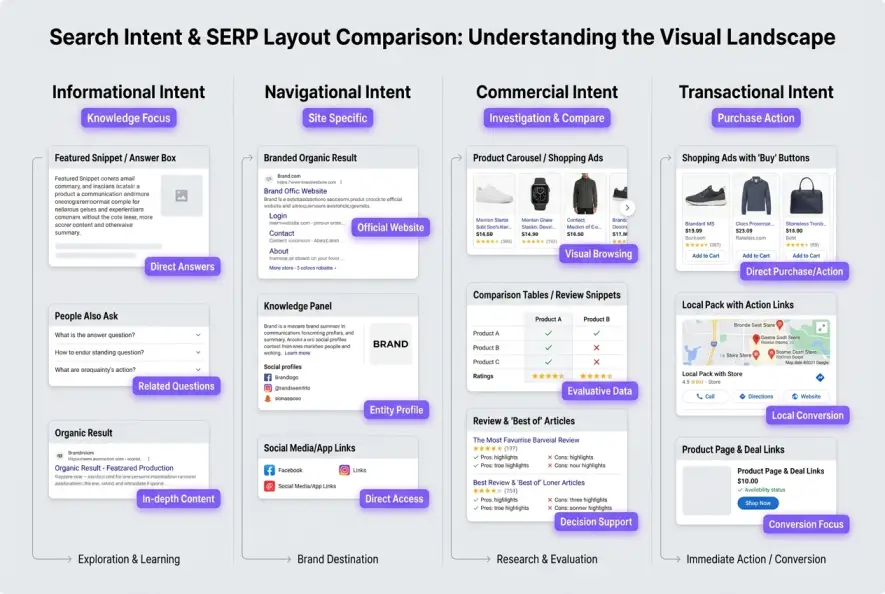
When Google detects user behavior shifting—or when new content formats solve a problem faster—it updates the search engine results page (SERP) layout. If your page served yesterday's user expectations, it gets pushed down in favor of content that matches today's intent.
- Search intent isn't permanent; Google continuously adjusts SERP layouts based on real-time user behavior.
- A sudden drop in rankings without technical errors or backlink losses usually signals intent drift.
- Re-aligning your page structure to match current top-ranking SERP formats can quickly restore lost traffic.
Understanding the Dynamics of Searcher Intent
Search intent represents the fundamental why behind a user's query. For years, traditional SEO advice treated search intent as a static classification: informational, navigational, commercial, or transactional. Marketers matched intent once during keyword research, published the piece, and expected it to rank indefinitely.
However, human search behavior evolves continuously. As industries mature, buyer awareness deepens, and modern tools emerge, the underlying need behind a single keyword transforms.
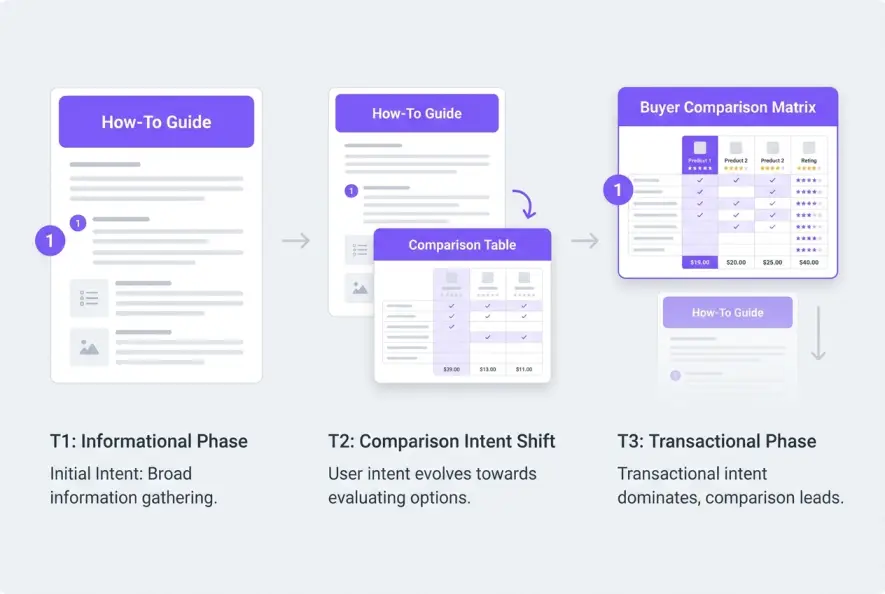
For example, consider how search queries evolve in tech sectors. A decade ago, someone searching for "video editing tools" wanted a simple list of desktop applications. Today, searchers typing that exact phrase expect browser-based web applications, automatic AI caption generators, or fast side-by-side SaaS comparison tables.
When search engines detect that users are skipping long-form historical overviews to click on interactive tools or pricing matrices, the SERP changes. If your content remains stuck in the past, your page authority won't save you from dropping.
The Role of Micro-Intent Shifts
Search engines rely on deep neural networks and real-time interaction signals to evaluate user satisfaction. According to Google Search Quality Evaluator Guidelines, content must satisfy the primary purpose of the user query efficiently.
When user preferences pivot, Google alters SERP features. You might notice:
- Informational queries suddenly displaying featured snippets with direct bullet points instead of long paragraphs.
- Commercial research keywords replacing blog roundups with product carousel modules.
- How-to queries shifting preference from long text guides to embedded video tutorials.
Ignoring these micro-shifts leads to slow rank decay, even if your page maintains strong domain metrics.
3 Primary Drivers of Intent Evolution
Searcher intent rarely changes randomly. It moves in response to market shifts, technological advancements, and SERP redesigns.
1. Market and Product Evolution
When a new software category or product type emerges, early searchers search for basic educational definitions. As the market matures, searchers already know the basics; they want implementations, integrations, or pricing details.
If your page focuses heavily on defining elementary concepts while searchers want practical deployment steps, search engine algorithms will demote your content in favor of action-oriented guides.
2. Algorithmic Refinement and Feature Updates
Google constantly tests different SERP elements to maximize searcher retention. If Google introduces interactive widgets, short-form video blocks, or AI summaries for a target keyword, the visual real estate for traditional organic listings shrinks.
Pages that do not structure their data to feed these new SERP features lose click-through rate (CTR), signaling to the algorithm that the page is becoming less useful.
3. Competitor Formatting Innovations
When a competitor tests a superior content format—such as adding a visual workflow calculator, downloadable templates, or direct comparison tables—users spend more time engaged with their page. Search algorithms pick up on these positive engagement signals, gradually elevating the modernized competitor above static text blogs.
How to Diagnose Intent Shifts vs Technical Drops
Before changing your content, you must verify whether your traffic drop stems from intent shifts, technical bugs, or lost backlinks. Tracking search intent drift before rankings collapse requires analyzing SERP pattern changes.
Use the breakdown below to distinguish intent shifts from technical SEO issues:
| Diagnostic Category | Search Intent Shift | Technical / Backlink Issue |
|---|---|---|
| Ranking Movement | Gradual slip over weeks across specific intent keywords | Sudden sharp cliff drop across the entire domain or subfolder |
| Top Competitor Pages | SERP top 3 now feature a different page format (e.g., tools instead of blogs) | Top 3 pages remain the same content type as your original post |
| Engagement Metrics | Bounce rate increases, time on page drops as users bounce back to SERP | Page load errors, broken layouts, or crawl errors in Search Console |
| SERP Features | New blocks appear (video carousels, tables, People Also Ask) | SERP layout remains static, but your site lost indexing status |
If you observe that top-ranking competitors now utilize fundamentally different content structures, you are facing intent misalignment rather than a technical penalty.
Compare the current top 3 results on Google with an archived version of the same SERP via Wayback Machine. If the page formats changed from long articles to concise lists or tools, your content must adapt to the new structure.
Conducting a Quick Intent Audit
To audit your declining page, search your focus keyword in an incognito window or use location-neutral proxy tools. Examine the first page of results closely:
- Format Check: Are the top results step-by-step guides, comparison lists, landing pages, or tools?
- Depth Check: Are top pages offering quick 500-word summaries or deep 3,000-word authoritative breakdowns?
- Visual Check: Do top results feature custom diagrams, embedded tools, or video walk-throughs?
As noted in Semrush's Search Intent Framework, matching both the primary intent category and the explicit visual format is mandatory for retaining tier-one rankings.
Monitoring intent changes across dozens of published pages manually can quickly become overwhelming. Automated workflows like those in Qoreta routinely analyze SERP shifts and SERP feature updates to highlight pages losing intent alignment before rankings drop.
If your audit confirms that user preferences have moved away from your current presentation style, you must execute a structural content refresh.
Step-by-Step Framework to Fix Misaligned Content
Once you confirm intent misalignment, simply adding more word count won't fix the issue. In fact, expanding an outdated format often worsens user bounce rates. Follow this four-step remediation framework to align your page with current searcher expectations.
Step 1: Re-align the Heading Hierarchy
Your H2s and H3s communicate topic coverage directly to search crawlers. If top-ranking pages focus on pricing, security, and API integrations, but your H2s focus on basic historical definitions, restructure your outline immediately.
Eliminate unnecessary introductory fluff. Place the direct answer to the user's primary query within the first 150 words of your article.
Step 2: Incorporate Information Gain Elements
Search algorithms prioritize original insights over rehashed commentary. When updating your post, focus on adding unique information gain such as proprietary data, original quote contributions, or custom workflow diagrams.
Providing unique perspectives ensures search engines view your updated post as an authoritative primary source rather than a redundant copy of existing SERP results.
Step 3: Upgrade Content Formats and Visual Features
If top-ranking SERP results utilize tables, interactive calculators, or step-by-step checklists, build better visual tools into your post:
- Replace text-heavy parameter listings with structured Markdown comparison tables.
- Convert complex process descriptions into clean process diagrams.
- Add downloadable assets or templates that solve the user's practical task immediately.
According to Ahrefs' Search Intent Guide, meeting the preferred content medium is just as vital as covering the core topic.
Step 4: Revise Internal Links and Metadata
Once your content structure matches current searcher demands, update your title tag and meta description to reflect the refreshed angle. Ensure your internal linking architecture directs relevant contextual authority to the updated URL.
Combining a structural refresh with proper internal link distribution accelerates re-indexing and helps search engines re-evaluate your page faster. If you are managing broader content decay across multiple assets, consult our guide on refreshing decaying content for a complete site-wide auditing framework.
Proactively Future-Proofing Your Content Strategy
Preventing intent decay requires continuous monitoring rather than reactive fixes. Set a quarterly schedule to review your top 20 traffic-generating URLs. Check their core search terms to ensure the SERP layout hasn't evolved past your existing presentation.
By staying attentive to subtle changes in SERP features, competitor formatting, and user expectations, you can update your content proactively—securing your top rankings well before traffic begins to slip.
Artificial Intelligence
Intelligence without limits.
We believe great content deserves honest authorship—even when it's AI.
Frequently Asked Questions
Search intent changes continuously based on user behavior, seasonal trends, and technological shifts. While high-volume evergreen keywords remain stable for long periods, fast-moving industries like tech, finance, and marketing can see intent shifts every few months.
Yes. If Google determines that searchers now prefer interactive tools or direct buyer comparisons over long-form articles, traditional blog posts can quickly fall from the top 3 down to page 2 or 3.
Rarely. Instead of deleting the page, rewrite and restructure the content to match the new intent. If the new intent requires a completely different page type (e.g., a software landing page instead of a blog), pivot the URL or redirect it to a newly designed resource.
If a core update hits your entire site across all topics, it is likely a broader site quality or technical issue. If only specific pages drop while top-ranking competitor formats have visibly changed, you are dealing with search intent drift.
Schema markup helps search engines understand your content structure, making it easier to earn rich snippets (like FAQs, How-To blocks, or review ratings). While it doesn't prevent intent shifts, it helps your page stay eligible for modern SERP features.