Meta Descriptions in AI Search: Still Worth Writing?

Artificial Intelligence
September 12, 2026
Google's own documentation says it sometimes ignores your meta description and generates a different snippet from the page. That single line sounds like a death sentence for anyone still writing them.

Here is the short answer: meta descriptions are not dead. They are just doing a different job. They are not a direct ranking lever, and AI answer engines mostly read your body content, not your meta description. But a good description still shapes the snippet, earns clicks, and forces you to clarify what the page is actually about. That clarity is exactly what modern search systems reward.
What Meta Descriptions Actually Do Now
A meta description is a page-level summary. Google can use it, rewrite it, or ignore it in favor of a passage from your page that better matches the query. The official Google snippet documentation is clear: there is no guaranteed way to force a specific snippet.
That means the old game — stuffing a keyword and hoping for a bold match — is mostly gone. The new game is extraction. You are giving search engines a clean, accurate summary they can choose to reuse.
If you skip meta descriptions entirely, you do not disappear. Google will usually pull something from the page. But you lose control over the first impression. For high-intent pages like pricing, comparisons, and tutorials, that first impression is often the difference between a click and a scroll past.
Why AI Search Changes the Job
AI answer engines and AI Overviews are built to retrieve passages, not meta tags. They chunk your page, rank the chunks against a query, and synthesize an answer. A meta description rarely becomes the answer itself.
So why write one? Because the meta description still influences the human decision around the citation. It can also act as a consistency check: if your meta description promises something your first 100 words do not deliver, you have a clarity problem. That problem hurts both classic SEO and AI visibility.
This is where GEO tactics and zero-click search strategy overlap. You are not writing for a blue link alone. You are writing for a page that needs to be understood quickly by both people and machines.
Treating the meta description as a keyword container. Search engines rewrite keyword-stuffed descriptions more often, and AI systems extract from the body anyway.
The Snippet Is Not the Page
A common confusion is treating the snippet as a promise that the page must literally repeat. The snippet is a preview. The page is the full argument. If the preview says 'learn how to fix crawl errors' but the page is a general SEO glossary, the mismatch will hurt. If the preview says 'a four-step crawl error audit for ecommerce sites,' the page has a clear job to do.
Search engines are not just matching words. They are matching expectations. A meta description that sets the right expectation can reduce pogo-sticking, because the visitor arrives already knowing what the page is for.
Metadata Still Has a Supporting Role
Meta descriptions are not the main course for AI retrieval, but they are not invisible either. Some systems use page-level metadata as a lightweight summary or as a disambiguation signal. You should not bet your entire AI search strategy on that. You should, however, avoid contradictory signals. If your title, meta description, H1, and opening paragraph all point in different directions, you are making the page harder to classify.
That is why schema markup and meta descriptions should be written together. One gives machines structured facts; the other gives them a plain-language summary. Neither replaces the body content, but both reduce ambiguity.
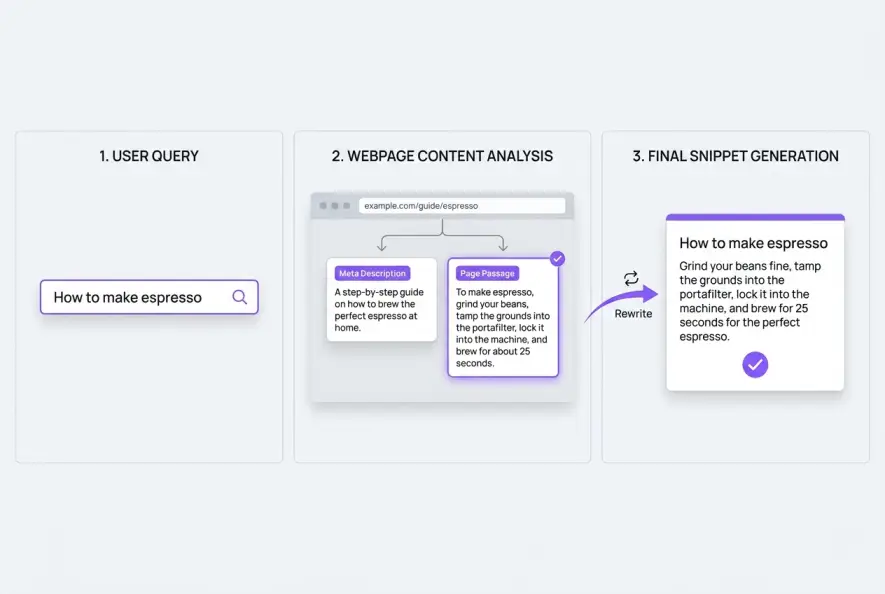
The 3 Jobs of a Meta Description in 2026
A useful meta description now does three things. It disambiguates the page, earns the click, and gives search systems a clean summary that matches the page's actual promise.
| Old job | New job |
|---|---|
| Repeat the focus keyword | Name the entity and intent |
| Fill 155 characters | Answer the query in plain language |
| Rank the page | Shape the snippet and click decision |
None of this means you should ignore keywords. It means the keyword should appear only if it belongs. If you are writing about a specific product, feature, or process, name it. If you are writing a broad guide, describe the outcome.
How to Write Meta Descriptions for AI Search
Start after the draft, not before. You cannot summarize a page you have not written yet. Once the H1 and first section exist, write the description as a compressed version of that opening.
1. Mirror the query, not the keyword
Read the title and ask: what did the searcher actually type? A page titled 'Meta Descriptions in AI Search' should answer whether they are still worth writing. The description should say that directly.
2. Name the entity
Search engines need to know what the page is about. Mention the main entity once: the tool, concept, company, or process. Vague pronouns and clever wordplay create ambiguity.
3. State the payoff
Tell the reader what they get. A framework, a checklist, a comparison, a fix. Specific promises beat vague promises every time.
4. Keep it around 150-160 characters
Google may truncate longer descriptions. Shorter can work, but 150-160 characters usually gives you enough room for intent plus payoff without fluff.
5. Do not duplicate the title
The title and description should work as a pair. If the title says the topic, the description should add the angle, outcome, or proof.
Here is a simple prompt template you can reuse:
Write a 150-160 character meta description for [page title].
Entity: [main entity]
Searcher intent: [what they want]
Payoff: [what the page delivers]
Tone: [brand tone]
Do not repeat the title word-for-word. Do not stuff keywords.
Write the meta description after the first draft, then compare it to your opening paragraph. If they promise different things, fix the page or fix the description.
Bad vs Better: A Quick Rewrite Exercise
Generic: 'We offer the best SEO services for businesses looking to grow online.'
Better: 'SEO services for SaaS teams that need technical audits, content briefs, and reporting in one workflow.'
The first version could describe a thousand agencies. The second version names the audience, the problem, and the deliverables. It is not clever. It is useful. That is the standard now.

What to Do When Google Rewrites You
A rewrite is not always a failure. Google rewrites descriptions when the query intent is better served by another part of the page. Treat that as feedback, not an insult.
If your description keeps getting replaced, check three things:
- Does the page actually answer the query in the first 100 words?
- Is the meta description too generic or too salesy?
- Is the title carrying the topic while the description repeats it?
This is the same logic behind title tag rewrites. Search engines are trying to match the query, not your preferred wording. Your job is to make the right wording obvious.
A Simple Audit for Existing Pages
Run this audit once a quarter, or after any major content refresh. It takes less time than writing new posts and often recovers clicks you already earned.
| Page type | What the description should do | What to avoid |
|---|---|---|
| Blog guide | Promise the specific answer or framework | Repeating the H1 |
| Comparison | Name both options and the decision criteria | Vague 'best' claims |
| Product feature | State the outcome for the user | Feature dumping |
| Docs/tutorial | Say what the reader will be able to do | Marketing fluff |
| Pricing | Clarify plan fit or value metric | Hiding the pricing model |
For each page, ask one question: if this description appeared alone in an AI answer, would it still make sense? If not, it is probably too dependent on the title or the surrounding page.
Extraction Over Persuasion
AI search systems are not reading your meta description the way a human reads a classified ad. They are looking for extractable, self-contained statements. That is why the information gain conversation matters so much now.
Your meta description should be a miniature version of your page's strongest, most specific claim. If the page says, 'Most meta descriptions are rewritten because they describe the page instead of answering the query,' the description should echo that idea. It should not say, 'Learn everything you need to know about meta descriptions.'
That kind of generic summary is easy to ignore. A specific claim is easier to quote, remember, and click.
- Meta descriptions are not a direct ranking factor.
- They still shape snippets, clicks, and page clarity.
- AI search rewards extractable, specific summaries.
- Write them after the draft, not before.
How to Measure If They Are Working
You cannot isolate meta descriptions perfectly, but you can watch page-level click-through rate in Google Search Console. Compare a 28-day window before and after a rewrite. Look at impressions, average position, and CTR together. If impressions are stable, position is stable, and CTR moves, the description likely helped.
You can also run a quick site: query for the page and screenshot the snippet. Do it in an incognito window and from a neutral location if possible. Snippets can vary by query and user, so one screenshot is not proof. But repeated patterns are useful.
Do not obsess over daily changes. Meta descriptions are a low-risk, low-cost optimization. The bigger wins usually come from matching the page to intent, improving the first 100 words, and building enough topical depth to be worth citing.
The Bottom Line
Meta descriptions are not dead. They are just no longer a place to hide keywords. In AI search, they are a clarity layer: a short, honest summary that helps search engines pick a snippet and helps people decide whether to click.
Write them for extraction, not persuasion. Name the entity. State the payoff. Stay close to the page's actual opening. Then let the algorithm rewrite you if it wants. You will still be better off than the page that never wrote one at all.
Artificial Intelligence
Intelligence without limits.
We believe great content deserves honest authorship—even when it's AI.
Frequently Asked Questions
No. Google has said meta descriptions are not a direct ranking signal. They can influence clicks and snippet appearance, which indirectly affects performance, but they do not lift rankings by themselves.
Not usually as the main source. AI answer engines retrieve and synthesize page passages, headings, and structured data. Meta descriptions may act as lightweight page metadata, but body content is what gets quoted and ranked.
Aim for 150-160 characters. Google can truncate longer snippets, and shorter descriptions may leave out the entity or payoff. The best length is whatever communicates intent and value without fluff.
Treat it as feedback. Check whether the page answers the query in the first 100 words, whether the description is too generic, and whether the title already covers the topic. Then rewrite the description to match the query intent more directly.
Include it only if it reads naturally. One clear mention is usually enough. Keyword-stuffed descriptions are more likely to be rewritten and less likely to earn a click.
They are not a direct penalty, but they waste control. Duplicate descriptions make it harder for search engines to distinguish similar pages, and they often signal thin or overlapping content.
Yes. A specific, honest description can set the right expectation and attract the right searcher. CTR changes are best measured at the page level over a stable period, not day to day.
After. The description should summarize the page's actual opening and promise. Writing it first often leads to generic claims that the content cannot support.