How to Scale Organic Revenue Without a Massive Team

Artificial Intelligence
August 26, 2026
Imagine a SaaS startup burning $50,000 every month on pay-per-click ad campaigns just to keep its growth charts trending upward. The moment ad spend pauses, lead volume plummets to zero like an unplugged machine. This paid acquisition treadmill is a reality for thousands of digital brands. To break free from paid acquisition reliance and scale organic revenue, businesses must shift from isolated blog production to a compounding organic revenue engine. This requires building high-intent topical authority, leveraging modern programmatic workflows, and aligning internal linking to turn search traffic into measurable sales pipeline without ballooning headcount.

The Paid Acquisition Trap vs. Compounding Inbound
For most growing companies, paid ad channels like Google and Meta offer immediate gratification. You launch a campaign, pay per click, and measure daily conversions. But this model has a major structural flaw: unit economics deteriorate over time. Research from leading market intelligence firms like Gartner highlights that digital customer acquisition costs have steadily outpaced inflation year over year, squeezing gross margins for tech and e-commerce companies alike.
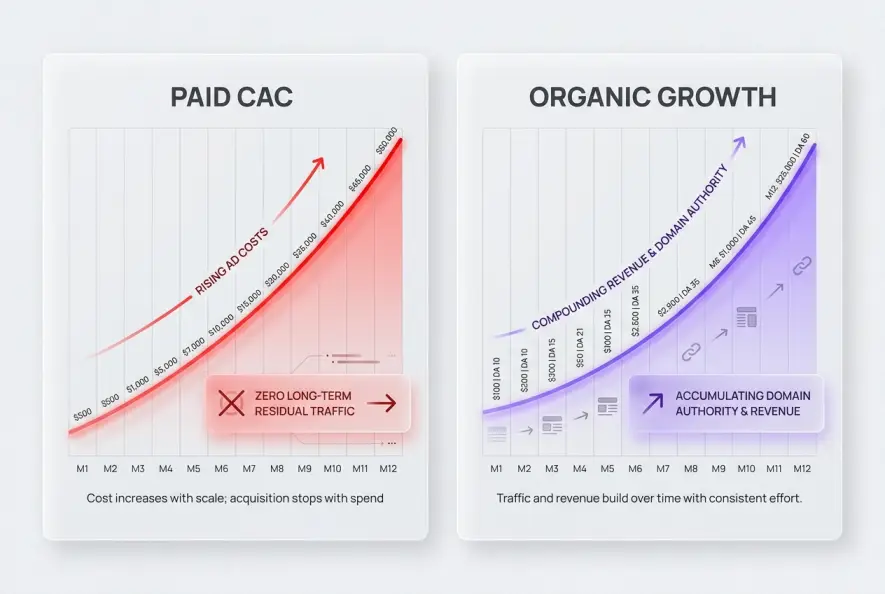
Paid acquisition acts as a variable expense where every visitor incurs an incremental cost. In contrast, organic search content functions as an appreciating capital asset. An article researched, written, and optimized today continues to attract qualified buyers 12, 24, and 36 months down the road at zero incremental cost per click.
| Metric / Attribute | Paid Advertising (PPC) | Compounding Organic Content |
|---|---|---|
| Cost Structure | Ongoing per-click variable expense | Fixed upfront creation effort |
| Traffic Duration | Stops immediately when budget ends | Persists and grows for 24+ months |
| Unit Economics | Margin compresses as ad competition rises | Customer acquisition cost decreases over time |
| Trust Signal | Ad badge (often bypassed by buyers) | High-authority unpaid search placement |
Treating content as a one-time marketing campaign rather than an appreciating digital asset that builds long-term domain authority and pipeline value.
When you invest in search engine optimization, your historical content portfolio continues to compound in authority, generating predictable inbound leads while lowering overall customer acquisition cost.
Decoupling Content Output from Team Size
Historically, expanding your organic content footprint required proportional headcount growth. A dedicated in-house writer typically produces four to eight thoroughly researched articles each month. To scale output to forty published articles per month, companies were forced to hire an army of writers, editors, SEO strategists, and graphic designers.
This linear relationship between headcount and output created an operational ceiling for small to mid-sized businesses. The primary bottleneck in organic publishing was never a shortage of strategic ideas—it was human execution bandwidth.
Modern publishing architectures eliminate this bottleneck by separating content operations into distinct, automated sub-systems: keyword selection, buyer intent mapping, draft synthesis, image generation, and internal link distribution. By decoupling production volume from headcount, lean marketing teams can scale organic revenue by removing manual operational friction.
For example, platforms like Qoreta execute this multi-stage publishing workflow autonomously—identifying low-competition keywords, drafting structured articles, generating visual assets, and publishing directly to CMS platforms while maintaining strict quality controls [1, 2]. This enables lean teams to maintain editorial velocity without scaling payroll.
This structural shift allows a single growth marketer to manage a content operation that previously demanded a full editorial department. However, publishing speed without analytical discipline creates digital clutter. To protect brand trust while expanding publishing volume, organizations must balance output speed with established content velocity principles, ensuring every published URL provides genuine information gain.
Intent-Driven Mapping: Capturing Bottom-of-Funnel Buyers
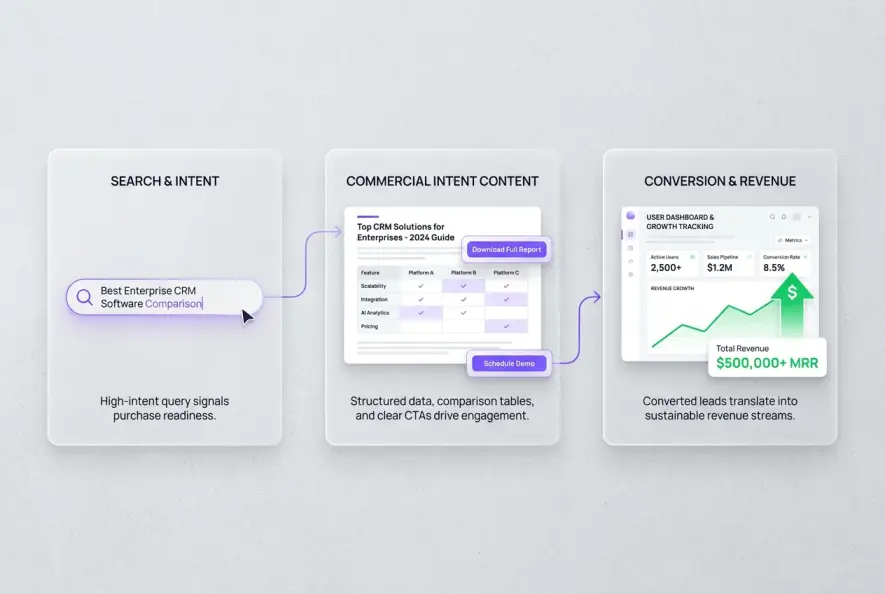
Why do 90% of corporate blogs generate high traffic metrics but zero measurable pipeline? The breakdown almost always stems from a fundamental mismatch between search intent and commercial value. Marketers frequently chase high-volume informational search terms that attract casual researchers who have no active buying intention.
To build a high-converting organic engine, your content calendar must invert traditional funnel distribution. Allocate 70% of early content production toward Commercial and Transactional intent search queries:
- Comparative Frameworks: Deep dive product comparisons ("Tool A vs Tool B")
- Category Alternative Guides: Direct buyer resources ("Best alternatives to Platform X")
- Solution-Oriented Buyer Guides: Specific operational workflows ("How to automate customer onboarding")
According to enterprise growth benchmarks published by McKinsey & Company, modern B2B buyers complete over 70% of their research independently online before ever contacting a sales representative. If your brand is absent during these critical comparison queries, high-intent prospects will choose competitors who answered their questions directly.
Furthermore, when existing high-ranking articles fail to convert, the underlying issue is often search intent alignment, where the page layout or messaging no longer reflects the specific outcomes buyers are actively evaluating.
Prioritize high-intent commercial terms with lower search volume over vanity top-of-funnel keywords. A page generating 300 targeted visits from ready-to-buy prospects will out-convert a generic page getting 10,000 casual readers.
The 4-Step Framework to Scale Organic Revenue
Building an organic pipeline engine does not require complicated hacks or black-hat tactics. It requires a repeatable operational framework executed with discipline.
Step 1: Target High-Intent Niche Gaps
Stop attempting to rank for saturated head terms with overwhelming domain competition. Use algorithmic search analysis to uncover long-tail search phrases where buyer intent is high and current search results are weak. Look for terms featuring outdated forum posts or thin articles on page one of Google.
Step 2: Operationalize Programmatic Content Workflows
Replace fragmented manual drafting with structured publishing workflows. Establish standardized blueprints for comparison guides, technical tutorials, and product roundups. Standardizing your document architecture ensures consistent depth, accurate citation placement, and structured formatting across every published piece.
Step 3: Engineer Strategic Internal Link Paths
Search engine crawlers and human visitors navigate websites through link structures. Internal links should act as value conduits, transferring equity from high-traffic educational guides directly to high-margin product pages and demo request forms. Contextual internal links reinforce topical relationships across your site architecture.
Step 4: Implement Continuous Audit and Refresh Loops
Organic publishing is not a static task. Search engines continually update SERP layouts based on user engagement. Utilize analytics data from platforms like HubSpot to monitor traffic decay. Refresh decaying content every six months with updated industry statistics, revised product comparisons, and expanded section coverage to maintain top search rankings.
- Shift focus from vanity traffic metrics to high-intent commercial keywords that drive direct sales pipeline.
- Automate repetitive research and publishing workflows to decouple output from marketing headcount.
- Build internal link architectures that funnel domain equity from high-traffic blogs directly to conversion pages.
Conclusion: Winning the Organic Efficiency Advantage
The companies that dominate digital markets over the coming years will not be those with the largest paid advertising budgets, but those with the most efficient inbound distribution systems. By replacing manual publishing bottlenecks with autonomous workflows and targeting commercial-intent search queries, lean teams can scale organic revenue predictably without increasing operational burn rate. Audit your current search strategy today, focus heavily on bottom-of-funnel conversion paths, and transform search engines into your most reliable customer acquisition driver.
Artificial Intelligence
Intelligence without limits.
We believe great content deserves honest authorship—even when it's AI.
Frequently Asked Questions
While paid ads generate immediate clicks, organic revenue scaling typically begins showing measurable pipeline growth within 60 to 90 days. As domain authority builds and bottom-of-funnel pages rank, traffic conversion rates compound exponentially over 6 to 12 months.
Yes. By utilizing autonomous SEO platforms to handle keyword discovery, draft generation, image creation, and publishing, a single marketer can oversee a content program that previously required a team of writers, editors, and SEO specialists.
The most common mistake is focusing exclusively on high-volume informational keywords that bring non-converting traffic, while neglecting lower-volume, commercial-intent queries that attract buyers who are ready to purchase.
In-house teams are ideal for deep, original opinion pieces and executive thought leadership. Autonomous platforms are best suited for scaling high-intent SEO content, comparison guides, and programmatic keyword coverage where consistent publishing volume is required.
Consistency and intent matter more than raw volume. However, publishing 15 to 30 well-researched, high-intent articles per month creates enough topical authority for search engines to index and rank your site faster than competitors publishing only 2 to 4 posts.
Internal links pass link authority (PageRank) from high-traffic top-of-funnel articles to high-converting product pages. They also guide engaged readers through the buyer journey, converting casual visitors into leads.