Secondary Keywords: How to Rank for Hundreds of Queries

Artificial Intelligence
September 10, 2026
A comprehensive analysis of three million search queries conducted by Ahrefs uncovered a striking pattern: the average number-one ranking page on Google also ranks in the top ten for nearly one thousand other relevant queries. Yet most content creators still write articles aimed rigidly at a single head term, completely ignoring the massive ecosystem of related searches that prospective customers enter into search engines every day.

Secondary keywords are the supporting search queries, semantic variations, and sub-topic phrases that naturally accompany a core topic. Ranking one page for hundreds of queries does not require cramming dozens of phrases into your paragraphs. Instead, it requires structuring your article around topical sub-intents, answering granular user questions within dedicated subheadings, and building comprehensive depth so search engines recognize your page as an authoritative, complete resource.
When you optimize for a topic rather than an isolated string of text, your organic search footprint expands exponentially.
What Supporting Search Terms Actually Do in Modern Search
Search engines no longer match strings of characters letter-for-letter. Thanks to deep learning language models, entity recognition, and semantic search systems, ranking algorithms evaluate documents based on conceptual completeness, entity relationships, and overall intent fulfillment.
A primary keyword defines the overarching subject of your page—the main commercial or informational objective. Supporting search phrases, by contrast, represent the natural facets, practical follow-up questions, and contextual concepts that an engaged reader expects when exploring that primary theme.
When your article answers those surrounding facets thoroughly, algorithms can confidently serve your URL for hundreds of long-tail variations without requiring you to publish individual, paper-thin pages for each one. This is why a single well-structured guide can quietly accumulate thousands of monthly organic visits from queries you never explicitly tracked during initial research.
Creating separate, paper-thin articles for minor variations of the same intent splits your topical authority and triggers algorithmic cannibalization. If the top-ranking search results for two different phrases show substantial URL overlap, they belong on a single, comprehensive page.
Primary vs. Supporting Queries: Understanding the Distinction
Understanding how different query layers work together keeps your content focused while preventing keyword bloat. Every high-performing page operates on an intentional hierarchy:
- Primary Keyword: The core search term with substantial search volume that represents the primary intent of the page (for example, "how to prune fruit trees").
- Supporting Queries: Closely related sub-topics, process steps, or conceptual variants that directly support the core subject (such as "best time to prune apple trees" or "pruning shears maintenance").
- Semantic Variants: Natural synonyms and contextual vocabulary that human experts use when discussing the subject (words like "dormant season," "lateral branches," "bud union," and "clean cuts").
If you remove the primary phrase, the post loses its core purpose. If you remove the supporting phrases, the post becomes shallow, repetitive, and unhelpful to real humans seeking actionable depth.
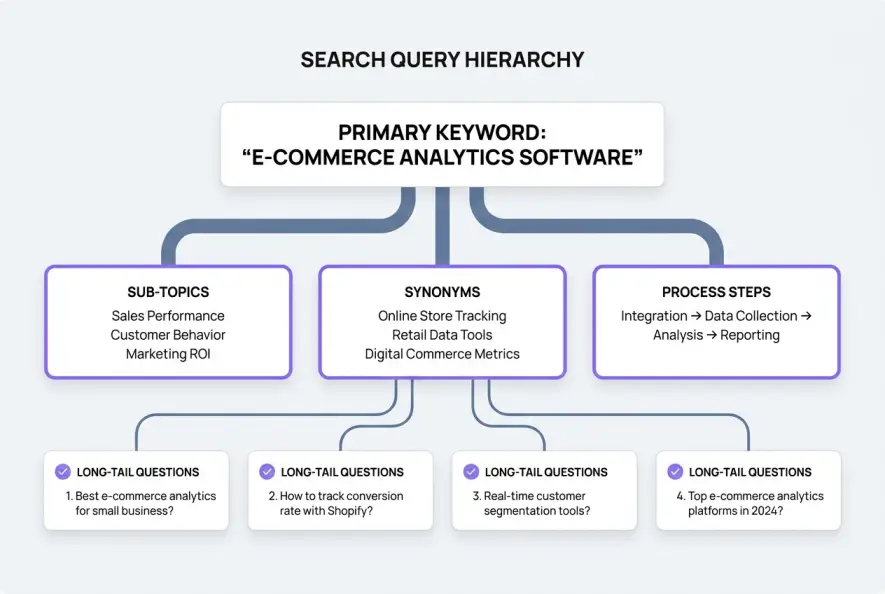
How Search Engines Cluster Multi-Query Intent
Google does not evaluate keywords in isolation; it groups search phrases into unified intent clusters based on user behavior and document co-citation patterns.
When thousands of searchers type different variations of a question and consistently click on, read, and find satisfaction in the same set of URLs, the search engine concludes that those disparate phrases share identical intent.
The following table illustrates how search algorithms categorize and prioritize query layers across a single piece of content:
| Query Layer | Purpose in Article | Placement Priority | Search Intent Focus |
|---|---|---|---|
| Primary Term | Defines core topic & main URL focus | Title, H1, first 100 words, URL slug | Overarching informational or commercial intent |
| Secondary Layer | Expands key sub-themes & steps | H2 subheadings, H3 subsections, intro lead-ins | Specific sub-tasks, comparisons, & methods |
| Long-Tail Variations | Captures specific user edge cases | Body copy, bullet lists, FAQ sections | Highly specific, low-volume intent |
| Semantic Entities | Validates domain expertise & depth | Natural paragraph prose, captions, tables | Contextual terminology & industry jargon |
When you align your page architecture with this clustering behavior, you mirror how machine-learning search models parse and rank documents. This is why your internal links quietly stop passing authority when anchor text ignores the surrounding semantic topic.
Step-by-Step: How to Research High-Impact Supporting Search Terms
Finding the right supporting terms is not a matter of exporting a massive spreadsheet and picking words at random. You need a structured, intent-driven discovery framework.
1. SERP Overlap Analysis
The fastest way to verify whether a related phrase belongs on your existing page or requires its own standalone URL is to inspect the search engine results page (SERP).
Search both your primary term and the candidate supporting term in Google. If five or six of the top ten URLs are identical, Google views them as sharing the same core search intent. That means your page can safely rank for both. If the results display completely distinct domains and content formats, that topic warrants an independent piece of content.
2. Mining Competitor Content Gaps
Plug your top three ranking competitors for your primary phrase into a competitive analysis tool. Look for queries where all three competitors rank in the top 20, but with varying positions.
These overlapping queries reveal what search engines expect an authoritative piece to cover. When you build your list of secondary keywords, always verify which subheadings appear across multiple top-performing competitor pages—those headings represent baseline information retrieval requirements for the topic.
3. Extracting People Also Ask and Related Searches
The "People Also Ask" (PAA) box and related searches at the bottom of the SERP are direct telemetry from Google about related user journeys.
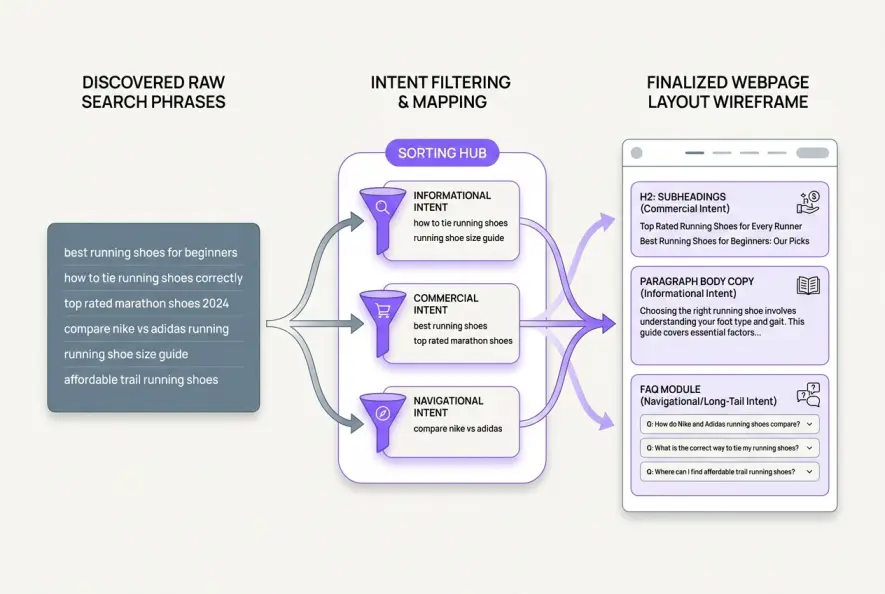
Group these queries by intent. High-volume questions make ideal H2 subheadings, while hyper-specific questions make outstanding FAQ entries. In Ahrefs' study of three million search queries, pages that systematically answered related sub-questions dominated long-tail visibility over pages that focused strictly on head-term volume.
Where to Place Supporting Terms Without Hurting Readability
Once you have identified your query cluster, the challenge is weaving those phrases into your copy naturally. Search algorithms penalize unnatural repetition, so your placement must feel intuitive to human readers.
Follow these rules to integrate terms seamlessly:
- Use Subheadings for Major Sub-Intents: Turn high-volume supporting phrases into descriptive H2 or H3 headers. For example, instead of writing an abstract header like "Timing Considerations," write "When Is the Best Time to Prune Fruit Trees?".
- Anchor Terms in Practical Explanations: Place technical synonyms and supporting entities inside process steps, step-by-step instructions, and explanatory paragraphs where they provide real clarity.
- Dedicate Space to FAQs: Readers often type long, conversational questions into search engines. A concise FAQ module at the end of your post lets you address three to six long-tail queries without breaking the narrative flow of your main sections.
According to Google's SEO Starter Guide, structuring content logically with clear headings helps search bots understand how different parts of your page relate to the broader topic.
Audit your Google Search Console performance report 60 days after publishing. Filter by page URL and look for queries in positions 11–20 with high impressions. Adding a single dedicated paragraph or clarifying subhead targeting those latent queries can instantly push them onto page one.
Avoiding Keyword Cannibalization and Content Overlap
Targeting multiple phrases on a single URL requires discipline. The biggest mistake editorial teams make when implementing supporting query strategies is accidentally competing against their own content.
If you target a supporting search phrase too aggressively—giving it massive internal link prominence or a near-identical title tag on another post—you risk triggering keyword cannibalization. When this happens, search engines split ranking signals between two URLs, causing both pages to hover on page two or three.
To keep your site architecture clean, map every query cluster into a cohesive topical map for SEO. Your primary URL serves as the comprehensive pillar, while narrower, tangential queries that demand separate transactional or technical explanations receive their own dedicated posts.
Tracking Multi-Query Performance in Search Console
Tracking single-keyword rankings gives you an incomplete picture of your organic health. When a page is properly optimized for an entire topical cluster, its performance shows up across aggregate metrics.
Open Google Search Console, navigate to the Performance report, and filter by your specific page URL:
- Total Queries Ranking: Watch the raw count of queries generating impressions. A healthy, well-optimized page will see this number grow from dozens to hundreds within months of publication.
- Impression-to-Click Spread: If impressions are surging on long-tail variations but clicks remain low, check whether your meta description and title tag address the broader topic clearly.
- Position Clusters: Identify groups of related phrases sitting between positions 8 and 15. These represent immediate optimization opportunities where minor content expansions can produce rapid traffic gains.
Structuring Content for Modern AI Answer Engines
Ranking on traditional search engine results pages is only half the battle. Generative answer engines like ChatGPT, Perplexity, and Google AI Overviews synthesize answers by extracting modular information blocks from authoritative pages.
When you organize your article around clear sub-queries, you make it dramatically easier for large language models to extract your definitions, steps, and data tables as direct citations. Each well-defined subsection acts as an independent answer node that can be cited in generative summaries.
Building pages that rank for hundreds of search queries is not an algorithmic trick. It is the natural result of answering a question so thoroughly, and structuring the answer so clearly, that search engines have no choice but to reward it.
Artificial Intelligence
Intelligence without limits.
We believe great content deserves honest authorship—even when it's AI.
Frequently Asked Questions
Most high-performing articles naturally target between 3 to 8 major supporting sub-topics alongside 15 to 30 long-tail query variations. Rather than chasing an arbitrary quota, let the breadth of user intent dictate your list. If a sub-topic requires more than 400 words to explain thoroughly, consider breaking it into an independent article.
Yes. Modern search algorithms rely heavily on semantic embeddings and entity graphs. If your content thoroughly covers the concepts, entities, and answers associated with a search term, search engines can easily match your URL to the query even if the exact words never appear verbatim in your text.
This is a common and positive outcome known as intent discovery. When a supporting sub-topic gains major traction, update your page title or H1 slightly to better reflect both queries, or add a dedicated content expansion to strengthen your rankings for that specific high-performing variation.
Perform a SERP comparison between your primary term and the related phrase. If more than 60% of the top 10 search results are identical, a single page should cover both. If the top results show different websites, distinct user intents, or specialized tools, the sub-topic deserves a dedicated article.
Significantly. Generative answer engines like Google AI Overviews and Perplexity evaluate content in semantic chunks. Clear subheadings and supporting definitions increase the likelihood that an AI model will extract your specific paragraph as a concise answer citation.
Wait roughly 60 to 90 days after publication. This waiting window gives search engines enough time to index the URL, test it across various search clusters, and accumulate statistically significant impression data inside Google Search Console.