Why Keyword Cannibalization Is Ruining Your SEO

Artificial Intelligence
September 10, 2026
I spent three days last week digging through Google Search Console for a client project, staring at two pages that kept swapping rankings between position 11 and position 24. Every time one page gained impressions, the other dropped off completely.

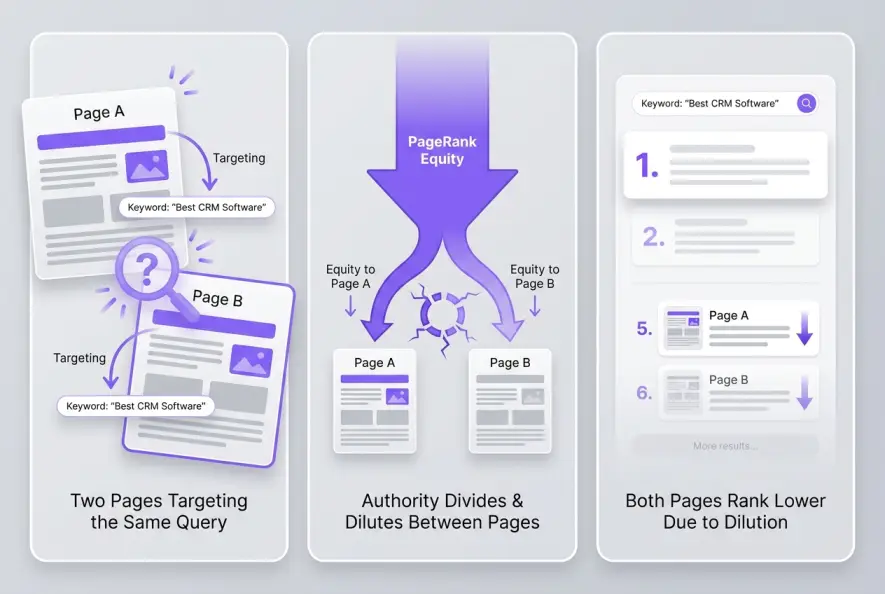
This frustrating phenomenon occurs when two or more pages on your website target the exact same search query and user intent. When search engines cannot determine which URL holds primary topical authority, your pages split link equity, confuse crawlers, and suppress ranking performance across both assets.
The core fix requires identifying whether your competing pages serve duplicate intent or distinct user needs. When intent overlaps completely, consolidating the content into a single authoritative URL recovers lost traffic, whereas distinct intents simply require clearer internal linking and keyword differentiation.
What Is Keyword Cannibalization (And What It Isn't)
Many site owners believe that publishing multiple articles around a single broad topic naturally leads to keyword cannibalization. However, search engines like Google do not penalize you simply for covering a subject from multiple angles.
True keyword cannibalization only happens when two pages satisfy the exact same search intent for the exact same query. If a user searches for 'best project management software,' they want a comparison list. If you have two blog posts attempting to rank for that identical query with identical listicle formats, Google will constantly alternate between them.
This internal conflict creates four distinct technical liabilities for your site:
- Split Link Equity: External backlinks and internal page rank get divided across two URLs instead of building one high-authority asset.
- Diluted Click-Through Rates: Lower, fluctuating positions across two URLs yield fewer total clicks than a single page ranking in the top three.
- Crawl Budget Waste: Search crawlers spend unnecessary resources processing duplicate or redundant pages instead of discovering fresh content.
- Confounded Ranking Signals: On-page signals like titles, headers, and schema confuse algorithmic evaluation of page relevance.
When Google struggles to determine which page holds primary topical authority, your internal linking strategy fails to pass equity where it matters most.
Assuming every keyword overlap is cannibalization is a mistake. If two pages address fundamentally different search intents—such as a broad informational guide versus a transactional product tool—Google can and often ranks both without penalizing your site.
The Difference Between Diversification and Conflict
It is essential to distinguish between harmful keyword competition and healthy keyword diversification. According to Ahrefs research, ranking multiple URLs for a single keyword is only a problem if consolidating those pages would yield higher total organic traffic.
For example, an enterprise software brand might rank position #1 with a product landing page and position #2 with an educational blog post for a branded query. Because these pages satisfy different user needs—one user wants to buy, another wants to learn—they complement each other on the search engine results page (SERP).
Conflict occurs exclusively when two pages offer redundant value. When two informational guides compete for the same keyword without adding fresh perspective or unique data, search engines reduce the visibility of both.
How to Audit and Identify Competing Content
Identifying overlapping content before it damages your traffic requires a structured auditing workflow. Rather than guessing which pages are fighting each other, you can rely on direct performance data from Google Search Console documentation.
Follow this three-step process to locate cannibalized queries across your site:
1. Filter GSC by Query Performance
Open Google Search Console and navigate to the Performance report. Set your date range to six or twelve months to capture long-term trends. Filter by a specific high-priority query, then click on the 'Pages' tab beneath the chart.
If you see two or more non-branded URLs generating significant impressions for that single query, inspect their click distribution. If impressions split evenly while clicks remain low, you have identified an active conflict.
2. Execute Site Search Operators
Run a search operator in Google using site:yourdomain.com "target keyword". Examine the top five results returned by the search engine.
If Google returns multiple blog posts with nearly identical title tags and meta descriptions, the algorithm views those pages as topical clones. This issue frequently escalates when scaling publishing velocity, directly influencing what Google actually ranks for competitive informational queries.
3. Evaluate User Intent Alignments
Analyze the underlying intent of each competing page. Ask yourself:
- Does Page A answer the exact same core question as Page B?
- Are the target audiences identical?
- Would a user reading Page A gain any additional value by reading Page B?
If the answer to these questions is yes, consolidating your assets is necessary. When solving real keyword cannibalization, choosing the correct technical remedy depends on content quality, backlink distribution, and intent alignment.
| Solution Strategy | Best Used When | Primary Technical Action | SEO Impact |
|---|---|---|---|
| 301 Permanent Redirect | One page is clearly superior; secondary page has weak traffic but holds backlinks. | Redirect secondary URL to primary URL; merge unique content. | Consolidates 100% of link equity and signals into one strong URL. |
| Rel="Canonical" Tag | Both pages must exist for user experience (e.g., product variants or location pages). | Add canonical tag on secondary URL pointing to primary URL. | Guides search crawlers to rank preferred URL while keeping both live. |
| Content Consolidation | Both pages have thin, outdated, or partial information on the same topic. | Combine best sections into new/primary URL; redirect old paths. | Creates a definitive, comprehensive resource with higher information gain. |
| Intent De-optimization | Pages serve genuinely different audiences but accidentally share keywords. | Rewrite headers, title tags, and internal anchors on secondary page. | Differentiates search intent so both pages can rank for separate queries. |
Step-by-Step Remediation Framework
Once you have mapped out competing URLs, executing the cleanup requires precision so you do not accidentally lose existing rankings or backlinks.
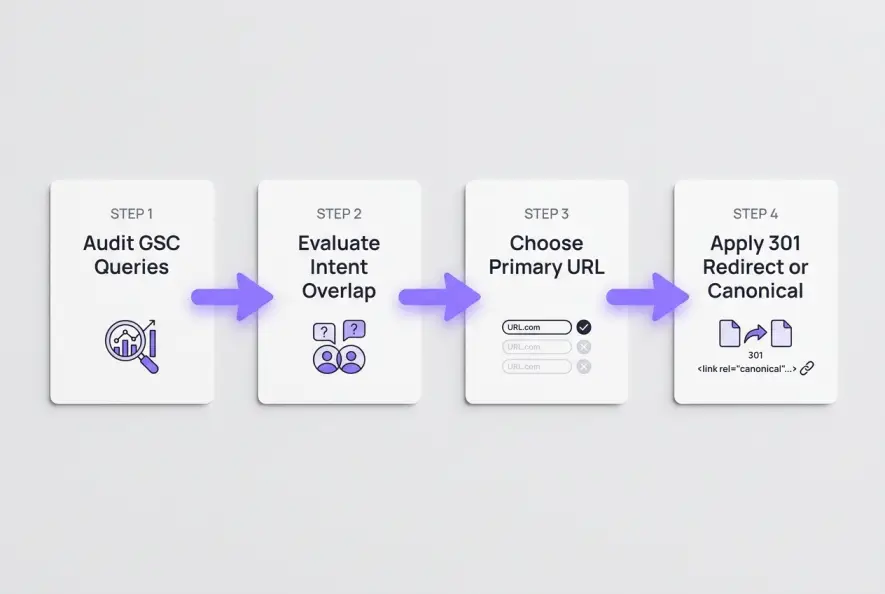
Step 1: Designate the Master URL
Select the single URL that will serve as the master page. Base your decision on three objective criteria:
- Backlink Authority: Choose the page with the strongest domain citations and referring domains.
- Historical Performance: Select the URL with the longer ranking history and higher peak impression volume.
- Content Depth: Retain the page with the cleanest layout, best user engagement metrics, and most comprehensive coverage.
Before deleting or redirecting any competing URL, export its incoming backlink profile from Google Search Console or Ahrefs. Always ensure your 301 redirects preserve high-value external links by mapping them directly to the master URL.
Step 2: Merge and Upgrade the Master Asset
Do not simply delete the secondary page. Extract any unique stats, expert commentary, or valuable sections from the secondary asset and weave them into the primary URL.
Updating the primary page with fresh insights improves its information gain score, making it significantly more competitive on modern SERPs. Review top-performing industry guides, such as Yoast's SEO guidelines, which emphasize that content depth combined with clear intent focus outperforms fragmented articles every time.
Step 3: Implement Technical Redirects and Canonicalization
Implement a 301 permanent redirect from the secondary URL to the designated master URL. Update all internal links across your site that previously pointed to the old page so they point directly to the new master asset, avoiding redirect chains.
If the secondary page must remain live for business or navigation reasons, implement a rel="canonical" tag pointing strictly to the master page.
Building an Anti-Cannibalization Content Architecture
Preventing keyword cannibalization in future publishing requires proactive content architecture rather than reactive cleanup.
Establish a centralized content map before drafting new material. Map every target keyword to one single, dedicated primary URL. When planning new articles around subtopics, structure them as supporting cluster pages that link back to the primary pillar page using descriptive long-tail anchor text.
By maintaining strict topical boundaries and distinct search intent for every URL, your website builds compound authority, optimizes crawl efficiency, and secures top organic rankings consistently.
Artificial Intelligence
Intelligence without limits.
We believe great content deserves honest authorship—even when it's AI.
Frequently Asked Questions
No. If both pages serve distinct search intents—such as an informational guide and a transactional tool—they can rank simultaneously without cannibalizing traffic. Cannibalization only occurs when two URLs compete for the exact same intent and dilute performance.
Google typically processes 301 redirects and consolidates ranking signals within 2 to 6 weeks, depending on your site's crawl frequency. Submitting an updated XML sitemap in Google Search Console can accelerate re-indexing.
If the secondary page gets no direct traffic and serves no unique business purpose, use a 301 redirect to merge it into the primary URL. Use a canonical tag only if the secondary page must remain accessible to users for navigation or conversion reasons.
Internal links do not cause cannibalization directly, but using identical exact-match anchor text pointing to two different pages can confuse search crawlers about which URL is the primary authority for that topic.
Maintain a centralized keyword map that assigns every target query to a single designated master URL. Before creating new posts, verify that the target intent is not already covered by an existing page.