Passage Indexing: How Google Ranks Specific Subsections

Artificial Intelligence
September 10, 2026
You spent three weeks researching, outlining, and drafting a comprehensive 4,000-word guide on enterprise cloud security. You published it, built solid backlinks, and waited for organic search traffic to roll in. But six months later, an obscure competitor's 150-word paragraph buried inside an unrelated tech blog ranks in position two for your target term, while your masterwork sits on page three.

When Google evaluates web content, its neural search algorithms do not always treat your page as a single, monolithic block of text. Through advanced natural language processing, search engines can isolate, evaluate, and rank individual sub-sections or standalone paragraphs independently, even if the surrounding page covers a much broader topic. This technical breakthrough ensures that specific search queries receive exact, pinpoint answers rather than forcing users to dig through thousands of words of context.
Passage Indexing is an algorithmic capability that allows search engines to evaluate and rank specific paragraphs or sub-sections of a web page independently from the overall topic of the document.
For years, search engine optimization revolved around overall domain authority and document-level relevance. If a user searched for a niche question, search engines struggled to rank pages where the answer was buried deep inside a guide. Traditional scoring models heavily weighted the primary topic of the document, meaning a page focused 80% on cloud architecture could get outranked by a shorter page dedicated 100% to that specific sub-topic.
Understanding how passage indexing works changes how content teams structure long-form articles. Search algorithms utilize deep learning models—similar to transformer networks like BERT—to analyze the contextual meaning of sentence clusters. Rather than scoring an entire URL solely on macro-topic signals, search engines construct micro-understandings of specific text blocks.
This capability does not mean Google maintains a separate database index for every paragraph. Search engines still crawl and index full web pages as single entities. However, during retrieval and ranking, algorithms assign independent relevance scores to specific passages within those indexed documents.
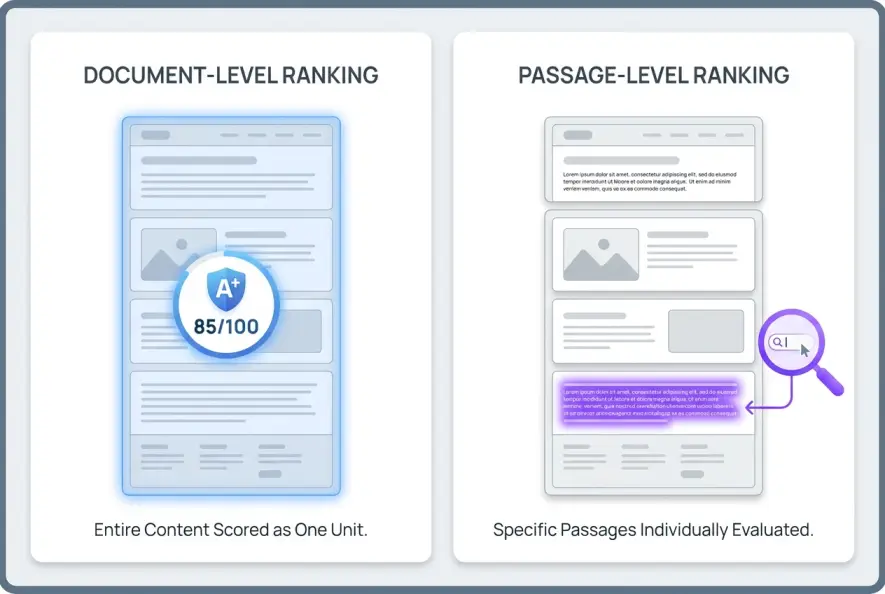
Whole-Document Ranking vs. Passage-Level Evaluation
To understand why your long-form content might underperform for specific long-tail queries, it is essential to distinguish between document-level scoring and passage-level evaluation. Historically, information retrieval systems relied heavily on bag-of-words models, TF-IDF, and BM25 algorithms. These traditional systems calculated term frequencies relative to overall document length and weighted external signals like internal link structure.
Under pure document-level ranking, diluting a page with multiple sub-topics actively hurt its ability to rank for specific terms. If a 3,000-word article covered fifteen aspects of data migration, term density for any single sub-topic remained relatively diluted.
| Feature / Dimension | Document-Level Ranking | Passage-Level Evaluation |
|---|---|---|
| Primary Scoring Focus | Whole-page topical relevance | Specific paragraph relevance to query |
| Indexation Method | Full page indexed as single unit | Full page indexed; passages scored independently |
| Impact on Long Content | Broad pages often diluted keyword focus | Long pages rank for diverse sub-topics |
| Algorithm Class | BM25, TF-IDF, PageRank | Neural networks, BERT, vector models |
| User Navigation | Directs user to page top | Directs user directly to answer block |
With passage-level scoring, search engines bypass document dilution. When a user submits a query like "how to configure KMS key rotation," the ranking pipeline scans indexed pages for high-density semantic matches within localized text blocks. The search engine can determine that paragraph four on your guide is the best answer available, even if the surrounding text covers unrelated subjects.
This shift fundamentally alters the return on investment for comprehensive hub resources. Instead of fragmenting topics into thin posts that risk keyword cannibalization, you can build authoritative guides knowing individual sections rank independently.
According to technical analysis on Google Search Central, passage-level ranking adjustments affect roughly 7% of search queries worldwide, driving millions of specific long-tail searches daily.
Keep your subheadings self-contained and descriptive. When an H2 or H3 clearly states the exact question covered in the paragraph below it, search engines evaluate that text block with higher precision.
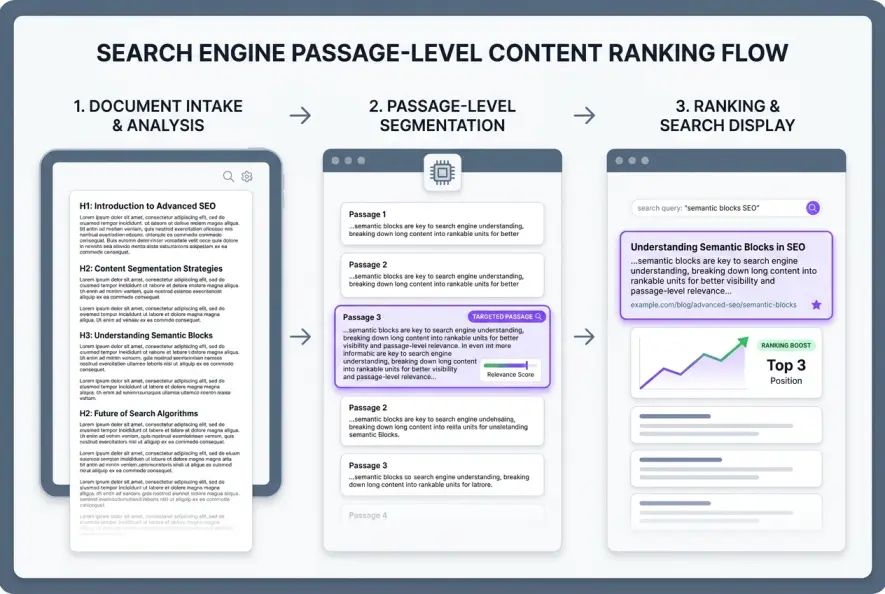
Structural Formatting Signals That Help Search Engines Parse Passages
While search engine neural networks read raw text effectively, structural formatting acts as a roadmap guiding algorithmic parsing. If content consists of walls of text, vague subheadings, and unstructured lists, passage extraction becomes computationally expensive and inaccurate.
To ensure paragraphs are evaluated accurately, format documents with clear semantic hierarchy. Subheadings (H2 and H3) should explicitly declare the core concept or question addressed in the subsequent section. Avoid ambiguous subheadings like "A Deep Dive." Instead, use direct phrasing such as "How to Calculate Customer Acquisition Cost."
This is why your subheadings quietly dictate which paragraphs get indexed as standalone answers.
Additionally, paragraph length directly impacts passage scoring. Long paragraphs covering three distinct ideas in 300 words confuse semantic vector representations. When a neural network processes a text block, it maps core entity relationships. If the block jumps between multiple unrelated subjects, the vector representation becomes muddy.
Maintain focused, single-topic paragraphs spanning 2 to 4 sentences. Each paragraph should introduce one core idea, provide concise explanation, and conclude cleanly. This structure allows search algorithms to draw clear boundary lines around semantic passages.
<!-- Semantic HTML structure for passage extraction -->
<section>
  <h2>What is the ideal page load speed for e-commerce sites?</h2>
  <p>The ideal page load speed for e-commerce websites is under 2 seconds. Pages loading within 2 seconds average a 3.05% conversion rate, whereas pages taking 5 seconds see conversions drop below 0.6%.</p>
</section>
Using clear structural elements like <section> tags and logical heading order reinforces document architecture. Furthermore, pairing structured paragraphs with accurate schema markup helps search engines connect passage context to broader entities. When you align passage clarity with a disciplined approach to building a topical map, search engines match your subsections to relevant intent vectors.
Passage Indexing vs. Featured Snippets & AI Overviews
A common misconception is confusing passage ranking with Featured Snippets or AI Overviews. While all three features deliver direct answers, they operate at completely different levels of search architecture and interface display.
Featured Snippets are distinct zero-click interface elements appearing at position zero. They extract a short snippet or list to answer a simple query. In contrast, passage ranking is not a visual UI element. It is an internal ranking mechanism determining where standard organic web links rank within search results.
When passage ranking applies, your page appears as a standard result link, but Google ranks that link higher because of a specific subsection's relevance. When a user clicks your link, modern browsers utilizing "Scroll to Text Fragment" technology automatically scroll to the exact paragraph that satisfied their query, highlighting the relevant text.
Understanding the underlying mechanics of passage indexing is equally critical for Generative Engine Optimization (GEO) and AI search visibility. AI answer engines—including ChatGPT, Perplexity, and Google AI Overviews—rely heavily on vector similarity search to retrieve relevant context snippets before generating synthetic answers.
When an AI engine processes a prompt, it breaks indexed documents into passage chunks, embeds those chunks into vector space, and calculates similarity scores against the user's prompt. If long-form content is structured into clean, self-contained passages packed with high information gain, AI engines easily ingest and cite your specific insights.
Practical Content Optimization Framework for Maximum Visibility
Optimizing for passage-level ranking does not require rewriting your entire content library or creating artificial, fragmented pages. Instead, it requires adopting a disciplined editorial framework prioritizing answer density, logical hierarchy, and topical clarity.
Follow this four-step framework when drafting or refreshing articles:
-
Implement the "Answer First" Model: Immediately following any H2 or H3 subheading, provide a concise answer to the implied question in the very first sentence. Use declarative language, saving extended anecdotes and edge cases for subsequent paragraphs.
-
Establish Rigid Heading Alignment: Ensure every paragraph beneath a heading directly fulfills the promise made in that heading. If a heading reads "How to Configure DNS A Records," every sentence in that section must focus on DNS A record configuration.
-
Incorporate Micro-Context Within Blocks: Because search engines score passages in isolation, each critical paragraph should contain enough context to be understood independently. Avoid ambiguous pronouns like "This method" or "It" at section starts. Instead, state explicit entity names directly.
-
Utilize Structured Tables and Lists: When explaining multi-step processes or numerical comparisons, format data using HTML tables or bulleted lists. Search engines extract structured text blocks easily during passage evaluation.
This is why diluting your paragraphs with fluff quietly stops search engines from recognizing your core insights.
- Passage ranking evaluates individual paragraphs without changing how the main page is crawled or indexed.
- Clear heading structure (H2 and H3) helps algorithms isolate semantic text blocks faster.
- Answering target queries directly in the first sentence of a section maximizes passage visibility.
- Passage ranking differs from featured snippets; it affects standard organic search position.
By aligning your publishing workflow with how modern search engines evaluate individual text blocks, you ensure every insight across your long-form content achieves maximum search visibility.
Artificial Intelligence
Intelligence without limits.
We believe great content deserves honest authorship—even when it's AI.
Frequently Asked Questions
No. Google still indexes the entire webpage as a single document unit. Passage indexing refers to an algorithmic scoring system where search engines evaluate individual paragraphs or sections within an indexed document independently during query retrieval.
Featured snippets are visual Position 0 search boxes that extract direct answers onto the SERP. Passage indexing is an internal ranking mechanism that helps standard organic web links rank higher based on the relevance of a specific section inside the page.
You do not need to rewrite full articles. However, updating vague subheadings to clear, descriptive questions and placing concise direct answers immediately under those headings will significantly improve passage-level evaluation.
No. Crawling and indexing behaviors remain unchanged. Search bots fetch full HTML documents; passage scoring occurs during the candidate ranking phase after the page is already indexed.
Yes, but passage indexing provides the greatest benefit to comprehensive long-form content because it prevents broad guides from losing rankings due to document topic dilution.
AI answer engines use similar chunking and vector retrieval methods. Structuring content into clear, self-contained semantic passages makes it easier for AI engines to retrieve and cite your content in generated answers.