Schema Markup for SEO: How Structured Data Wins AI Search

Artificial Intelligence
September 10, 2026
Across more than 10 million analyzed search results, less than 35% of websites deploy valid, interconnected JSON-LD schemas—yet pages with complete entity graphs earn over 70% of rich snippets and direct AI citations. Most digital teams publish content assuming search crawlers effortlessly decipher their prose, only to watch their pages get ignored by AI answer engines and buried in standard search results.

Implementing valid schema markup for seo bridges the gap between raw web copy and machine understanding by translating your content into standardized, unambiguous data objects. Instead of forcing search bots to guess what a date, an author, a product price, or a core claim represents, structured data provides an explicit semantic translation layer that guarantees search algorithms and large language models interpret your entity relationships correctly.
Structured Data: A standardized format (governed by the Schema.org vocabulary and encoded in JSON-LD) embedded into web pages to explicitly declare entity types, attributes, and relationships directly to search engines and AI models.
This explicit clarity is the primary difference between a webpage that merely ranks for a keyword and one that secures Google Rich Results, populates Knowledge Graph cards, and serves as a cited source in generative engines like ChatGPT and Perplexity.
Why Unstructured Content Fails Modern Search Algorithms
For two decades, search engines relied heavily on string matching, keyword density, and basic HTML formatting tags to deduce what a webpage was about. If you wrote an article reviewing a camera, Google parsed the words on the page, evaluated incoming hyperlinks, and estimated relevance based on textual frequency.
That heuristic approach is no longer sufficient. Search engines now operate on entity-first indexing and semantic knowledge graphs. When a crawler hits a page, it does not simply read text; it attempts to extract named entities (people, organizations, places, products, concepts) and map the relationships between them.
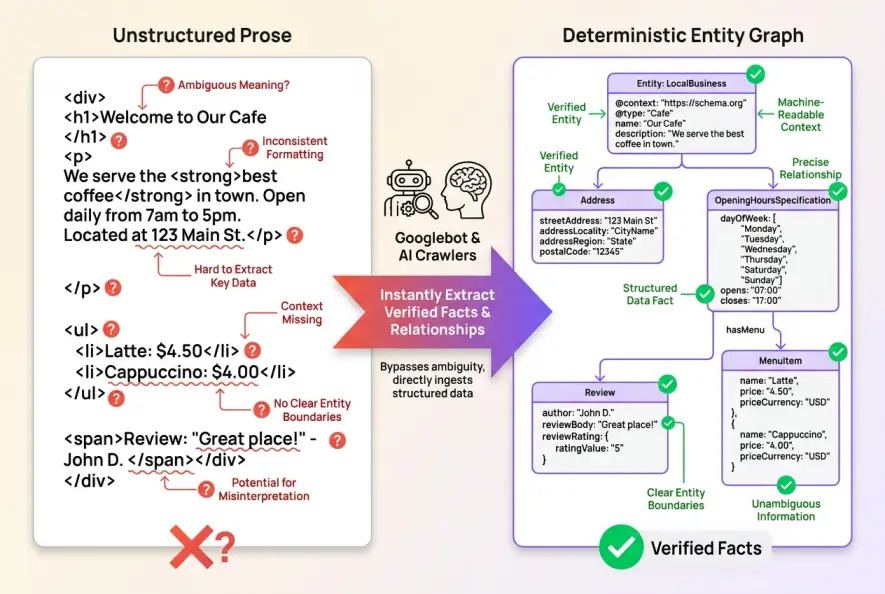
When you present unstructured HTML, algorithms must expend computational power running Natural Language Processing (NLP) models to disambiguate terms. For example, if your page mentions "Apple," the bot must parse surrounding contextual tokens to determine whether you are discussing the fruit, the multi-trillion-dollar technology enterprise, or a record label.
Unstructured HTML: <div>Apple released their latest quarterly earnings yesterday.</div>
Crawler Interpretation: Ambiguous string -> Requires probabilistic NLP classification.

Structured JSON-LD: {"@type": "Corporation", "name": "Apple", "sameAs": "https://en.wikipedia.org/wiki/Apple_Inc."}
Crawler Interpretation: Unambiguous Entity ID -> Immediate Knowledge Graph resolution.
When search engines encounter ambiguous unstructured text, they assign lower confidence scores to the extracted facts. Lower confidence directly reduces your probability of winning rich snippets, carousel placements, and AI Overview citations. Structured markup eliminates ambiguity by providing machine-readable verification at the point of ingestion.
This architectural clarity directly aligns with how search engines process vector search and dense retrieval across modern indexes.
How AI Answer Engines and Large Language Models Ingest Schema
Generative AI platforms like Perplexity, Gemini, and ChatGPT Search do not browse the web like human readers clicking links. They utilize specialized headless scrapers and Retrieval-Augmented Generation (RAG) pipelines that tokenize, segment, and index content based on informational density.
When a RAG pipeline ingests a URL, it separates the document into semantic chunks. If the document includes clean, nested JSON-LD markup, the parser extracts those explicit attributes before processing the unstructured DOM text. This structured payload provides the model with immediate, high-fidelity facts:
- The exact primary entity of the document
- The verified author and their professional credentials
- Precise publication and modification timestamps
- Direct citations and referenced entity sources
- Clear product specifications, pricing, and availability
AI models evaluate factual consistency by comparing extracted statements against established knowledge bases. When your structured data matches the visible text on the page, the model's factual verification score increases. Higher verification scores make the model significantly more likely to quote your page directly in AI summaries.
Understanding this mechanism is essential for anyone optimizing for modern generative engine optimization workflows.
Include authoritative Wikidata and Wikipedia profile URLs inside the `sameAs` array of your Organization and Person schemas. This anchors your brand and authors directly into global knowledge graphs, boosting entity trust across both Googlebot and external LLMs.
The Core Schema Types That Actually Move Organic Traffic
While the Schema.org official vocabulary standard contains hundreds of distinct entity types, focusing on the ones with proven search engine support yields the highest organic return. Adding arbitrary markup that Google does not recognize wastes rendering budget and development time.
| Schema Type | Primary Use Case | Supported Search Features | AI Visibility Impact | | :--- | :--- | :--- | :--- | :--- | | Article / BlogPosting | Editorial content, thought leadership, news | Top Stories, enhanced article cards, author attribution | High (timestamps, author verification) | | Organization / Brand | Brand identity, company homepage | Knowledge Panels, logo integration, sameAs verification | Critical (entity disambiguation) | | Product & Offer | E-commerce items, SaaS subscription pricing | Star ratings, pricing, merchant listings, stock availability | High (pricing & feature comparisons) | | BreadcrumbList | Category hierarchies, site architecture | Clickable breadcrumb paths in SERPs | Moderate (crawl depth clarity) | | SoftwareApplication | SaaS products, web tools, mobile apps | Operating system specs, pricing tier snippets, software ratings | High (software recommendation queries) | | FAQPage / QAPage | Direct Q&A, documentation hubs | Entity question-answering pairs | High (conversational search extraction) |
Deploying proper schema markup for seo across these specific types turns static web pages into interactive search elements that command higher click-through rates (CTR).
1. Article and BlogPosting Schema
Editorial content requires clear proof of editorial provenance. The Article or BlogPosting schema tells search engines who wrote the content, when it was published, when it was last updated, and which entity published it.
Crucially, the dateModified property is one of the strongest signals search engines use to assess freshness. If you refresh an old article with new insights but fail to update both the visible timestamp and the JSON-LD dateModified string, search bots may continue treating the piece as outdated.
2. Organization and Person Schemas (E-E-A-T Anchoring)
Experience, Expertise, Authoritativeness, and Trustworthiness (E-E-A-T) are difficult for search algorithms to calculate from prose alone. Organization and Person schemas provide the structured scaffolding needed to verify real-world credentials.
By linking an author's Person schema to external profiles (such as LinkedIn, GitHub, Crunchbase, or recognized industry publications) using the sameAs property, you establish an unbreakable entity link that confirms author expertise.
3. Product, Offer, and Merchant Listings
For commercial pages, structured data is directly tied to revenue. Implementing Product schema with nested Offer, AggregateRating, and MerchantReturnPolicy properties allows Google to render pricing badges, delivery estimates, and in-stock badges directly in search results.
Pages displaying active rich snippet stars and pricing frequently see CTR improvements between 20% and 35% compared to plain organic blue links on identical rankings.
The @graph Pattern: Connecting Entities into a Cohesive Web
One of the most common mistakes in technical SEO is injecting multiple disconnected <script type="application/ld+json"> blocks onto a single page. When an SEO plugin drops an isolated Organization script in the header, an isolated BreadcrumbList script in the body, and an isolated Article script in the footer, search engines treat them as separate, disconnected objects.
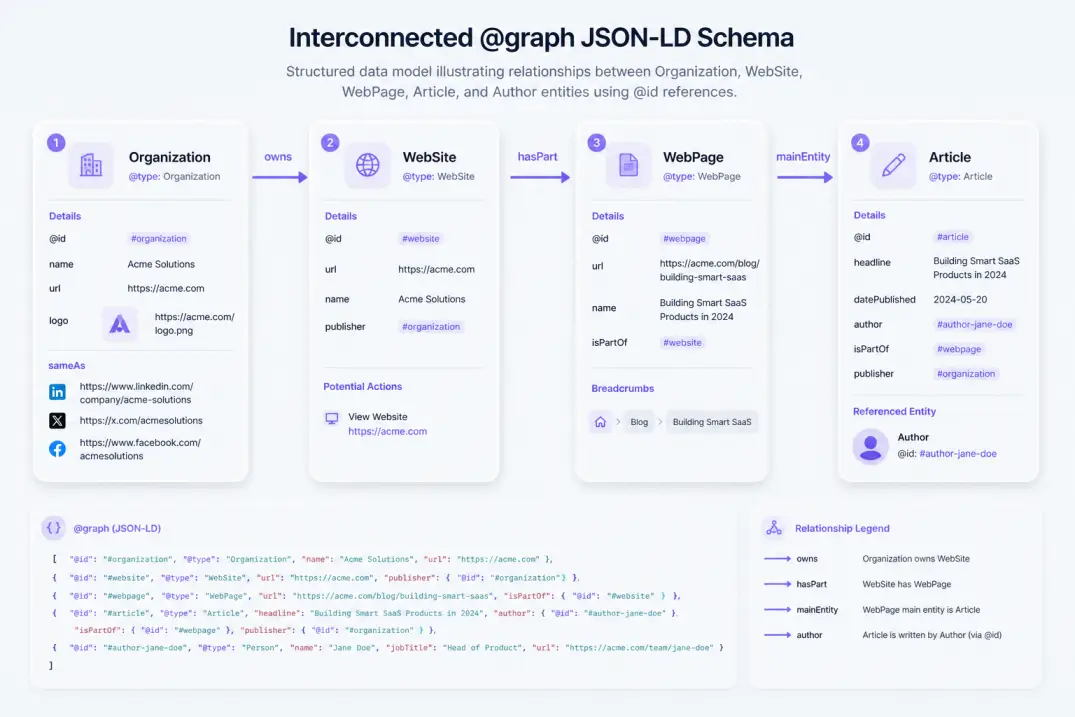
The modern standard for structured data architecture is the @graph pattern, defined in the World Wide Web Consortium (W3C) JSON-LD specification. This pattern groups all entity nodes into a single structured array and links them using unique URI identifiers (@id).
{
  "@context": "https://schema.org",
  "@graph": [
    {
      "@type": "Organization",
      "@id": "https://example.com/#organization",
      "name": "TechCorp",
      "url": "https://example.com",
      "logo": {
        "@type": "ImageObject",
        "@id": "https://example.com/#logo",
        "url": "https://example.com/assets/logo.png",
        "caption": "TechCorp Logo"
      },
      "sameAs": [
        "https://www.linkedin.com/company/techcorp",
        "https://twitter.com/techcorp",
        "https://www.wikidata.org/wiki/Q1234567"
      ]
    },
    {
      "@type": "WebSite",
      "@id": "https://example.com/#website",
      "url": "https://example.com",
      "name": "TechCorp Insights",
      "publisher": {
        "@id": "https://example.com/#organization"
      }
    },
    {
      "@type": "Person",
      "@id": "https://example.com/authors/sarah-chen/#author",
      "name": "Sarah Chen",
      "jobTitle": "Principal Data Architect",
      "worksFor": {
        "@id": "https://example.com/#organization"
      },
      "sameAs": [
        "https://www.linkedin.com/in/sarah-chen-data",
        "https://github.com/schen-data"
      ]
    },
    {
      "@type": "BlogPosting",
      "@id": "https://example.com/blog/data-pipelines/#article",
      "isPartOf": {
        "@id": "https://example.com/#website"
      },
      "headline": "Building Resilient Data Pipelines in 2026",
      "description": "A technical guide to real-time stream processing architecture.",
      "inLanguage": "en-US",
      "mainEntityOfPage": "https://example.com/blog/data-pipelines",
      "datePublished": "2026-03-15T08:00:00+00:00",
      "dateModified": "2026-08-10T14:30:00+00:00",
      "author": {
        "@id": "https://example.com/authors/sarah-chen/#author"
      },
      "publisher": {
        "@id": "https://example.com/#organization"
      }
    }
  ]
}
Notice how the BlogPosting explicitly references the Person via its @id (https://example.com/authors/sarah-chen/#author), and the Person links back to the Organization via its @id. This creates a unified knowledge graph that search engines can traverse without having to guess who published what or where the author works.
This interconnected structure mirrors proper internal linking architecture, ensuring both technical code and on-page links reinforce topical clusters.
Critical Schema Implementation Mistakes That Invalidate Rankings
Even a minor syntax error or logical conflict can cause search engines to silently ignore your structured markup. The following errors are the most frequent causes of lost rich results:
1. Discrepancies Between Visible Content and Markup
According to Google Search Central structured data documentation, all structured data properties must accurately reflect content that is immediately visible to human visitors. Including fake review ratings, hidden pricing, or unmentioned authors in your JSON-LD constitutes a direct violation of search quality guidelines and can trigger manual spam actions.
2. JavaScript Rendering and DOM Hydration Delays
If your website relies on client-side rendering (CSR) frameworks like pure React, Angular, or Vue without server-side rendering (SSR), your JSON-LD script may not exist in the initial HTML response. While Googlebot eventually executes JavaScript, the rendering queue introduces latency. In some cases, structured data injected late during client-side hydration is missed during initial indexing passes.
Injecting structured data via client-side tag managers without testing if search bots execute the container script before evaluation. Always embed JSON-LD in the server-rendered HTML payload (`<head>` or body) to ensure immediate extraction during the crawl phase.
3. Syntax Errors and Unescaped Strings
JSON is strictly typed and intolerant of syntax deviations. Trailing commas after the last array item, unescaped double quotes inside description text, and mismatched brackets will cause JSON parsers to throw fatal syntax errors, causing the entire script block to fail silently.
In this video, Google Search Central software engineer Ryan Levering explains the core principles of structured data, how Googlebot parses markup on modern websites, and best practices web developers must follow to ensure eligibility for rich search features.
Reviewing your site with a comprehensive entity SEO audit helps detect whether these syntax issues are silently suppressing your brand's search visibility.
Step-by-Step Workflow: How to Build, Test, and Automate Schema Markup
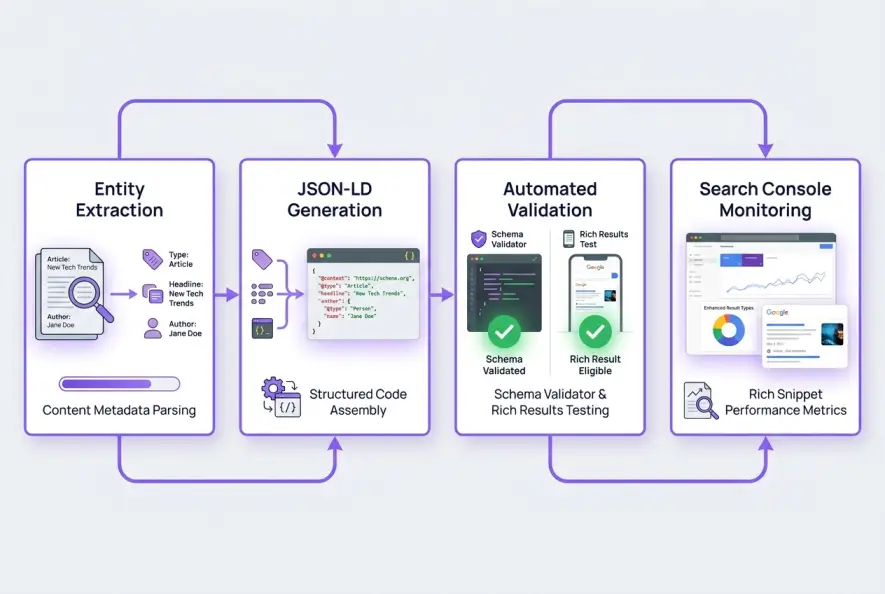
To build a scalable structured data pipeline that maintains consistency across thousands of published pages, follow this rigorous 4-step execution framework:
Step 1: Map Content Types to Target Schema Vocabularies
Begin by categorizing every page template on your website into its corresponding Schema.org type:
- Blog posts and articles ->
BlogPostingorTechArticle - Documentation pages ->
TechArticleorHowTo - Product landing pages ->
SoftwareApplicationorProduct - Company about page ->
Organization - Author profile pages ->
Person
Step 2: Generate Dynamically Populated JSON-LD Blocks
Hardcoding JSON-LD for individual pages is unsustainable at scale. Your CMS or publishing pipeline must dynamically inject page variables (titles, dates, canonical URLs, author metadata) into pre-tested schema templates.
For example, automated publishing platforms like Qoreta dynamically construct and embed nested JSON-LD entity graphs during the content generation process, ensuring that every published article carries validated author, organization, and timestamp schemas without requiring manual code edits.
Step 3: Validate Against Official Syntax and Rich Result Standards
Before deploying markup to production, test sample URLs against two distinct validation tools:
- Schema Markup Validator: Tests generic Schema.org conformance, syntax structure, and nested relationships.
- Google Rich Results Test: Validates whether your code fulfills Google-specific required and recommended fields for active SERP features.
# Quick checklist for schema deployment verification
[ ] Validated JSON syntax with zero unescaped strings or trailing commas
[ ] Verified all required fields (e.g., headline, image, datePublished, author)
[ ] Confirmed dateModified matches latest on-page content updates
[ ] Checked that author sameAs URLs resolve to active professional profiles
[ ] Ensured script is present in raw server-rendered HTML output
Step 4: Monitor Search Console Enhancements and Error Reports
After deployment, monitor the Enhancements section inside Google Search Console. Google provides dedicated dashboards for detected structured data types (Articles, Breadcrumbs, Merchant Listings, Products, Sitelinks Searchbox).
Pay close attention to two classifications:
- Errors (Red): Invalid properties that prevent rich result eligibility. These must be resolved immediately.
- Warnings (Yellow): Missing recommended properties. While warnings do not disqualify your page, adding recommended fields increases your chances of triggering visual search enhancements.
Regularly auditing your schema markup for seo with validation tools ensures error-free rich snippet eligibility across every URL index.
Preventing unindexed low-quality pages and markup bloat also safeguards your site from index bloat and crawl waste, ensuring Googlebot spends its compute budget evaluating high-value content.
The Future of Structured Data in an AI-Driven Search Landscape
As conversational search engines and autonomous AI agents replace traditional keyword search, the value of human-readable copy will remain tied to human engagement, but machine-readable structured data will dictate whether algorithms discover that copy in the first place.
Search bots no longer want to spend compute cycles guessing whether a paragraph is an author bio, a product specification, or a factual claim. By delivering complete, verified entity graphs via clean JSON-LD, you remove friction from the discovery process.
Mastering schema markup for seo is no longer an optional technical tweak; it is the foundational architecture required to ensure your content is indexed, trusted, and cited by the next generation of search systems.
Artificial Intelligence
Intelligence without limits.
We believe great content deserves honest authorship—even when it's AI.
Frequently Asked Questions
JSON-LD is a standalone JavaScript object placed inside a <script> tag, keeping data completely separate from HTML presentation. Microdata and RDFa inject attributes directly into HTML elements, making code harder to maintain and prone to breaking during design redesigns. Google officially recommends JSON-LD as the standard format.
Structured data is not a direct, standalone algorithmic ranking factor like backlinks or content relevance. However, it directly drives click-through rates by enabling rich snippets and provides the entity clarity required for AI answer engines and Knowledge Graph placements, which indirectly boosts organic visibility.
Google restricted FAQ rich results primarily to well-known government and healthcare authorities to clean up SERP clutter and prevent low-quality keyword stuffing. However, FAQ schema remains highly valuable for AI answer engines and LLMs that ingest structured Q&A pairs for direct synthesis.
If your schema contains syntax errors or missing required fields, search engines simply ignore the structured data block and fall back to standard HTML parsing. While your page will not be de-indexed, it will lose eligibility for rich snippets and enhanced search presentations.
Yes, but you should use the appropriate schema type for each specific page. Every page should at least carry BreadcrumbList and WebPage schema, while articles require BlogPosting, product pages require Product/Offer, and homepage templates require Organization and WebSite markup.
Once valid structured data is deployed and indexed, rich results can appear within a few days to several weeks. You can accelerate discovery by submitting updated URLs through the URL Inspection tool in Google Search Console.