Zero-Click Search SEO: How to Win Traffic in 2026

Artificial Intelligence
September 10, 2026
Last month, I pulled up our analytics dashboard expecting a steady rise in organic sessions, only to find our impression count up 40% while organic clicks dropped by 18%. I spent three days digging through server logs before realizing we hadn't lost our top rankings—Google was simply answering the queries directly on the search page.

The answer to surviving this shift isn't fighting for lost traffic, but mastering zero-click search seo: structuring your content to capture direct SERP real estate, feed AI search models, and convert zero-click impressions into direct brand searches.
According to SparkToro's zero-click search study, nearly seven out of ten Google searches now end without a single click to an external site. Between AI Overviews, featured snippets, and interactive knowledge widgets, search engines are increasingly acting as answer destinations rather than referral gateways.
If your growth model relies entirely on visitors clicking through to read a 2,000-word guide, your top-of-funnel pipeline is actively leaking prospects. But zero-click searches do not mean zero value. When you adjust your strategy, an unclicked impression becomes a powerful brand touchpoint that builds recall, establishes topical authority, and drives high-intent direct traffic.
Why Search Engines Are Walled Gardens
To understand why traditional organic search traffic is shrinking, you have to look at how search engines handle user intent. Five years ago, a query like "what is information gain in SEO" resulted in ten blue links. A user had to click a link, load a webpage, scan the headers, and locate the definition themselves.
Today, search engines process that query through large language models and display a multi-paragraph summary right at the top of the page. The user gets their answer in three seconds and closes the tab.
This shift isn't accidental. Search platforms want to minimize friction for users while maximizing time spent inside their own ecosystem. When an AI Overview satisfies a user query instantly, the user gets a great experience, but the publishing website loses a session.
Does this mean content marketing is dead? Far from it. It means the definition of success has shifted from traffic volume to entity influence.
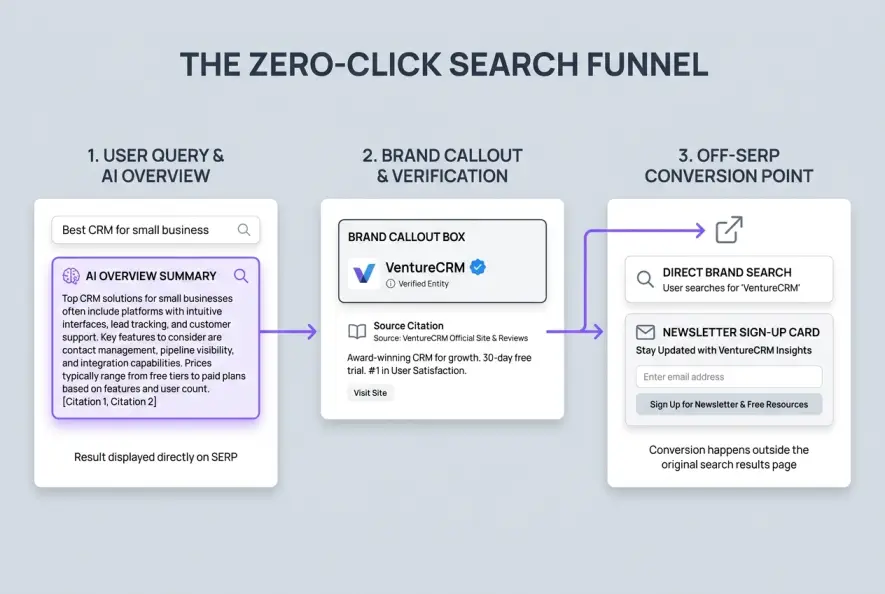
When Google generates an AI Overview, it extracts factual claims, data points, and concise definitions from authoritative sources across the web. If your site provides the clearest, most structured answer, your brand name and source citation sit directly inside that answer box. Even if the user doesn't click, they read your brand name alongside the definitive answer.
This mechanism is closely tied to generative engine optimization, where the goal is to become the primary reference material for synthesized search answers.
Optimize your brand entity so AI search engines recognize your business as the definitive source. Include structured Schema markup (Organization, SameAs, Article) on every key landing page.
The Three Pillars of In-SERP Dominance
Winning in a clickless environment requires a fundamental re-architecting of how you format and position information. Executing zero-click search seo requires focusing on three specific content pillars:
1. Target Definition Blocks
AI answer engines and traditional snippets favor content formatted in crisp, self-contained blocks. To capture these positions, place a clear 40 to 60-word definition directly beneath your H2 or H3 subheadings. Avoid clever intros or preamble—answer the implied question in sentence one.
2. Build Uniquely Identifiable Information
If your article simply repeats common industry knowledge, search engines will summarize the general concept without attributing it to you. To force a citation, you need proprietary data, original quotes, unique frameworks, or distinct terminology. This concept, known as information gain, gives algorithms a distinct reason to single out your source.
3. Embed In-SERP Brand Anchors
Since users may not click through to your site, your brand name must be embedded inside the snippet or summary itself. Mention your custom methodology or proprietary tool directly in the introductory text of key definitions. When a search engine pulls that excerpt, your brand identity travels with it.
- Over 68% of Google searches end without a click to an external site.
- AI Overviews and featured snippets answer informational queries directly on the SERP.
- To win in 2026, shift focus from raw traffic volume to entity visibility, brand recall, and high-intent zero-click capture.
When you structure content around these pillars, you stop viewing zero-click searches as lost visitors. Instead, you treat the search results page as a high-volume distribution channel where your brand receives free impressions in front of active, solution-seeking buyers.
Turning Unclicked Impressions into Revenue
A common frustration among content teams is proving the ROI of zero-click visibility. When Google Analytics shows declining organic sessions, leadership often assumes content marketing is failing.
However, if you analyze downstream metrics, you will often notice a strange trend: while organic traffic drops, direct traffic, branded search volume, and high-intent demo requests increase.
This happens because users who encounter your brand inside an answer box or featured snippet don't always click immediately. Instead, they remember your brand name, research your platform later, or type your domain directly into their browser when they are ready to buy.
To capture and measure this indirect value, you need to align your content publishing pipeline with modern discovery channels.
For example, Qoreta handles this multi-step process automatically by scanning niche entities, structuring data for AI engines, and embedding schema directly into published posts. This ensures content satisfies both human readers and search crawlers without requiring constant manual oversight.
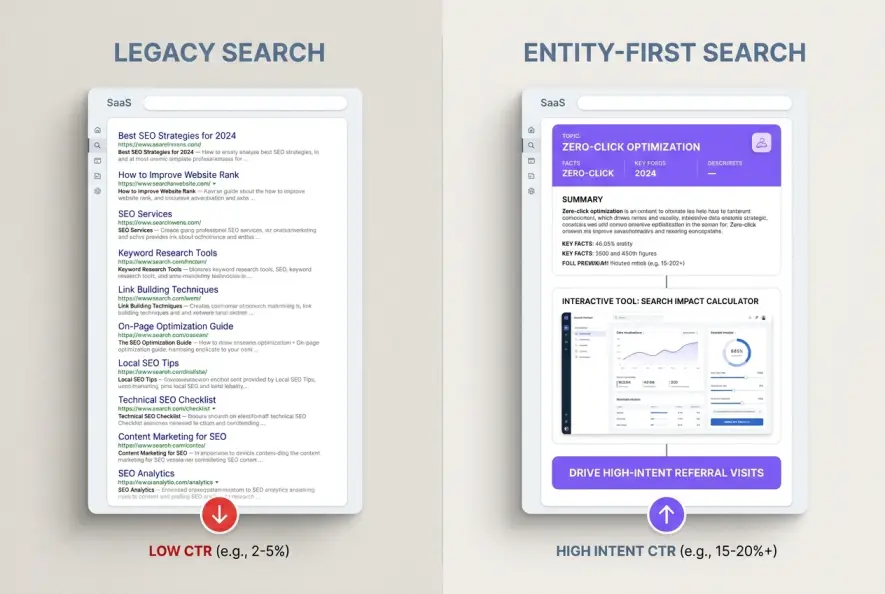
Additionally, make sure your on-page assets offer exclusive value that cannot be summarized in a search snippet. If an article provides a quick answer on the SERP, give readers a reason to visit by offering downloadable templates, interactive calculators, proprietary software tools, or deep-dive video walkthroughs.
When your page offers interactive tools or specialized utility, search engines can answer the basic concept on the SERP, but users who need actual execution will still click through to your platform.
Step-by-Step Tactical Workflow for 2026
If you want to audit your existing library and optimize for in-SERP presence, follow this four-step tactical workflow:
| Step | Focus Area | Actionable Execution |
|---|---|---|
| 1. Identify Targets | Search Console Audit | Filter for position 1–3 keywords with CTR below 3% where AI Overviews dominate. |
| 2. Restructure | Definition Snippets | Place 40–60 word declarative answers immediately below subheadings. |
| 3. Schema Markup | Entity Clarification | Deploy Article, Organization, and FAQPage JSON-LD schema across target pages. |
| 4. Value Anchors | Conversion Loops | Add interactive calculators or downloadable assets that require off-SERP visits. |
Step 1: Identify High-Impression, Low-CTR Keywords
Open Google Search Console and filter for queries where your site ranks in positions 1 through 3 but has a click-through rate under 3%. These are prime candidates where AI Overviews or featured snippets are satisfying user intent on the page.
Step 2: Restructure Headings for Answer Extraction
According to Google's Search Central documentation, search algorithms rely heavily on clear HTML heading structure to parse page content. Ensure your H2s use direct question phrasing (e.g., "What is zero-click search?") and immediately follow them with short, factual paragraph answers.
Step 3: Implement Rich Structured Data
Implement detailed Article, FAQPage, and HowTo Schema markup across all informational guides. Structured data gives search crawlers explicit metadata about your content entities, making it far easier for generative algorithms to digest and cite your text correctly.
Step 4: Audit and Refresh Stale Information
Search algorithms heavily prioritize freshness for zero-click answer blocks. Update your core posts with current statistics, revised steps, and fresh market data to maintain your positioning in dynamic AI summary modules.
Succeeding with zero-click search seo comes down to shifting your mindset from traffic hoarding to message distribution. By optimizing for maximum entity clarity and providing standalone value, you turn the search results page into your brand's biggest megaphone.
Artificial Intelligence
Intelligence without limits.
We believe great content deserves honest authorship—even when it's AI.
Frequently Asked Questions
No. While top-of-funnel informational traffic is decreasing, high-intent traffic for complex, transactional, or tool-based queries remains strong. Zero-click optimization helps capture brand awareness on broad queries while filtering for high-value visitors.
Track direct traffic growth, branded search impression volume, and view-through conversions in multi-touch attribution models. When users see your brand in AI Overviews, they often navigate directly to your site later.
You can use the max-snippet or nosnippet robots meta tags to restrict snippet generation, but doing so will also remove your content from traditional featured snippets and can harm overall organic rankings.
Clear paragraph definitions (40–60 words), numbered step-by-step lists, data tables, and bulleted takeaways are extracted far more frequently than long-form narrative text.
Schema markup clarifies relationships between entities, authors, and topics. It allows search engines to confidently verify facts on your page and credit your site as the source in generative summaries.
Yes. Focus on exact user questions and clear, intent-driven titles rather than clickbait phrasing. Matching the user's natural query structure makes it easier for algorithms to map your page to the search answer.