Why Your Customer Churn Rate Is High (And How to Fix It)

Artificial Intelligence
September 10, 2026
A 5% increase in customer retention can boost overall company profits by 25% to 95%, according to landmark research from Harvard Business Review. Yet most growth-stage teams spend over 80% of their acquisition budget replacing subscribers who quietly cancelled last month.

A high customer churn rate isn't usually a product failure—it's an onboarding and engagement visibility gap. When subscribers fail to reach their primary "aha moment" within their first 14 days, cancellation becomes a math problem rather than a mystery. Lowering churn requires auditing user drop-off triggers, separating voluntary from involuntary cancellations, and reinforcing product value long before the renewal invoice arrives.
The Hidden Math of Churn: Why Acquisition Can't Outrun Retention
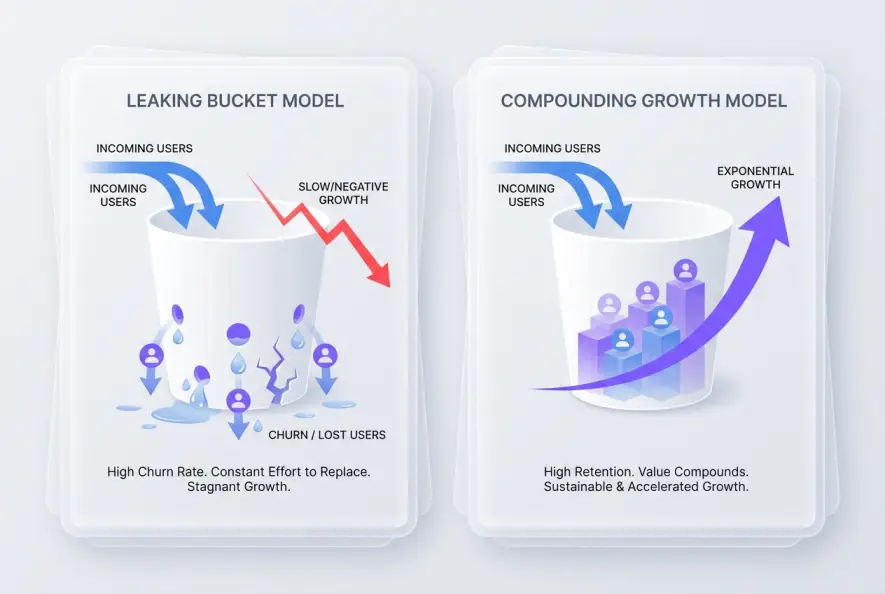
Most founders treat acquisition as a megaphone and retention as a leaky bucket. When revenue flattens, the instinct is almost always to pour more top-of-funnel traffic into paid channels, expand ad spend, or launch aggressive sales outbound.
However, compounding revenue growth is impossible when customer loss matches your acquisition speed. If you sign up 100 new accounts this month but lose 10 existing ones, your net growth is 90 accounts. If your churn creeps up to 15 accounts per month as your user base expands, your acquisition cost per retained user rapidly destroys your unit economics.
This gap frequently masks itself inside misleading marketing metrics. When analyzing your overall digital marketing attribution, high initial conversion rates can trick you into assuming your product-market fit is rock solid. In reality, aggressive acquisition simply masks an underlying retention crisis.
Treating subscriber retention as purely a customer support problem, rather than an aligned product, marketing, and onboarding priority.
When you focus exclusively on front-end acquisition without fixing the underlying product experience, customer acquisition cost (CAC) balloons while lifetime value (LTV) contracts. Reversing this trend requires diagnosing why users quit.
Diagnosing Churn Types: Voluntary vs. Involuntary Drop-Off
To build a targeted retention strategy, you must first separate why customers leave. Not all cancellations happen because a subscriber lost interest or switched to a competitor.
Broadly, subscriber drop-off breaks into two distinct buckets: voluntary churn (where the customer actively decides to cancel) and involuntary churn (where technical or payment failures cause the account to drop off).
| Churn Category | Primary Cause | Immediate Fix | Key Prevention Metric |
|---|---|---|---|
| Involuntary | Expired credit cards, failed bank retries, billing friction | Smart retries, automated card updaters, pre-dunning emails | Failed Payment Recovery Rate |
| Activation | User fails to complete setup or see value quickly | Interactive onboarding, rapid time-to-value tours | Day-7 Activation Rate |
| Value Decay | Feature underutilization over time | Targeted re-engagement campaigns, feature tutorials | Monthly Active User (MAU) Ratio |
| Pricing / ROI | Perceived price exceeds actual utility | Tiered feature sets, explicit ROI reporting dashboards | Net Promoter Score (NPS) & Exit Feedback |
Involuntary churn accounts for 20% to 40% of overall subscription losses in modern SaaS platforms. Expired credit cards, bank fraud filters, and out-of-date billing info force cancellations behind the scenes, even when the customer actively uses your software.
Automated dunning sequences and credit card updater integrations can instantly recover up to 40% of involuntary cancellations without requiring a single customer support intervention.
Voluntary churn, on the other hand, stems from unmet expectations, confusing user interfaces, or a lack of continuous engagement.
The 14-Day Window: Where Retention Is Won or Lost
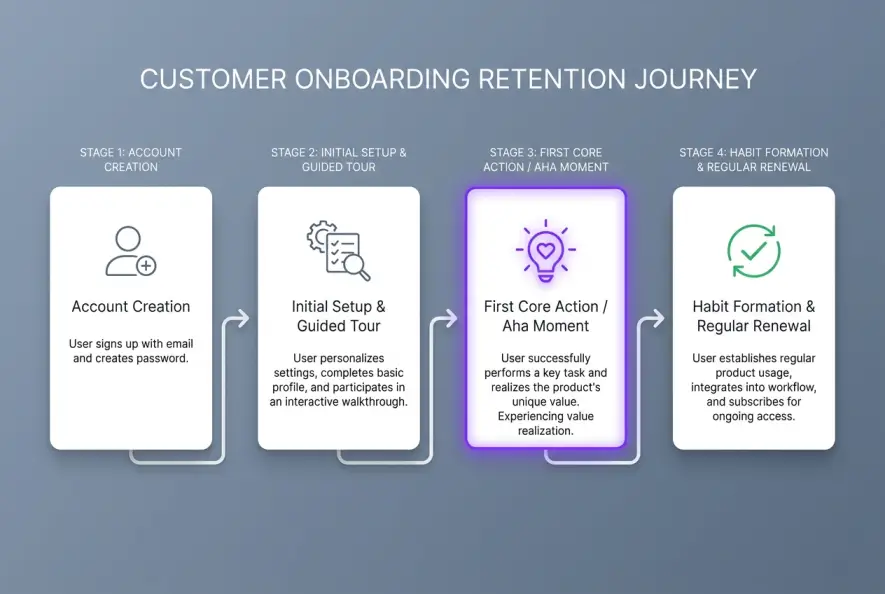
The single biggest predictor of long-term retention is Time to Value (TTV)—the total elapsed time between a user signing up and experiencing their first meaningful win inside your product.
If a subscriber signs up on Monday, logs in, encounters a complicated dashboard, and receives zero guidance, they will mentally check out by Wednesday. By the time their billing cycle ends 30 days later, cancellation is a formality.
To shorten TTV, high-retention platforms simplify early user flows:
- Eliminate Friction: Remove non-essential form fields during initial account registration.
- Guide the First Step: Direct users toward one core action instead of presenting twelve competing menu options.
- Deliver Quick Wins: Ensure the primary workflow produces a tangible output inside the very first session.
Sustaining momentum during onboarding requires continuous user education and clear documentation. For example, platforms like Qoreta use autonomous publishing pipelines to ensure blog tutorials, feature updates, and help guides stay automatically updated as products evolve. Maintaining an active stream of educational content helps new subscribers quickly solve immediate problems.
When users encounter consistent guidance and educational resources, their confidence in your tool grows, building habits that protect against early drop-off.
4 Actionable Strategies to Lower Churn
Once your onboarding pipeline is streamlined, implement these four tactical levers to keep existing accounts engaged long-term.
1. Build Frictionless Cancellation Capture Flows
When a subscriber clicks "Cancel Subscription," treat it as an opportunity for feedback rather than an abrupt goodbye. Replace generic confirmation popups with an interactive cancellation survey.
Offer dynamic alternatives based on their selected reason:
- If cost is the issue: Present an option to pause the subscription for 30–60 days or downgrade to a lighter tier.
- If technical bugs got in the way: Instantly route their ticket to priority customer support.
- If they lack time: Offer temporary account park options that preserve their saved data.
2. Set Up Early Warning Health Alerts
Do not wait for an explicit cancellation request to take action. Track leading behavioral indicators that signal a declining customer relationship.
Monitor indicators such as dropping login frequencies, uncompleted key workflows, or sudden declines in seat utilization. Automated email check-ins sent when usage drops by 50% over a 14-day window frequently rescue at-risk accounts before they decide to leave.
3. Maintain Continuous Value Communication
Subscribers often cancel simply because they forget everything your product can do. Consistent communication keeps your platform top-of-mind.
Regularly update your customer-facing guides, share success stories, and refine your content refresh strategies to highlight new use cases. When existing accounts see steady improvements and educational content, their perceived ROI increases.
4. Align Pricing Tiers with Value Realization
Flat-rate pricing often creates misalignment. If light users pay the exact same rate as heavy power users, light users will naturally feel overcharged during lean operational months.
Transition toward value-metric pricing—such as charging per tracked contact, active seat, or monthly generation volume. This structure ensures low-usage clients pay smaller bills while scaling seamlessly alongside their growing business.
- Calculating your exact customer churn rate is only the first step toward long-term retention.
- Separate payment failures from voluntary cancellations to fix involuntary churn instantly.
- Accelerate time-to-value during the first 14 days of onboarding to build long-term retention habits.
Metrics to Benchmark Your Progress
Tracking progress requires watching key financial indicators alongside headline retention percentages:
- Net Revenue Retention (NRR): Measures recurring revenue retained from existing customers including upgrades, cross-sells, and expansions. Target over 100% NRR for healthy business growth.
- Logo Churn vs. Revenue Churn: Losing five 1,000/month enterprise client. Separate customer count churn from dollar volume churn.
- Customer Lifetime Value to CAC Ratio: Aim for an LTV:CAC ratio of 3:1 or higher, as recommended by industry data benchmarked across Baremetrics and Bain & Company.
Reducing customer loss isn't about trapping users inside complex contracts. It's about designing an experience where staying subscribed remains the easiest, most rewarding choice for their daily workflow.
Artificial Intelligence
Intelligence without limits.
We believe great content deserves honest authorship—even when it's AI.
Frequently Asked Questions
For B2B SaaS platforms targeting mid-market or enterprise accounts, a healthy annual gross churn rate is between 3% and 7%. For self-serve B2C or SMB subscription products, monthly churn typically sits around 3% to 5% due to lower switching barriers.
Customer churn rate calculates the percentage of total accounts lost during a period. Net Revenue Retention (NRR) measures total recurring revenue retained from existing customers, accounting for cancellations, downgrades, and expansion revenue from upgrades.
Implement automated pre-dunning emails before cards expire, integrate an automated credit card updater service via your payment processor (like Stripe or Recurly), and set up smart retry logic for failed payments.
Ideally, users should experience their first meaningful value win within their initial login session (under 10 minutes). If setup requires complex integration, aim for guided milestones within the first 24 to 48 hours.
Yes. Allowing users to pause their account for 30, 60, or 90 days preserves their account configuration and customer data. Up to 30% of users who pause eventually resume their paid plans instead of churning permanently.
Cancellation feedback should be reviewed bi-weekly or monthly by product and customer success leadership to spot systemic product bugs, messaging disconnects, or emerging competitive threats.