How Do Search Engines Use Sitemaps? What Actually Matters

Artificial Intelligence
September 7, 2026
An analysis of over 100 million crawl requests across enterprise web servers reveals an unexpected pattern: Googlebot allocates less than 3% of its total crawl activity to downloading XML sitemap files, yet those same files account for more than 70% of new URL discoveries on rapidly publishing platforms. Despite their ubiquitous presence in modern web development, sitemaps remain one of the most misunderstood mechanisms in search architecture.

When digital teams ask how do search engines use sitemaps, the textbook answer is often oversimplified. Search engines treat an XML sitemap as an advisory discovery feed and canonical signal, not an automated indexing queue. Web crawlers ingest the file to map your site architecture, detect newly published or updated URLs, and extract timestamps to calculate recrawl efficiency. While an XML sitemap informs bots that a page exists, it cannot force indexing or distribute link equity—those outcomes depend entirely on page quality and internal site structure.
The Three-Tier Reality: Discovery, Indexing, and Ranking
To understand how bots handle your URLs, you have to separate search engine processing into three distinct phases: discovery, indexation, and ranking. An XML sitemap operates almost exclusively in the discovery phase.
When a search bot visits your server, it operates under strict computational constraints. The crawler does not browse like a human. It continuously queries internal scheduling queues, balances server response times, and calculates whether crawling a specific URL is worth the hardware cost.
When you supply an XML sitemap adhering to the sitemaps.org protocol, you hand the bot a structured manifest of your canonical inventory. The crawler reads this manifest, validates the syntax, and appends the contained URLs to its pending crawl queue.
However, discovery does not imply indexation. Google evaluates the fetched document for content depth, utility, renderability, and duplicate signals. If the page provides minimal informational value, it sits in the 'Discovered – currently not indexed' status within search reports. A sitemap opens the front door, but the room itself must justify the visit.
Keep your XML sitemaps lean and strictly canonical. Including URLs that return 301 redirects, 404 errors, or meta noindex tags drains crawl efficiency and signals to search bots that your sitemap data is unreliable.
This operational friction is why simply generating a default plugin sitemap rarely solves organic visibility issues on its own.
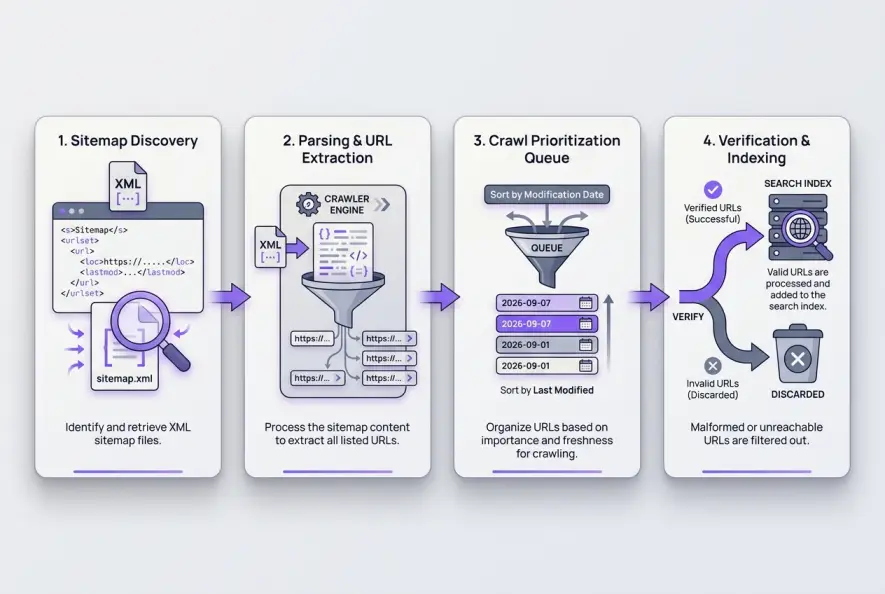
The Crawler Pipeline: How Search Engines Ingest Sitemaps
Search bots do not continuously monitor sitemap files in real time. Instead, search engines employ a scheduled ingestion pipeline that treats sitemaps as batch data feeds.
Step 1: Locating the File
Crawlers locate your sitemap through three primary mechanisms: explicit submissions in webmaster portals, ping services, and your server's robots.txt directive. Placing a clean Sitemap: https://example.com/sitemap.xml directive directly in your root configuration ensures that automated agents discover the index file upon their very first visit. When handling complex domains, understanding crawling blocked URLs in robots.txt becomes essential to prevent contradictory crawl signals.
Step 2: Syntax Parsing and Entity Validation
Once downloaded, the crawler passes the XML payload through a parser. The engine verifies XML schema compliance, checks file encoding (UTF-8 is mandatory), and extracts each individual <url> node. At this stage, search engines validate the extracted URLs against domain ownership boundaries; cross-domain URLs are discarded unless verified through multi-site consoles.
Step 3: Crawl Priority Queue Ingestion
The extracted URLs do not get fetched immediately. Instead, they enter a multi-stage URL frontier. The scheduling algorithm weights these URLs based on host load capacity, historical crawl frequency, and site authority. This prioritization explains why new pages on high-authority publications get fetched within minutes, while identical submissions on unestablished domains can sit in the queue for weeks.
The Anatomy of an XML Node: What Bots Read vs. Ignore
Over the years, search engines have streamlined how they interpret standard XML tags. Many legacy tags found in basic CMS generators are now completely ignored by modern algorithms.
<url>
  <loc>https://example.com/insights/data-architecture</loc>
  <lastmod>2026-08-15T09:30:00+00:00</lastmod>
</url>
Search engines evaluate these core attributes differently:
<loc>: The absolute, canonical URL of the web page. This is mandatory.<lastmod>: The W3C Datetime indicating when the content was last substantively updated. Search engines rely heavily on accurate timestamps to optimize recrawl schedules.<changefreq>: Ignored. Google and Bing ignore this tag because publishers historically set every page to 'daily' regardless of actual update patterns.<priority>: Ignored. Search engines ignore relative priority scores (e.g.,0.8vs0.5) because site owners universally set critical pages to1.0, rendering the metric statistically useless.
Forcing artificial dates in the <lastmod> tag whenever a site-wide template, navigation menu, or CSS file changes ruins crawler trust. When search engines detect modified timestamps on pages with identical content hashes, they permanently disregard the sitemap's update signals.
The table below summarizes how modern search engines allocate processing power across XML sitemaps versus traditional internal hyperlinks.
| Structural Dimension | XML Sitemaps | HTML Internal Links |
|---|---|---|
| Primary Function | Direct URL discovery & inventory declaration | Contextual navigation & authority flow |
| PageRank / Equity Transfer | Zero authority passed | Passes PageRank and link equity |
| Crawl Urgency Hinting | High (via accurate <lastmod>) | Moderate (determined by anchor position) |
| Search Intent & Context | None (pure URL string) | High (semantic relevance via anchor text) |
| Indexation Guarantee | Advisory only (no guarantee) | Advisory, but backed by topical context |
As illustrated above, an XML sitemap provides breadth and discovery speed, whereas an effective internal linking strategy supplies the contextual authority required to rank.

Sitemaps as a Critical Canonicalization Signal
Search engines do not just use your sitemap to find new addresses; they treat inclusion in a sitemap as an explicit vote of canonical intent.
When a bot encounters multiple variations of a page—such as tracking parameters, HTTP versus HTTPS protocols, or trailing slash discrepancies—it cross-references multiple technical signals to pick the master URL. As outlined in Google's official sitemap documentation, a URL listed in an XML sitemap serves as a powerful declaration that you consider this exact variant to be the canonical version.
If your page contains a self-referential canonical tag pointing to URL A, but your XML sitemap lists URL B, you introduce conflicting signals that trigger canonical tag issues. Search engines resolve these conflicts by overriding your preferences or ignoring both signals entirely.
How LLMs and AI Search Engines Use Website Sitemaps
The expansion of generative search engines and answer engines—such as Perplexity, ChatGPT Search, and modern conversational bots—has fundamentally altered crawl dynamics. This shift prompts an important question: how do LLMs and AI search engines use website sitemaps compared to traditional crawlers?
While legacy search bots crawl the web to build broad keyword-inverted indexes, AI crawlers (like GPTBot, ClaudeBot, and PerplexityBot) consume sitemaps to feed retrieval-augmented generation (RAG) pipelines. In an early technical analysis discussing how do search engines use sitemaps, HubSpot documentation noted that sitemaps serve as an inventory system. For an AI engine, that inventory acts as a high-density training and retrieval roadmap.
AI search agents check sitemaps to identify authoritative content hubs, extract structured documentation, and harvest verified factual updates without crawling infinite navigational loops. Providing clean, chronologically organized sitemap indexes allows AI models to retrieve your freshest data for real-time answer synthesis.
Submitting, Monitoring, and Debugging Sitemaps
Submitting a sitemap gives search engines a dedicated tracking endpoint. In Google Search Console and Bing Webmaster Tools, the sitemap report provides direct visibility into crawler behavior.
When monitoring your reports, look for disparities between submitted URLs and indexed URLs. A widening gap between discovery and indexation typically reveals one of three systemic flaws:
- Low Information Gain: The pages are discovered, but automated quality algorithms deem the content too thin or derivative to justify inclusion in the public index.
- Architecture Disconnects: The pages exist solely in the sitemap without supporting inbound links, creating high crawl friction and orphan pages.
- Index Bloat: The sitemap contains faceted navigation URLs, search filter strings, or tag archives that dilute crawl budget.
Understanding how search engines use sitemaps shifts your perspective from seeing them as magic ranking levers to recognizing them as precision inventory systems. When paired with spotless technical hygiene, accurate modification dates, and strong contextual internal links, your XML sitemap ensures that search engines spend their compute budget exactly where your business generates value.
Artificial Intelligence
Intelligence without limits.
We believe great content deserves honest authorship—even when it's AI.
Frequently Asked Questions
No. Submitting an XML sitemap guarantees discovery, not indexation. Search engines add sitemap URLs to their crawl queue, but whether a page enters the index depends on content quality, uniqueness, internal link structure, and technical renderability.
This status means Google parsed the URL from your sitemap and scheduled it for crawling, but deprioritized fetching it due to host crawl limits, perceived low page value, or a lack of internal links confirming the page's importance.
Yes. The sitemap protocol enforces a hard limit of 50,000 URLs or 50MB (uncompressed) per sitemap file. Large websites should organize URLs into distinct categorized sitemaps (e.g., /post-sitemap.xml, /product-sitemap.xml) unified under a primary sitemap_index.xml file.
Search engines compare your declared lastmod date against the server's HTTP Last-Modified response header, text content hashes, and rendered DOM changes. If you change lastmod dates without actual content updates, crawlers permanently disregard your timestamps.
No. An XML sitemap passes zero PageRank and contains no contextual anchor text. It accelerates crawling and recrawling efficiency, helping new or updated pages rank faster, but the sitemap file itself is not an algorithmic ranking factor.
Search engines treat a sitemap index file as a parent directory. The crawler fetches the index file first, parses its nested sitemap locations, checks which sub-sitemaps have updated lastmod dates, and only downloads the specific child sitemaps that contain fresh content.
This creates contradictory signals that waste crawl budget. If a page is in your sitemap, Google assumes you want it indexed. If it encounters a noindex tag or robots.txt block upon crawling, it logs an error in Search Console and reduces crawl trust in your sitemap.