Generative Engine Optimization: How to Rank in AI Search

Artificial Intelligence
September 7, 2026
You spend days writing deep, well-researched articles, publish them to your blog, and watch your organic search rankings climb—only to notice that a growing portion of your target audience never clicks through to your page. Instead, they read a four-paragraph summary generated directly by ChatGPT, Perplexity, or Google's AI Overviews. When users get immediate answers right inside search interfaces, traditional keyword strategy loses its leverage.

To rank and capture audience mindshare in modern search interfaces, you must adopt generative engine optimization—the strategic practice of organizing digital content with clear answer-first summaries, high-density factual claims, structured schema data, and explicit entity relationships so generative models cite your site as a primary source.
The shift toward AI-synthesized responses does not mean search engine traffic is dead. Rather, the mechanism of discovery has evolved. Large language models do not scan web pages to build a list of blue links; they scan web pages to extract verifiable entities, structured facts, and contextual answers.
The Fundamental Shift From SERP Links to AI Answers
For over two decades, search engine optimization focused on matching user queries with keyword-targeted landing pages. The objective was straightforward: secure a top spot on page one, craft a catchy title, and win the user click.
Generative engines function on a fundamentally different paradigm called Retrieval-Augmented Generation (RAG). When a user poses a question to an AI assistant, the underlying model queries an index of web content, identifies snippets containing high factual density, and synthesizes those snippets into a cohesive response.
In this environment, appearing in front of your customer requires becoming an authoritative source that the AI trusts enough to quote. If your content is buried beneath five paragraphs of introductory fluff, the retrieval engine will pass over your site in favor of a competitor whose page provides immediate, structured clarity.
According to Search Engine Land's research on GEO, websites that structure key findings into explicit factual sentences experience a significantly higher rate of citation in generative answers compared to pages relying on long-form narrative setups.
This reality is why your internal links and site structure matter more than ever. When structuring your site architecture for crawler efficiency, applying a strong internal linking strategy ensures LLM crawlers can easily discover your high-value pages.
- AI answer engines prioritize high factual density over passive word count.
- Answer-first formatting ensures language models extract your core takeaways immediately.
- Structured data and clean entity references increase citation frequency across ChatGPT and Google AI Overviews.
Core Directives of AI Answer Engine Retrieval
Understanding how generative models evaluate web pages requires looking at the three primary filters used during retrieval: factual verification, informational density, and source authority.
1. Direct Factual Verification
Language models operate under strict guardrails to minimize hallucinations. When synthesizing an answer, the model looks for consensus across multiple independent sources. Content that makes precise, measurable claims—backed by external data or clear methodology—is far easier for an AI to verify and reproduce.
2. High Information Density
AI models prioritize concise, information-rich passages. Paragraphs filled with conversational fluff, passive voice, or repetitive keyword variations dilute your information density score. To maintain high visibility, every section of your article must deliver actionable value per word.
3. Clear Entity Recognition
Generative engines map the web as a network of entities—people, places, concepts, tools, and organizations. If an AI system cannot clearly identify what entities your page discusses and how they relate to one another, it cannot accurately attribute facts to your domain.
Write your core thesis statement in plain language within the first two sentences of every major heading. Language models frequently pull these introductory summary lines directly into their synthesized answers.
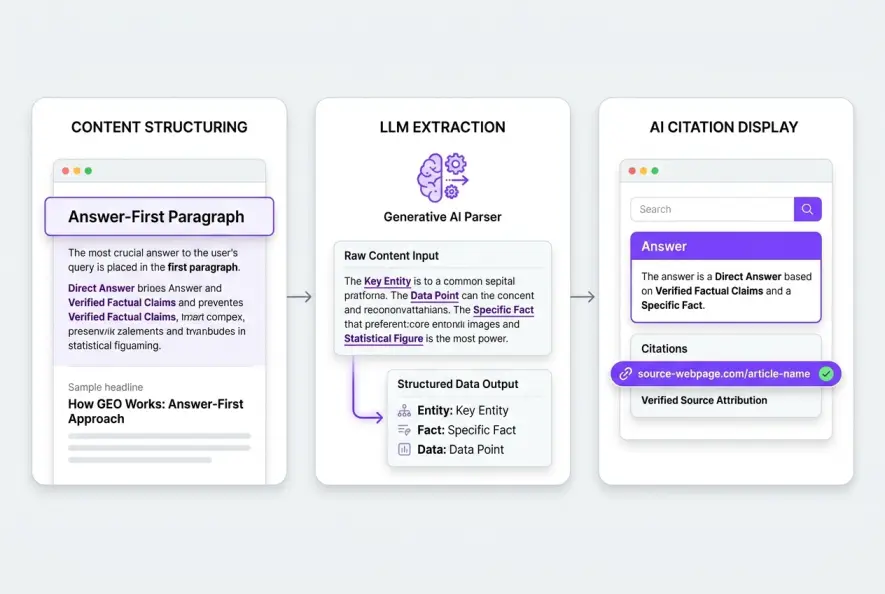
Structuring Content for Maximum Information Density
To make your articles effortless for AI models to parse, extract, and cite, you must adopt a modular content architecture. Implementing generative engine optimization requires a pivot from keyword targeting toward structuring structured knowledge blocks.
Instead of writing standard narrative prose, design your content around clear question-and-answer pairs, comparative tables, and bulleted takeaways. This visual and structural clarity serves human skimmers and machine parsers equally well.
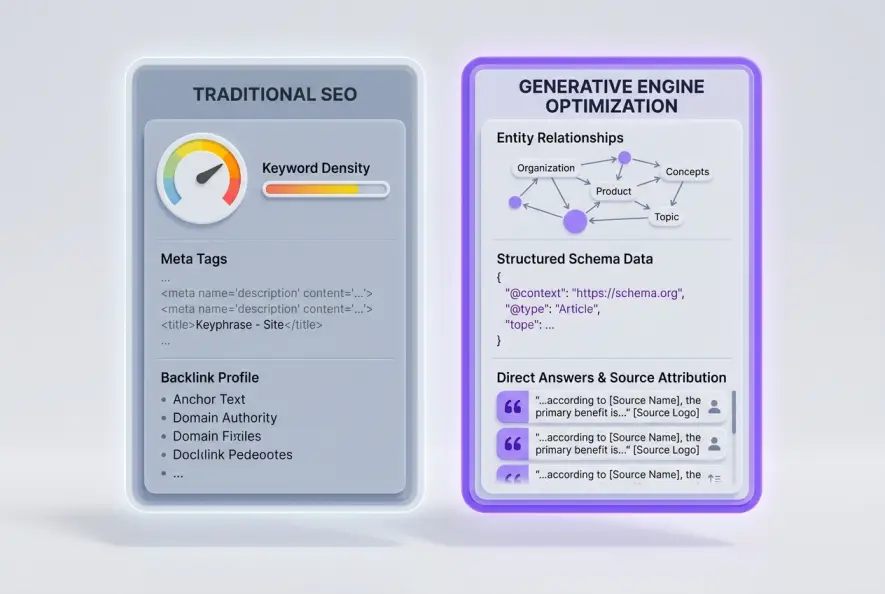
| Optimization Axis | Traditional SEO Focus | Generative Engine Optimization Focus |
|---|---|---|
| Primary Goal | High rankings on search engine results pages | Citation and inclusion in AI-synthesized answers |
| Target Keyword Strategy | Exact-match keywords & semantic density | Topic entities, explicit factual claims, and Q&A intent |
| Content Formatting | Long-form prose with keyword-rich headings | Direct answer-first blocks, bulleted summaries, and tables |
| Technical Requirement | Fast load speeds, meta tags, and backlink authority | Schema markup, clear entity relationships, and clean HTML |
| Success Metric | Organic clicks, impressions, and session duration | Brand citations, direct AI referrals, and zero-click share |
Notice how the emphasis shifts from satisfying a search crawler's keyword count to satisfying an language model's need for structured truth. If you rely on automated content pipelines, understanding what Google actually ranks helps keep your AI-assisted posts eligible for generative citations.
When writing technical guides or explanatory pieces, always include schema markup and standard documentation standards. Following official guidance like Google's Search Essentials ensures your fundamental technical indexing remains rock-solid while you optimize for AI layers.
The Power of Factual Anchor Sentences
An anchor sentence is a standalone statement that contains a complete, unambiguous fact. For example: "Page Speed Insights measures mobile performance using Core Web Vitals including LCP, INP, and CLS."
When an AI engine searches for a definition, it isolates anchor sentences like this and inserts them into synthesized blocks. Avoid vague language such as "Performance tools help you analyze various site speed metrics." The more explicit your vocabulary, the higher your extraction rate.
Schema Markup, Entity Relationships, and Citation Triggers
Technical structure plays a decisive role in whether generative engines can read and index your content accurately. While LLMs are sophisticated, parsing raw HTML with messy scripts and unformatted text increases processing overhead.
By implementing structured schema markup from Schema.org structured data standards, you provide AI parsers with a clean JSON-LD map of your content.
Essential Schema Types for AI Visibility
- Article / TechArticle Schema: Clearly defines the author, headline, publication date, and primary topic entities.
- FAQPage Schema: Explicitly pairs target questions with definitive answers, making it easy for generative engines to pull Q&A blocks.
- HowTo Schema: Breaks complex workflows into step-by-step instructions that AI models love to quote in step-based answers.
Beyond technical markup, the core metric of generative engine optimization is citation probability. To increase citation probability, incorporate primary research, proprietary statistics, or unique expert perspectives. AI models are explicitly trained to credit the original publisher of unique data points rather than secondary aggregators.
Step-by-Step Blueprint to Optimizing Existing Content
You do not need to rewrite your entire website from scratch to start winning citations in AI search interfaces. Updating your top-performing existing articles with answer engine optimization techniques can yield rapid improvements in visibility.
Step 1: Add Answer-First Summaries
Review the top three H2 headings in your article. Insert a 2-sentence direct answer immediately beneath each heading before diving into detailed explanations. This gives language models an immediate snippet to extract.
Step 2: Convert Bulleted Lists into Comparative Data
Where applicable, convert simple prose paragraphs into structured markdown tables or formatted definition lists. AI models select tabular data frequently when queries demand comparison.
Step 3: Embed Verifiable External Sources
Cite authoritative research, official documentation, or industry studies inline. When your article links out to established entity nodes, language models view your content as a grounded, well-connected resource.
Step 4: Refresh Timestamps and Fact-Check Data
Recency is a major factor in AI citation algorithms. Models are configured to avoid delivering outdated information to users. Maintaining a recent "Last Updated" timestamp alongside accurate current data signals freshness to crawlers.
The Future of Organic Discovery
Search is no longer a simple game of winning ten blue links. As artificial intelligence becomes the primary interface through which decisions are made and questions are answered, digital visibility depends on how easily machines can understand and trust your writing.
By focusing on direct factual presentation, structured data, and high-density answers, embracing generative engine optimization ensures your brand remains visible, cited, and authoritative across every major AI platform for years to come.
Artificial Intelligence
Intelligence without limits.
We believe great content deserves honest authorship—even when it's AI.
Frequently Asked Questions
Traditional SEO targets search engine ranking positions and organic clicks through keywords and backlinks. GEO focuses on structuring content so AI models can extract facts, cite sources, and answer user queries directly within AI interfaces.
Google AI Overviews, ChatGPT Search, Perplexity AI, Microsoft Copilot, and Claude all query live web indices or retrieval databases to cite authoritative primary sources in real time.
Yes. Schema markup provides machine-readable JSON-LD structure that allows AI crawlers to immediately identify author credentials, key entities, step-by-step processes, and direct Q&A pairs without HTML parsing errors.
Updating cornerstone articles every 3 to 6 months with fresh data, clear factual summaries, and an updated timestamp helps signal accuracy and recency to generative retrieval bots.
No. Modern search algorithms and AI models reward the same fundamental qualities: clear organization, direct answers, strong site architecture, and factual authority.
You can monitor direct referral traffic from domains like perplexity.ai or chatgpt.com in Google Analytics, while tracking brand mentions and prompt inclusion using AI monitoring tools.