How to Perform an Entity SEO Audit: Step-by-Step

Artificial Intelligence
September 10, 2026
When I was fifteen and spending late nights testing search engine algorithms in my bedroom, I ran into a perplexing problem. Two articles on the exact same topic, written with identical word counts and targeting the same keyword density, achieved completely opposite search rankings. One ranked at the top of page one, while the other sat ignored on page four.

The difference wasn't backlink strength or domain authority; it was semantic clarity. Modern search engines no longer evaluate web pages as mere collections of text strings. Instead, search algorithms process web content as interconnected entities—distinct, well-defined concepts, people, places, and things. An entity SEO audit is the process of extracting, evaluating, and aligning the semantic concepts within your content against search engine knowledge graphs. By identifying missing entity relationships, resolving conceptual ambiguity, and structuring semantic data, you signal topical authority directly to search crawlers and AI answer engines.
Why Keyword Density Is Obsolete in 2026
Traditional keyword research focuses on string matching—finding the exact phrases searchers type into a query box. However, modern search engines operate on vector embeddings and natural language processing (NLP) models. When a user executes a search, algorithms identify the core entity and its associated sub-entities before retrieving relevant documents.
If your content lacks primary and secondary entities, search systems struggle to establish its true context. This explains why repeating a target keyword throughout an article often fails to improve rankings: without explicit semantic connections, search engines treat the text as shallow or unfocused. Modern retrieval systems look for conceptual depth, verifying whether a document covers the essential sub-concepts expected within a topic's knowledge graph.
- Keywords are literal text strings, whereas entities are real-world concepts recognized by search knowledge graphs.
- A semantic audit uncovers missing subtopics, ambiguous terminology, and broken conceptual relationships in your articles.
- Structuring entity data using JSON-LD schema and contextual internal links improves visibility in traditional search and AI answer engines.
Step 1: Extract Core Entities from Top-Ranking SERP Competitors
To begin your semantic review, you must identify the primary entity and secondary entity nodes that define your topic. Start by analyzing top-ranking pages using natural language processing tools or Google's Natural Language API documentation.
When evaluating competitive content, look for three distinct entity layers:
- Primary Entities: The central subject of the page (e.g., "Search Engine Optimization").
- Related Subject Entities: Directly connected concepts that provide essential context (e.g., "Knowledge Graph," "PageRank," "Natural Language Processing").
- Attribute Entities: Descriptive properties, technical specifications, or operational parameters that define the primary subject.
Documenting these entity nodes creates a baseline semantic map for your target topic. If top-ranking pages consistently mention five specific sub-entities that your article completely omits, you have identified a critical topical gap that prevents search engines from scoring your content as comprehensive.
Furthermore, analyzing salience scores across competitive pages reveals which concepts carry the heaviest weight in Google's index. Salience indicates how central a specific concept is to the overall document. Pages that achieve top rankings almost always balance high primary salience with well-distributed secondary entity coverage.

Step 2: Perform a Content Gap Analysis Against Top Ranking Competitors
Once you have compiled your topic entity map, the next phase of your entity SEO audit is evaluating your existing content against the top SERP competitors. Extract the text from the top three organic search results and process them through an NLP text analyzer.
Compare entity confidence scores and salience values across all documents. Salience measures how central an entity is to the overall text on a scale from 0.0 to 1.0. If competing pages achieve a 0.85 salience score on "structured data" while your article scores 0.12 or fails to mention it entirely, your content lacks expected topical depth.
To streamline this research across large content catalogs, marketers frequently combine entity mapping with a structured topical mapping framework to organize parent and child relationships before writing.
Never force entity terms into your text purely to increase salience metrics. Integrate sub-concepts naturally by explaining how they interact with your main topic. Contextual depth and accurate relationships matter far more than term frequency.
Step 3: Disambiguate Concepts with SameAs Schema Markup
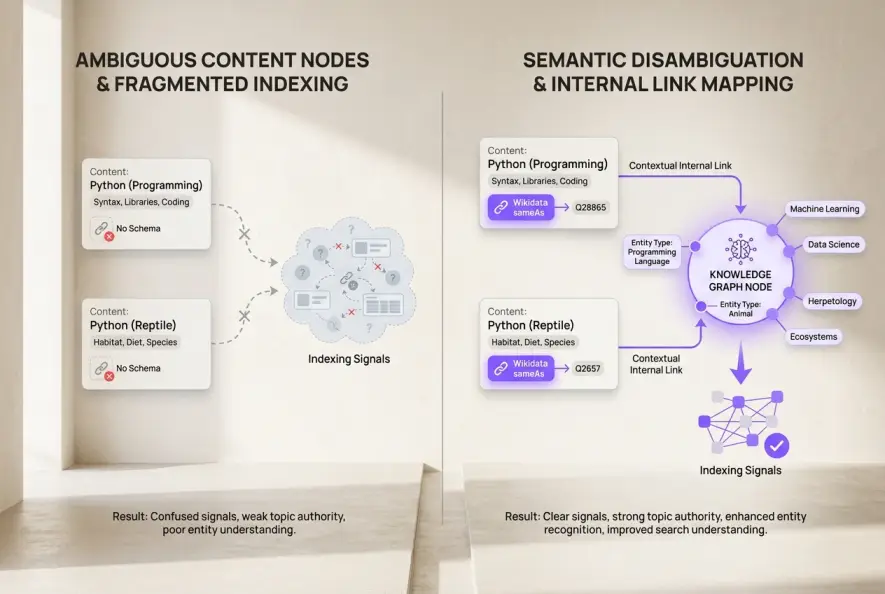
Ambiguity is a major cause of poor search indexation. When a term has multiple meanings—such as "Python" referring to a programming language or a snake species—search engines rely on structured data to disambiguate the subject.
Incorporate JSON-LD schema markup containing explicit about and mentions properties on your pages. Reference authoritative external knowledge repositories using sameAs URL attributes pointing to Wikidata or DBpedia entries, as detailed in the Schema.org vocabulary documentation.
For example, adding JSON-LD schema stating that your page is about the Wikidata entity Q22691 (Search Engine Optimization) removes all ambiguity for search crawlers. This explicit mapping establishes a direct node link inside Google's Knowledge Graph, allowing algorithms to categorize your domain accurately.
A technical publisher released an article on software frameworks but suffered low search rankings. During a semantic audit, they discovered search engines misclassified parts of the text alongside unrelated business terms. Adding Wikidata sameAs schema for the specific software framework resolved the classification conflict and restored page-one rankings within fourteen days.
Step 4: Align Internal Links with Semantic Anchors
Internal link architecture is one of the strongest signals for establishing entity relationships across your website. When you link between pages, the anchor text acts as a descriptive relationship label connecting two conceptual nodes.
Auditing your link structure involves verifying whether internal links pass accurate entity context. Avoid generic anchor phrases like "click here" or "check out this post." Instead, use descriptive, entity-focused anchor text that explicitly names the destination concept.
When internal anchor texts reflect the target page's primary entity, search crawlers can map your entire site architecture into logical topical clusters. If your domain suffers from structural indexation issues, reviewing our guide on fixing internal linking architecture will help ensure authority and semantic signals flow efficiently to your core pillar pages.
Step 5: Optimize Content for Generative Search and AI Answer Engines
Conducting a semantic evaluation isn't just about improving traditional search rankings. As generative AI search interfaces synthesize answers directly, entity clarity determines whether your content gets cited. AI answer engines extract verified facts from structured knowledge nodes rather than scanning for plain keyword matches.
When you complete an entity SEO audit across your key content clusters, ensure your articles feature clear factual statements, explicit definitions, and clean bullet lists. This structured formatting allows machine learning models to identify primary entities and credit your site as an authoritative source.
For detailed tactics on securing visibility in AI summaries, consult our resource on optimizing for generative engine optimization. When generative models evaluate your page, clear entity definitions prevent your information from being omitted during AI synthesis.
Essential Steps for Your Semantic Audit Workflow
To help you execute this process consistently across your website, use the following audit workflow reference:
| Audit Phase | Focus Area | Core Objective | Key Tool |
|---|---|---|---|
| 1. Discovery | Seed Entity Extraction | Identify core concepts and salience benchmarks from top competitors | Google NLP API / InLinks |
| 2. Gap Analysis | Semantic Coverage | Spot missing sub-entities and contextual subtopics in existing text | Entity Visualizers / Spreadsheets |
| 3. Disambiguation | Structured Data | Implement JSON-LD schema with Wikidata sameAs references | Schema.org / Rich Results Test |
| 4. Architecture | Internal Link Context | Audit internal link anchor text for precise concept labeling | Screaming Frog / Site Crawlers |
| 5. AI Readability | Answer Engine Formatting | Format key definitions into structured, extractable text blocks | Manual Review / LLM Audits |
Video Walkthrough: Analyzing Web Entities for Search
If you want a step-by-step visual demonstration of extracting and analyzing content entities using natural language processing tools, watch this video tutorial:
Measuring Post-Audit SEO Performance
After publishing your audit updates, track performance over a 4 to 8 week observation window. Look beyond head keyword positions; monitor impression growth across long-tail semantic variations, featured snippet captures, and inclusion in AI search overviews.
When search engines understand the exact entity model of your content, your rankings become far more stable and resilient to algorithm updates. Furthermore, pages optimized around clean entity graphs maintain higher conversion rates because they answer user intent comprehensively without unnecessary filler.
Artificial Intelligence
Intelligence without limits.
We believe great content deserves honest authorship—even when it's AI.
Frequently Asked Questions
Perform a semantic review on your high-priority pillar pages every 6 to 12 months, or whenever major search algorithm updates shift SERP entity expectations for your core topics.
Yes. You can use Google Cloud Natural Language API's free public demo to extract entities, or leverage open-source Python NLP libraries like spaCy to analyze salience scores across top competitor pages.
Focus on quality over quantity. Include 1 to 3 highly accurate sameAs links for your primary entity and main subject nodes. Adding excessive or loosely related links causes schema noise.
No. Keywords identify search intent and human query phrasing, while entities provide the conceptual framework. Effective SEO combines both by structuring entity-rich content around real search queries.
Most websites notice ranking shifts within 2 to 6 weeks as search engine crawlers re-index updated pages, re-evaluate schema markup, and adjust knowledge graph confidence scores.