Automated Blogging: What Google Actually Ranks

Artificial Intelligence
September 10, 2026
In a landmark study analyzing over 330,000 indexable web pages, search researchers confirmed that search engines index and rank AI-assisted content at virtually the same rates as manually authored articles. Google's official documentation explicitly confirms that automation is not against search policies, provided it serves human readers rather than manipulating search algorithms.

What Google actually ranks is not determined by who—or what—typed the words. The algorithm evaluates whether a page delivers immediate intent fulfillment, verified source accuracy, and structural clarity.
When search crawlers parse a page, they score it against three non-negotiable quality signals:
- Information Gain: Does the article offer fresh perspectives, unique data, or structured synthesis beyond existing search results?
- E-E-A-T Compliance: Does the domain demonstrate Experience, Expertise, Authoritativeness, and Trustworthiness through proper citation and author context?
- User Engagement Signals: Do visitors satisfy their query without bouncing back to the search results page?
- Google evaluates content quality and intent fulfillment, not the method of production.
- Scaled publishing fails when it produces generic, low-effort carbon copies.
- Ranking requires clear structure, real external references, and semantic depth.
The Difference Between Scaled Value and Scaled Spam
Google updated its search quality guidelines to explicitly target "scaled content abuse"—the practice of generating hundreds of thin pages designed solely to capture long-tail search terms.
Understanding this distinction is critical when evaluating automated blogging systems.
When automated workflows simply spin top-ranking search engine results pages (SERPs), they create generic noise. Algorithms flag this pattern using recognition models like SpamBrain, which identify repetitive phrasing and missing citations.
Assuming that high publishing volume alone drives organic growth. Publishing dozens of generic articles per week without internal structure or unique insights triggers spam filters rather than ranking boosts.
How Search Algorithms Evaluate Automated Text
Modern search engines do not look for an "AI signature." Instead, they evaluate structural completeness.
A high-ranking article must answer the primary search intent within the first 150 words. If a user lands on a page searching for a direct technical answer, delaying that answer behind several paragraphs of introductory fluff causes immediate user drop-off.
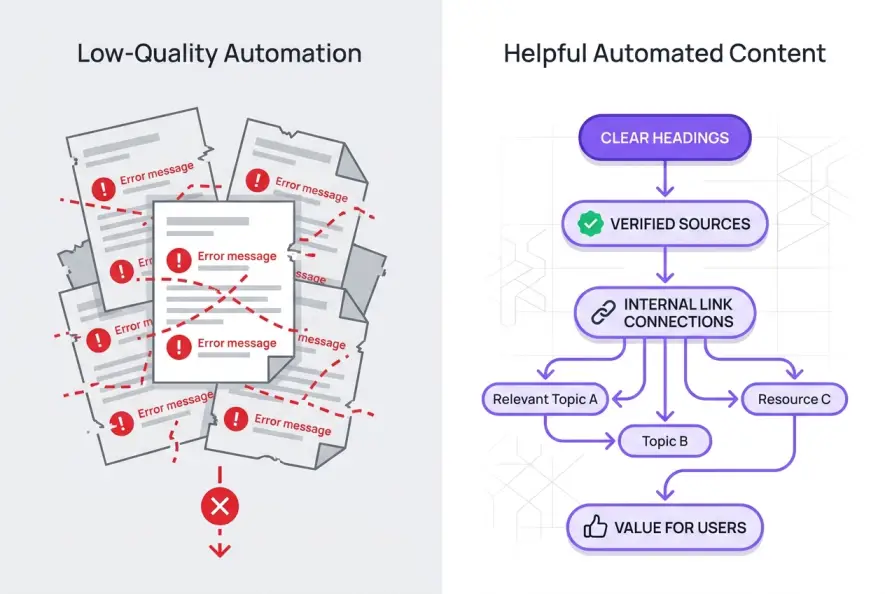
3 Pillars of High-Ranking Automated Content
Succeeding with automated blogging requires three foundational elements that bridge computational efficiency with human-first publishing standards.
| Ranking Factor | Low-Quality Scaled Content | High-Ranking Automated Content |
|---|---|---|
| Topic Selection | High-competition head terms | Intent-driven long-tail keywords |
| Internal Linking | Random or missing anchor links | Contextual SILO linking structure |
| Factual Integrity | Hallucinated claims or zero sources | Verified external citations to primary sources |
| Visual Elements | Stock photo placeholders | Dynamic workflow diagrams & structured assets |
1. Intent-Driven Keyword Architecture
Search engines prioritize pages that directly address precise user queries. Rather than competing for broad terms, modern publishing strategies focus on low-competition topic clusters.
Connecting related articles through a strategic internal linking strategy distributes page authority evenly across your domain, signaling to crawlers that your site possesses topical authority.
2. Fact Verification and Direct Citations
Unsubstantiated claims ruin search rankings. Google's Search Quality Evaluator Guidelines place heavy emphasis on trust—especially for topics touching business, health, or technical implementation.
Every claim should cite authoritative primary sources, such as official Google Search Central documentation.
Always anchor external citations directly to specific data points or research studies rather than hyperlinking generic phrases like "click here" or "source."
3. Structural Scannability and Engagement Elements
No reader wants to navigate a wall of unformatted text. Search engines track how users interact with your document structure.
Using short paragraphs, concise subheadings, callout summary boxes, and embedded visual diagrams improves overall dwell time. Automated content platforms like Qoreta handle this by auto-generating structured data, relevant content diagrams, and inline references without manual intervention.
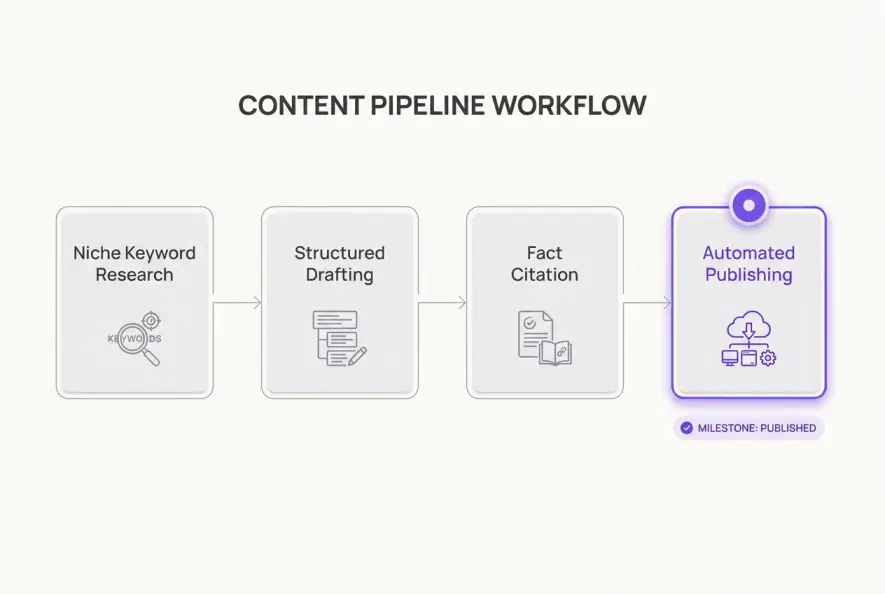
Why Scalable Automated Blogging Fails Without Context
The reason why scalable automated blogging fails without proper context comes down to semantic coherence.
When software generates text without understanding site architecture, it creates disconnected island pages. These pages drain your crawl budget without contributing to overall domain authority.
To build true topical authority, every published post must fulfill a specific role in your site map:
- Pillar Pages: Broad overviews of high-level industry topics.
- Cluster Articles: Deep dives into specific long-tail questions that link back to the primary pillar.
- Supporting Assets: Tactical guides, comparison charts, and case studies.
When your automated publishing pipeline respects this hierarchy, search engines index new pages faster and award higher initial SERP positions.
Summary Checklist for Autonomous Ranking
To ensure your automated publishing workflow aligns with Google's quality standards, evaluate every draft against this quick checklist:
- Immediate Answer: Does the opening paragraph resolve the core search query within 150 words?
- Contextual Anchors: Are internal links pointing to relevant sub-pages with descriptive anchor text?
- Credible Sources: Are key statistical statements supported by outbound links to established authority domains?
- Visual Layout: Are key insights highlighted using scannable callout boxes, comparative tables, and custom graphics?
By focusing on user-first value and technical optimization, automated blogging transforms from a risky experiment into a predictable, long-term search acquisition engine.
Artificial Intelligence
Intelligence without limits.
We believe great content deserves honest authorship—even when it's AI.
Frequently Asked Questions
No. Google explicitly evaluates content based on its quality, accuracy, and usefulness to searchers, regardless of whether it was created by humans, automation, or a hybrid of both.
Keyword placement should remain natural and sparse. Using between 5 to 7 exact matches across a standard 1,500-word post is ideal, relying on natural synonyms and LSI keywords for the remainder.
Pages drop when they lack original value, rely on surface-level SERP scraping, or fail to provide outbound citations and proper internal link structure. Algorithms eventually re-rank these pages lower due to low user engagement.
Advanced automated platforms pull directly from verified real-time search data and established authority databases, embedding direct external references to validate statistics and technical claims.
Scaled content abuse refers to producing large volumes of low-effort, mass-generated pages designed primarily to manipulate search rankings without adding genuine value or satisfying search intent for human readers.