Vector Search SEO: How AI Search Engines Rank Content

Artificial Intelligence
August 18, 2026
Search engines no longer interpret your website as a simple collection of literal text strings; over 70% of modern information retrieval architectures now rely on dense vector embeddings rather than raw keyword frequencies. When a user enters a query today, neural networks translate those words into a multi-dimensional mathematical coordinate, comparing it against billions of indexed web pages positioned across the exact same conceptual landscape.

Vector search SEO is the practice of structuring and writing digital content so neural search engines can accurately map its underlying meaning into high-dimensional vector space. Rather than evaluating how many times a specific phrase appears on a page, AI search systems measure geometric distance—most commonly cosine similarity—to determine how closely your content fulfills the user's intent. To rank consistently in this environment, publishers must shift from keyword density to topical completeness, logical passage chunking, and clear entity relationships.
This fundamental shift explains why pages stuffed with exact-match phrases are quietly losing ground to comprehensive, structured guides that never mention the exact keyword at all.
From Keywords to Coordinates: How Vector Embeddings Work
Traditional search algorithms relied on lexical matching, such as the BM25 scoring algorithm. If a user searched for "best way to fix bicycle chain slip," the engine searched its index for documents containing the words "fix," "bicycle," "chain," and "slip." If an article used the phrase "repair slipping bike drivetrain," an exact lexical engine might miss it entirely.
Vector search eliminates this limitation. Language models convert text into embeddings—long arrays of floating-point numbers that capture semantic meaning, context, and nuance. In an embedding model like BERT or modern multi-stage retrieval systems, words and concepts with similar meanings are positioned close together in high-dimensional vector space.
Vector Embedding: A numerical representation of text where words, sentences, or entire documents are converted into dense mathematical coordinates, allowing search engines to evaluate conceptual similarity based on geometric proximity rather than exact keyword matches.
When a search query is submitted, the search engine generates a vector for the query and retrieves the closest matching document vectors. If your content sits in the same semantic neighborhood as the searcher's problem, your page is retrieved—regardless of the specific vocabulary you chose.
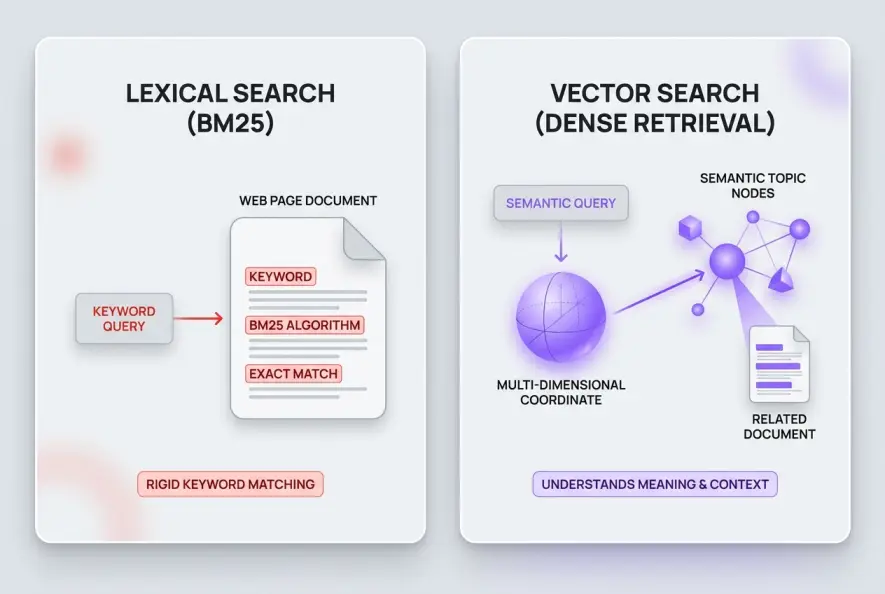
The Architecture of Dense Retrieval in Modern Search Engines
Modern search engines do not rely on a single algorithm; they use a multi-stage retrieval pipeline. Understanding these layers is crucial for diagnosing why your pages rank or stall in competitive SERPs.
- First-Stage Retrieval (Candidate Selection): The engine casts a wide net across billions of documents. Modern systems use bi-encoders to rapidly compare the query vector against pre-computed document embeddings, narrowing billions of pages down to the top few hundred candidates in milliseconds.
- Late Interaction and Re-Ranking: Advanced models, such as ColBERT (Contextualized Late Interaction over BERT), compare individual token vectors across the query and candidate documents. This preserves fine-grained context while maintaining retrieval speed.
- Cross-Encoder Scoring: The top candidates are evaluated by a computationally heavy cross-encoder that assesses deep semantic relevance, passage structure, and factual coherence.
| Search Dimension | Traditional Lexical Search (BM25) | Dense Vector Retrieval | Hybrid Search (Modern SERPs) |
|---|---|---|---|
| Core Mechanism | Inverted index & keyword frequency | High-dimensional geometric distance | Reciprocal Rank Fusion (BM25 + Vectors) |
| Synonym Handling | Requires manual synonym dictionaries | Native understanding of semantic context | Captures both exact terms and conceptual intent |
| Query Sensitivity | Fails on conversational or ambiguous queries | Excels at intent and long-tail nuance | Balances technical terms with conversational queries |
| Key Ranking Factor | Keyword density, URL strings, exact tags | Entity relationships & passage coherence | Holistic authority, exact matches, & semantic depth |
For a deeper technical look into how vector embeddings power similarity matching in production retrieval systems, reviewing industry documentation from Pinecone's vector search guide and Hugging Face's embeddings resources provides concrete architectural context.
Why Traditional Keyword Optimization Fails Vector Models
For two decades, SEO playbooks instructed writers to repeat their primary target keyword in the H1, the first 100 words, multiple H2 subheadings, and the conclusion. In a vector-driven search environment, this practice often backfires.
When you force an exact phrase repeatedly into a section where it does not naturally belong, you introduce semantic distortion. Neural embedding models analyze the entire contextual window of a paragraph. If you pad an explanation with repetitive keyword variations, you dilute the specific mathematical signal that defines the core topic of that section.
Repeating exact focus keywords across every subheading and introductory sentence. This creates repetitive vector profiles that degrade the contextual clarity of your sub-passages, lowering your document's similarity score for related long-tail queries.
Vector models evaluate whether a passage answers a question completely and authoritatively. If an H2 promises an answer to "how vector indexing works" but spends three paragraphs repeating the focus keyword before delivering a shallow summary, the model scores that passage as low relevance compared to a concise, entity-rich explanation.
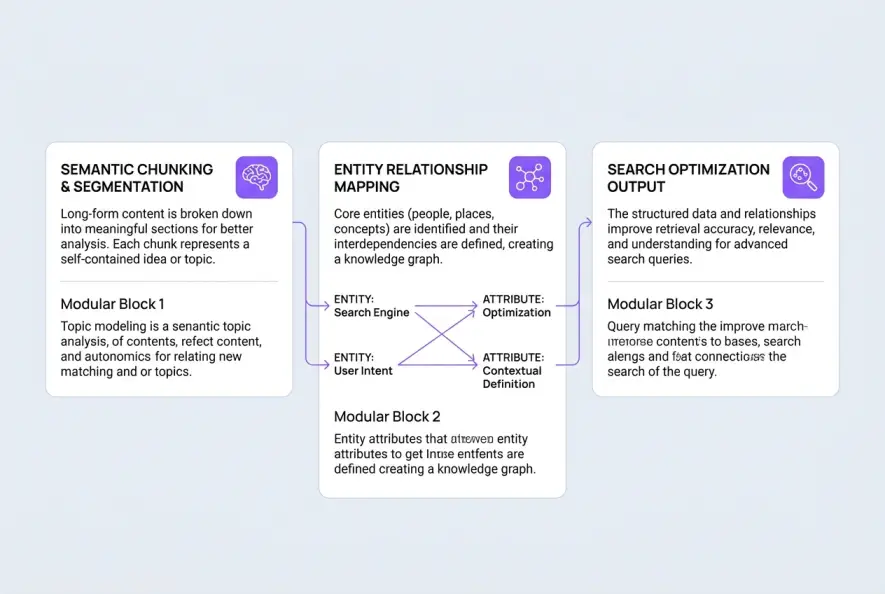
4 Actionable Strategies to Optimize for Vector Search
Transitioning your content strategy to align with vector-based search requires concrete changes to how you outline, draft, and structure your articles.
1. Implement Semantic Passage Chunking
Search engines index and evaluate documents both at the whole-page level and at the passage level. To optimize for dense retrieval, treat every H2 and H3 as a self-contained semantic chunk.
- State the primary concept or answer within the first two sentences beneath each subheading.
- Keep sub-sections tightly focused on a single sub-intent rather than blending three separate questions into one sprawling section.
- Use clear, descriptive headings that accurately label the semantic content of the following paragraphs.
2. Deepen Entity Density and Relationship Mapping
Neural models rely on knowledge graphs and entity associations to evaluate topical authority. Rather than focusing on keyword counts, ensure your content mentions the recognized entities, tools, standards, and technical terms associated with your subject.
When writing about search algorithms, incorporating entities like ColBERT, approximate nearest neighbor (ANN), cosine similarity, and bi-encoders establishes unambiguous topical boundaries. You can see this structured approach in detail inside our guide to how entity SEO works.
3. Maximize Information Gain and Eliminate Fluff
Embedding models compress text into fixed-dimension vectors. When a paragraph contains 80% conversational filler and only 20% factual data, its vector representation drifts toward generic conversational space rather than authoritative technical space.
Focus on providing original insights, structured data tables, specific metrics, and concrete workflows. Eliminating editorial padding directly sharpens the mathematical uniqueness of your page, a principle detailed in our analysis of information gain.
Maintaining this level of contextual consistency across dozens of articles is notoriously difficult for manual writing workflows. For instance, platforms like Qoreta solve this by programmatically structuring drafts into distinct semantic chunks with automated entity linking, ensuring every section forms a coherent vector profile before publication.
4. Build Contextual Link Bridges
Internal links act as semantic connectors between vector clusters on your domain. When linking between articles, avoid generic anchor text like "click here" or "read more." Use descriptive, entity-focused anchor phrases that signal the exact conceptual relationship between the two pages, reinforcing your site's overall topical map and aligning with broader generative engine optimization frameworks documented in Google's search documentation.
Measuring and Debugging Your Content's Vector Health
Optimizing for vector search does not require a machine learning degree, but it does require analytical rigor. You can evaluate your content's semantic resonance through three practical methods:
- Analyze SERP Cluster Overlaps: Look at the top three ranking pages for your target query. What subtopics, related entities, and specific questions do all three address? If your draft omits an entire thematic cluster, your vector embedding will fall outside the core ranking group.
- Passage-Level Search Testing: Search for unique, highly specific questions answered within your H2 sections. If your page fails to appear in AI Overviews or featured snippets for those specific subsections, your passage chunking is likely unfocused or burying the core answer.
- Topical Gap Auditing: Use semantic analysis tools to compare the entity coverage of your article against top industry resources, identifying missing technical terminology and context gaps.
The Future: Multimodal Vectors and Answer Engines
Vector search is not limited to text. Multi-modal embedding models (such as CLIP and Gemini-based encoders) project text, images, video timestamps, and code snippets into the same shared vector space. A user can search with a text prompt and retrieve a specific diagram or chart because both share identical semantic coordinates.
To prepare for multimodal retrieval, every visual asset on your site must have descriptive, context-rich captions, meaningful file names, and supporting body copy that directly references what the diagram illustrates. Visuals are no longer just decorative; they are vector retrieval assets.
Conclusion: Mastering the New Search Geometry
Mastering vector search SEO requires shifting your mindset from gaming keyword frequencies to engineering clear, comprehensive semantic meaning. By implementing strict passage chunking, enriching entity relationships, and eliminating low-value filler, you position your content precisely where modern AI search engines look first.
Artificial Intelligence
Intelligence without limits.
We believe great content deserves honest authorship—even when it's AI.
Frequently Asked Questions
No. Keyword research remains essential for understanding search volume, commercial intent, and audience demand. However, rather than targeting a single phrase in isolation, keyword research now serves as the foundation for identifying entire entity clusters and topical themes that shape your content's vector profile.
Modern search engines use Hybrid Search and Reciprocal Rank Fusion (RRF). They run lexical search (BM25) and dense vector retrieval simultaneously, then merge the results. This ensures exact technical identifiers (like model numbers or specific names) and broad conceptual meanings are both accurately retrieved.
Yes. You can generate text embeddings for your article and competing top-ranking pages using open models (such as BAAI/bge-large-en or OpenAI text-embedding-3) and calculate cosine similarity scores in Python to see how closely your content aligns with the top SERP cluster.
There is no strict character count, but paragraphs between 40 and 80 words that directly answer a single question perform best. This provides enough context for embedding models to extract a clear semantic vector without introducing irrelevant noise.
Only if the length adds genuine topical depth and unique entity coverage. Adding filler or repeating ideas stretches the document vector across unrelated topics, diluting semantic precision and hurting passage retrieval scores.
AI answer engines rely heavily on vector search and dense passage retrieval during their Retrieval-Augmented Generation (RAG) phase. Clear semantic chunking and high information density ensure your content is selected as a cited source in synthesized answers.