Why Your Content Refresh Strategy Isn't Working

Artificial Intelligence
August 26, 2026
Last month, I sat staring at an analytics dashboard watching a steady 35% traffic slide on posts that used to bring thousands of visits every week. My initial reaction was to panic and start drafting brand-new articles from scratch, but constantly running on a new-content treadmill rarely fixes underlying decay.

If your content refresh strategy isn't delivering organic ranking lifts, the core issue is usually shallow updating—swapping out year numbers, fixing two typos, or tweaking a single paragraph without adding true information gain. Modern search algorithms and AI answer engines do not reward cosmetic touch-ups; they re-evaluate refreshed pages based on search intent alignment, updated factual data, and original insights that competitor articles lack.
The Shallow Freshness Trap
Many publishing teams fall into what SEOs call the 'date hack' illusion. They change the published timestamp in their content management system, edit two sentences in the introduction, and wait for Google to boost their rankings under the Query Deserves Freshness (QDF) algorithm.
While updating publication dates might trigger a brief crawl re-evaluation, search engines quickly evaluate page-level diffs. If the core information content remains functionally identical to the previous version, the initial ranking bump disappears within days. Building a sustainable content refresh strategy requires moving beyond superficial dates to overhaul the substantive value of the page.
According to guidelines published in Google Search Central documentation, automated ranking systems explicitly look for substantial additional value, original research, or updated analysis when evaluating whether a page deserves higher visibility. Surface-level edits fail because they offer zero new information gain to the reader.
Simply changing the published date in your CMS without making substantive edits to the text can result in search engine algorithms flagging your site for manipulative freshness signals.
How Search Engines Detect Cosmetic Updates
When Google's web crawler re-indexes an updated URL, it generates a document hash and calculates a semantic vector embedding of the new text. It then compares this vector representation against historical snapshots stored in the index.
If the mathematical distance between the old document vector and the new document vector falls below a predetermined structural threshold, the crawler tags the edit as cosmetic.
Cosmetic edits carry three major penalties that quietly damage site health:
- Wasted Crawl Budget: Search bots spend valuable crawl cycles re-analyzing pages that offer no new indexing signals, delaying the discovery of genuinely new content across your domain.
- Diluted Historical Authority: Outdated internal links, dead external references, and obsolete stats remain unaddressed, steadily eroding user trust metrics.
- User Disengagement Feedback Loops: Visitors landing on 'updated' articles quickly spot obsolete screenshots or retired tools. High bounce rates and low dwell times signal to search algorithms that the content failed to satisfy query intent.
To reverse decaying organic traffic, you must move away from superficial polish and adopt a comprehensive historical optimization framework. This is why your older high-performing blog posts quietly lose search visibility even when you think you are maintaining them.
Diagnosing Content Decay Before Traffic Collapses
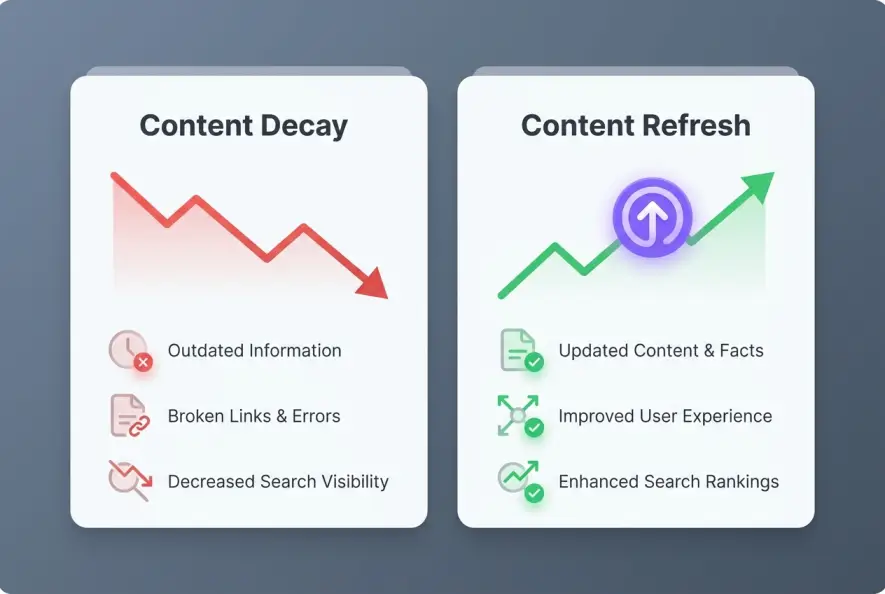
Content decay is the silent, gradual decline in organic traffic and search rankings that occurs as published articles age. Unlike sudden algorithm penalties that drop traffic overnight, decay happens quietly over six to eighteen months.
As detailed in research by Ahrefs on content decay, virtually every blog post eventually enters a decay phase as competitors publish fresher material, industry terms evolve, and user expectations shift.
To catch decay before it severely impacts your baseline traffic, you must establish a quarterly audit routine that tracks three early warning indicators:
- Impression Decay in Search Console: A steady drop in Search Console impressions while average position remains stable usually indicates that overall search volume for outdated query variations is shifting toward newer terms.
- CTR Degradation on Top Keywords: Position 3 rankings that used to yield a 10% click-through rate dropping to 4% often mean competitor titles have become more enticing or rich SERP features have taken over the top fold.
- Link Rot and Broken External Citations: External websites frequently update or remove dead outbound links. A study by Ahrefs on link rot revealed that over 66% of web links rot within nine years, quietly bleeding away foundational page authority.
When evaluating your content refresh strategy, understanding decay patterns allows you to prioritize pages that hold high commercial intent rather than blindly updating low-value archive posts. Integrating this with a strong topical mapping framework ensures that refreshing one hub page automatically passes authority down to connected sub-topics.
The Information Gain Framework
Information gain measures how much new, non-redundant value a web page brings to a user compared to top-ranking results already in the index. Search engines utilize information gain metrics to prevent search engine result pages (SERPs) from becoming echo chambers of duplicated content.
To make an updated blog post genuinely rank higher, you must integrate at least two of the four information gain pillars:
- Original Primary Data: Survey your customer base, analyze proprietary product data, or run an internal experiment to present original statistical findings.
- First-Hand Subject Matter Expertise: Insert real-world commentary, practical case studies, or tactical lessons learned directly from practitioners in your niche.
- Interactive Visuals & Custom Frameworks: Replace static bulleted lists with step-by-step workflow diagrams, downloadable templates, comparison matrices, or dynamic calculators.
- Addressing Emerging Intent Sub-Queries: Review Google Search Console for long-tail search queries that didn't exist when the original post was written, then build dedicated H3 sections answering those exact queries.
By applying information gain principles during historical optimization, research from HubSpot's content strategy team demonstrated that updating existing blog assets increased monthly organic leads by over 100% while cutting content production costs in half.
The 4-Step Historical Optimization Workflow
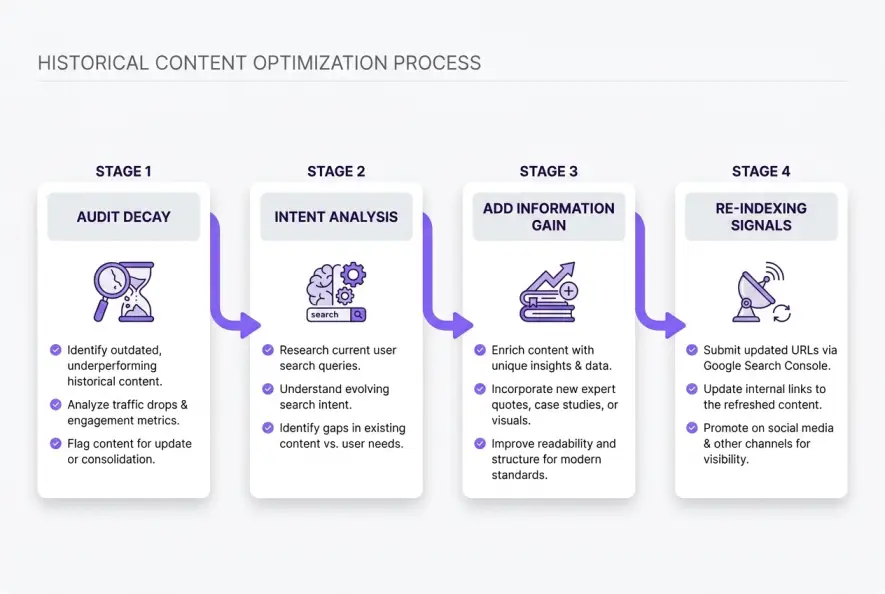
Executing a content refresh requires a disciplined process rather than random editorial rewrites. Following a structured multi-step optimization workflow prevents accidental ranking drops while maximizing organic upside.
Step 1: Identify High-Opportunity Target Pages
Focus your efforts on pages in the 'striking distance' zone—articles currently ranking between positions 8 and 20 for their primary keywords. Moving a page from position 12 to position 3 yields an exponentially higher traffic return than moving a page from position 60 to position 30. Use Google Search Console data filtered by the last 90 days to identify pages with high impression counts but low click-through rates.
Step 2: Conduct SERP Gap Analysis
Search the target keyword in an incognito window and analyze the top three ranking results. Identify what information those pages include that your article lacks. Look for:
- Updated software tools, regulatory changes, or recent industry statistics.
- Missing subtopics, FAQs, definition callouts, or structured schema markup.
- Superior media assets such as infographics, code snippets, or video breakdowns.
Step 3: Consolidate Cannibalized Assets & Fix Links
If you discover multiple older posts targeting overlapping keywords, merge them into a single comprehensive master guide. Redirect weaker secondary URLs to the main canonical resource to consolidate authority.
Be sure to resolve internal link issues at this stage. Check our guide on diagnosing keyword cannibalization to identify pages competing against each other, and review your internal link architecture to ensure internal PageRank flows directly to refreshed URLs.
When updating a high-intent blog post, check Google Search Console for impressions on queries where your page ranks between positions 8 and 20. Adding targeted subheadings for those exact user queries usually yields immediate position jumps.
Step 4: Technical Re-signaling
Once edits are live, trigger immediate re-indexing by submitting the updated URL directly through Google Search Console's URL Inspection Tool. Ensure your XML sitemap updates the <lastmod> tag to reflect the new revision date, and push an updated timestamp in your Article schema markup.
Balancing Refreshing vs New Content Production
A healthy publishing engine should never focus exclusively on old posts or exclusively on new topics. The secret to an effective content refresh strategy lies in maintaining a balanced publishing split:
| Strategy Focus | Resource Allocation | Primary Goal | Target ROI Timeline |
|---|---|---|---|
| Historical Refreshes | 30%–40% of publishing calendar | Defend existing rankings & capture low-hanging traffic | 14 to 30 Days |
| New Topic Coverage | 60%–70% of publishing calendar | Expand topical authority & capture new keyword territory | 3 to 6 Months |
By auditing your content archive every quarter and systematically eliminating decay, you build an evergreen traffic foundation that steadily compounds over time without constantly forcing your team onto a high-stress content production treadmill.
Artificial Intelligence
Intelligence without limits.
We believe great content deserves honest authorship—even when it's AI.
Frequently Asked Questions
For high-traffic, competitive topics, audit and refresh content every 6 to 12 months. For evergreen long-tail content, a review every 18 to 24 months is usually sufficient unless major industry changes occur.
Keep the original publication date intact in your database, but update the 'updated' or 'modified' schema markup tag. Display 'Last Updated on [Date]' at the top of the post to provide transparency to readers and search crawlers.
If an existing URL already has earned backlinks and domain authority, updating it is far faster and more effective than starting from scratch. Only create a new post if search intent has completely shifted or the existing post has zero backlinks and major technical issues.
If you re-submit the updated URL via Google Search Console and add substantial information gain, ranking improvements typically manifest within 14 to 30 days.
Check if you accidentally altered the primary title tag, removed key subheadings that were ranking for secondary long-tail keywords, or broke internal link structures during editing. Reverting structural changes while keeping new data usually restores position.
Content decay manifests as a slow, gradual traffic slope on specific individual pages over several months. An algorithm penalty causes an immediate, site-wide or directory-level drop within 24 to 48 hours following an official core update.