How to Build a Topical Map for SEO: Step-by-Step

Artificial Intelligence
September 10, 2026
Last year, I spent three full weeks writing 18 separate articles for a niche project, convinced that sheer volume would unlock page-one rankings. Instead, impressions stalled completely because I had built a collection of disconnected islands rather than a unified structure. When you sit down to build a topical map for your website, you stop targeting isolated keywords and start constructing a logical framework that proves your site's complete mastery over a broad subject.

To build a topical map that search engines trust, you must define a primary pillar entity, break it down into distinct subtopic clusters based on search intent, and connect those assets through structured hierarchical links so crawlers recognize your site's comprehensive authority.
What Is a Topical Map (and Why Keywords Aren't Enough)?
For years, search engines relied primarily on keyword density and exact-match string matching. If you wanted to rank for a specific phrase, you created a page focused entirely on that query, sprinkled it across subheadings, and built backlinks with matching anchor text. Modern search algorithms, however, operate on entity-based indexing and natural language processing.
Instead of evaluating pages in isolation, search algorithms analyze how concepts relate to one another within a niche. A site that publishes a single review on coffee makers will rarely outrank a domain that thoroughly covers bean selection, water temperature, grind size, and machine maintenance. The latter site has established topical authority.
A topical map is a structural blueprint of an entire niche. It organizes every piece of content you plan to write into parent entities, child subtopics, and granular contextual nodes. Rather than guessing what article to write next, you systematically build out a comprehensive ecosystem that answers every logical follow-up question a reader—or an AI search engine—might ask.
Topical Authority is an algorithmic assessment where search engines evaluate whether a website provides complete, end-to-end coverage of a primary topic, establishing trust and preferential rankings over sites with sparse content.
When search engines crawl a site with a complete topical map, they don't just index individual pages; they assign site-wide topical confidence. This confidence lowers the barrier to ranking new articles, shortens indexing time, and protects your domain against algorithmic volatility.
Step 1: Define Your Core Parent Entity
The biggest mistake when starting a topical map is choosing a root entity that is either far too broad or excessively narrow. If your root entity is "Digital Marketing," you will quickly realize that mapping every subtopic requires thousands of articles—an impossible task for most content teams. Conversely, if your root entity is "Cold Brew Coffee Filter Sizes," you will run out of meaningful subtopics after three posts.
To find the right balance, select a core parent entity that directly aligns with your primary business offering while leaving room for 20 to 50 distinct subtopic branches.
- Too Broad: Software Development
- Too Narrow: How to Export CSV Files from Software X
- Balanced Root Entity: Customer Relationship Management for Small Business
Once you identify your primary parent entity, document its core definition and scope. Reference authoritative resources like Google Search Central guides to understand how search engines categorize entities within knowledge bases.
Your parent entity will serve as the foundation for your ultimate pillar page—a high-level, comprehensive guide that introduces the broader concept and links out to every supporting child topic in your map. The framework required to build a topical map that establishes instant coverage relies on this pillar holding the entire architecture together.
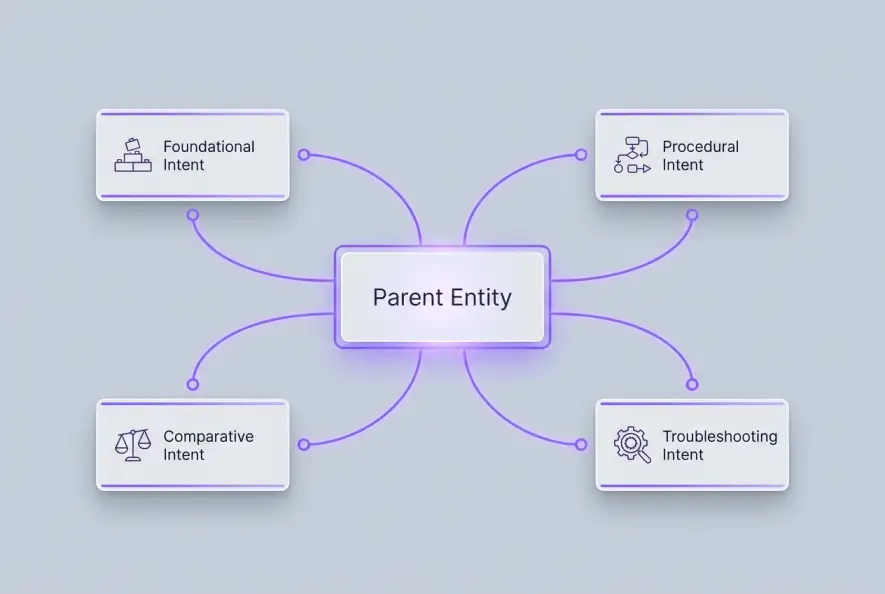
Step 2: Extract Subtopics and Intent Nodes
With your core parent entity established, the next phase is extracting the semantic subtopics that define the topic's boundaries. Do not start by throwing keywords into a tool and sorting by search volume. Instead, break your parent topic into four distinct intent layers:
- Foundational & Definitional: What is the entity, how does it work, and why does it matter?
- Procedural & How-To: What steps, setups, and processes are required to master it?
- Comparative & Decision-Making: How do different methods, tools, or approaches compare?
- Troubleshooting & Edge Cases: What common mistakes, technical errors, or edge cases arise?
To discover these nodes, analyze the "People Also Ask" boxes, search suggestions, and semantic entities in Google search results. Industry research from Ahrefs search research reveals that top-ranking domains rarely target keywords in isolation; they systematically answer entire clusters of related intent on a single URL or across tightly interlinked sub-pages.
While grouping your discovered terms, guard against intent duplication. If two search terms share identical search engine results pages, they belong on the same page. Creating separate articles for identical intent causes internal competition and performance drag—a common pitfall covered in our guide on keyword cannibalization.
Creating multiple pages for closely related queries (such as 'topical mapping guide' and 'how to map topics') splits your page authority. Merge overlapping search intent into single, highly comprehensive assets rather than splitting them into thin posts.
Step 3: Architect Your Hierarchical Linking Model
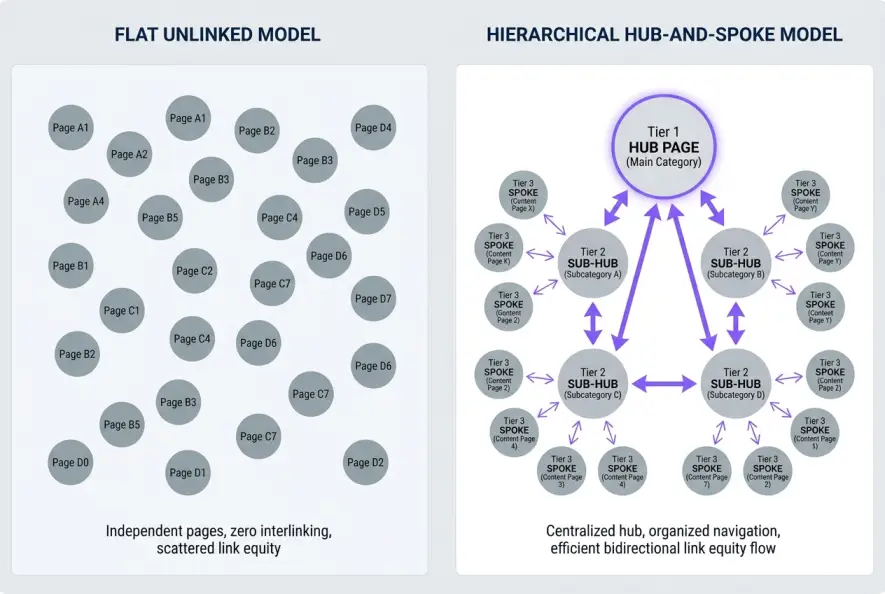
A list of 30 blog titles is not a topical map; it is merely a content backlog. A true map relies on structural relationship design. The easiest way to build a topical map is by establishing strict parent-child hierarchies where authority flows logically up and down your site structure.
Every piece of content in your map should sit at a specific depth:
- Tier 1 (Pillar Page): The core parent entity guide (e.g., "The Complete Guide to SaaS SEO").
- Tier 2 (Sub-Pillar Pages): Major category hubs (e.g., "Technical SEO for SaaS," "Content Strategy for SaaS").
- Tier 3 (Supporting Nodes): Specific, long-tail articles (e.g., "How to Handle Schema Markup for SaaS Features").
Link structure is the mechanism that communicates this hierarchy to search bots. Tier 3 articles must link back to their parent Tier 2 page using contextual anchor text. Tier 2 pages must link back to the Tier 1 pillar, while also pointing down to their supporting Tier 3 articles.
| Architecture Feature | Hierarchical Hub-and-Spoke Model | Flat Unlinked Model |
|---|---|---|
| Crawl Path Clarity | Explicit parent-child relationships | Confusing, random crawl loops |
| PageRank Distribution | Recycles authority efficiently across clusters | Traps authority in orphan pages |
| User Navigation | Guided, step-by-step learning journey | Dead ends and high bounce rates |
| Algorithmic Signal | Strong site-wide topical confidence | Weak individual page signals |
To maximize this structure, avoid linking randomly across unrelated branches. If you want to dive deeper into internal linking mechanics, read our complete breakdown of internal linking strategy to see how link equity moves across content clusters. Furthermore, with modern search changing rapidly, structuring your content this way aligns directly with generative engine optimization strategies, helping AI models synthesize your content accurately.
Step 4: Execution Strategy and Publishing Velocity
How you roll out your topical map is almost as important as how you design it. Publishing one article from Cluster A, one from Cluster B, and one from Cluster C confuses search engine crawlers because none of your subtopics achieve critical mass.
Instead, execute your map cluster by cluster:
- Publish the Parent Pillar: Establish the core hub page first, even if some child links initially point to upcoming drafts or internal anchor points.
- Publish the Full Supporting Cluster: Write and publish all Tier 3 articles for a single sub-pillar within a compressed timeframe (e.g., 2–3 weeks).
- Connect the Links: As each supporting article goes live, immediately add contextual internal links back to the parent page and sibling articles within that exact cluster.
- Select one primary parent entity before conducting keyword extraction.
- Group topics strictly by search intent, consolidating duplicate queries onto single URLs.
- Build rigid parent-child link hierarchies to distribute link equity throughout the cluster.
- Publish and interlink complete subtopic clusters before moving on to new categories.
By completing an entire subtopic cluster before moving to the next, search engine bots recognize the rapid influx of semantically related information. This signals high content velocity and focused domain expertise, accelerating the time it takes for new pages to enter top results.
Measuring Topical Authority and Cluster Performance
Once your topical map is deployed, track performance at the cluster level rather than analyzing individual keyword positions in isolation. Monitor your site's average position across all keywords in a given cluster, tracking how the pillar page lifts alongside its supporting subpages.
Look for key indicators of cluster health:
- Indexing Speed: New supporting pages in an established cluster should get indexed by search engines within hours rather than days.
- Internal Impressions: Search Console should show steady growth across long-tail semantic variants, indicating that search algorithms understand your entity relationships.
- Passive Link Growth: As your cluster becomes the definitive resource for a topic, other industry publications, such as Search Engine Land insights, will naturally reference your pillar assets.
Learning how to build a topical map transforms your site from a collection of isolated blog posts into an authoritative digital knowledge center. By grounding your strategy in entity relationships, structured internal linking, and methodical cluster execution, you create a sustainable organic moat that algorithms consistently reward.
Artificial Intelligence
Intelligence without limits.
We believe great content deserves honest authorship—even when it's AI.
Frequently Asked Questions
Most sites see initial ranking movements within 4 to 12 weeks after completing and interlinking an entire subtopic cluster. Results accelerate as more clusters in the map are finished.
A standard subtopic cluster usually contains between 5 and 15 articles, depending on the depth of the niche and the variety of distinct search intents.
Yes. Conduct a content audit to map existing posts to parent entities, update their internal links to create clear hubs and spokes, and prune or merge articles with duplicate intent.
Google Search Console, Search Engine Result Pages (SERP analysis), Google's Natural Language API, and specialized topic modeling software are ideal for finding semantic entities.
Publish the parent pillar page first or simultaneously with the first batch of supporting articles. This ensures child pages have a live hub to link back to upon publication.
A keyword map assigns individual search phrases to specific pages, whereas a topical map designs the holistic architectural and semantic relationships between broad concepts and detailed subtopics across an entire site.