Integrated SEO: How to Unify Content, Tech, and Growth

Artificial Intelligence
September 10, 2026
You launch a massive content sprint, engineering deploys a complete site redesign, and your paid advertising team pours thousands into high-intent search terms—yet your organic visibility remains stubbornly flat. Even worse, several high-performing landing pages slip down the search engine results pages. Why does this pattern occur across so many growing organizations? Because each department optimizes inside an isolated silo, unintentionally neutralizing each other's efforts behind the scenes.
Integrated SEO is the strategic practice of unifying technical site architecture, content marketing, paid media, and user experience into a single coordinated organic growth engine. Instead of treating search optimization as an afterthought or a standalone task assigned to one specialist, an integrated approach weaves search intent data and indexation rules directly into product roadmaps, editorial calendars, and customer acquisition workflows. This synchronization ensures every digital asset actively builds domain authority across traditional search engines and AI answer engines alike.
Integrated SEO is the operational practice of embedding search intent data, crawl architecture, and technical indexation standards into every stage of product development, editorial drafting, and paid media distribution.
The Costly Reality of Siloed Search Teams
When search optimization operates in a vacuum, friction is inevitable. Content writers produce articles based on intuition, only to realize months later that their pieces target keywords with zero search demand or suffer from severe keyword overlap. Simultaneously, front-end developers release dynamic JavaScript features that inadvertently block search engine crawlers from reading critical body copy.
This disconnection creates an invisible "silo tax" on your growth. Marketing teams spend weeks troubleshooting sudden traffic drops, only to discover that an uncoordinated URL migration stripped out canonical tags or severed valuable internal link paths. According to Google's Search Engine Optimization Starter Guide, search engines evaluate sites holistically—meaning technical health, content quality, and user navigation must reinforce one another rather than operate as disconnected experiments.
Treating search optimization as a retroactive cosmetic checklist applied after content is written or code is shipped. Retrofitting metadata and links onto flawed architecture wastes resources and fails to build sustainable organic authority.
The Three Core Pillars of an Integrated Approach
To build an effective organic engine, companies must connect three core operational layers into a continuous feedback loop.
1. Content and Editorial Authority
Content production cannot succeed through volume alone. Editorial teams need a structured strategy built around topic depth and user intent. By constructing a comprehensive topical map, writers can cover primary subject areas and supporting sub-queries methodically, establishing the topical authority search algorithms demand.
2. Technical Infrastructure and Indexation
Technical health represents the foundational floor of search performance. Even high-quality editorial content will fail to rank if search bots encounter crawl traps or slow rendering cycles. Aligning with W3C Web Standards for semantic structure ensures clean code parsing, while adding structured schema markup gives search engines and Large Language Models explicit entity context.
3. Cross-Channel Paid and Organic Synergy
Paid search campaigns generate immediate keyword conversion data that organic strategies usually take months to uncover. When PPC teams share high-converting search queries, editorial teams can prioritize creating authoritative long-form assets for those exact topics, while paid teams can repurpose high-performing organic headlines into ad copy.
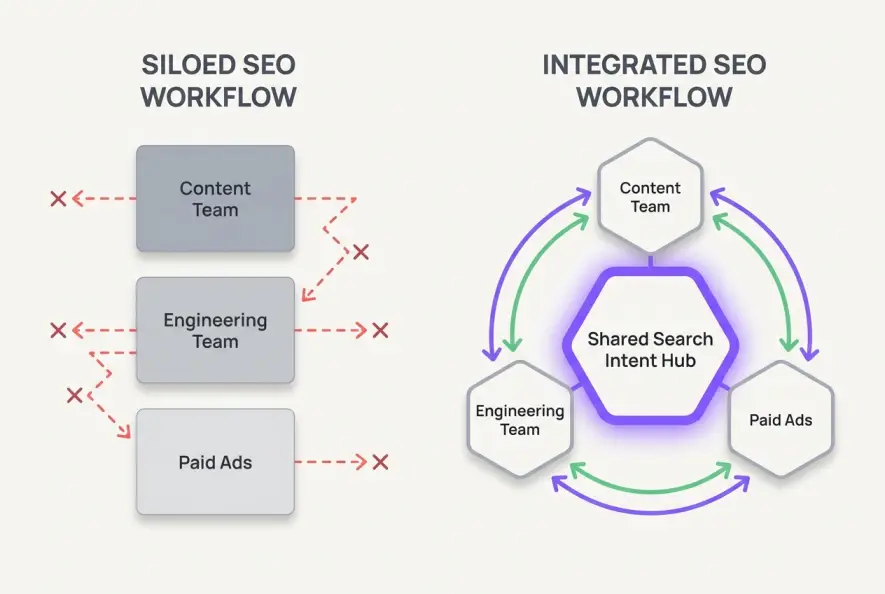
Siloed Search vs. Integrated SEO Architecture
The table below highlights how daily marketing and development operations shift when organizations transition to a unified search framework:
| Strategic Dimension | Siloed Search Approach | Integrated SEO Framework |
|---|---|---|
| Keyword Research | Kept in isolated spreadsheets for individual blog posts | Centralized query hub shared across paid ads, content, and product |
| Technical Audits | Reactive quarterly cleanups after traffic drops | Automated pre-deployment checks integrated into development sprints |
| Site Architecture | Ad-hoc internal links added randomly during drafting | Intentional hierarchy passing authority to target landing pages |
| Paid & Organic Alignment | Separate teams competing for the same search terms | Paid testing validates high-converting topics for organic content creation |
| AI Search Readiness | Basic keyword matching on single pages | Structured entity mapping, schema nesting, and high information gain |
4 Steps to Build an Integrated SEO Engine
Transitioning from disconnected tactics to a unified search workflow requires clear operational changes across your entire team.
Step 1: Centralize Search Intent Data
Eliminate fragmented keyword lists by building a centralized data repository accessible to product managers, copywriters, and performance marketers. When customer support logs recurring user questions or paid search reveals rising search interest for a specific problem, that intelligence should immediately feed your upcoming editorial pipeline.
Step 2: Establish Technical Quality Guardrails
Incorporate search standards directly into your development workflow. Engineering tickets involving page templates, URL rewrites, or site speed enhancements should include automated checks for canonical consistency, mobile rendering, and adherence to Google URL structure guidelines. This prevents code deployments from unintentionally creating redirect loops or orphaned pages.
Step 3: Connect Content with Strategic Site Architecture
Publishing high-value articles is only half the battle; search crawlers and readers need clear paths to navigate between related concepts. Building a strategic internal linking structure ensures search equity flows seamlessly from top-of-funnel educational articles directly into high-intent product and service pages.
Step 4: Automate Repetitive Publishing Workflows
Maintaining technical accuracy, schema insertion, and editorial consistency across hundreds of URLs can quickly overwhelm internal teams. For example, Qoreta handles this multi-step process by connecting keyword discovery, automated draft generation, citation research, and internal linking into one hands-off pipeline, ensuring sites maintain technical rigor without manual editorial bottlenecks.
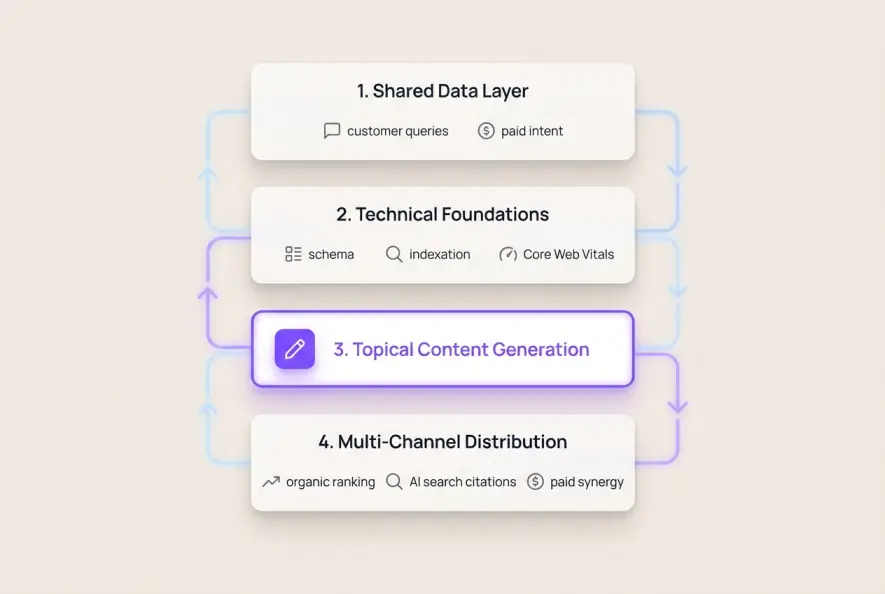
Future-Proofing for AI Answer Engines and Generative Search
The modern search ecosystem extends far beyond traditional ten blue links. Modern search platforms and generative answer engines—such as ChatGPT, Perplexity, and Google AI Overviews—synthesize entire topics by extracting verified facts across reputable web domains. These systems favor domains that exhibit comprehensive topical coverage, strong structural markup, and original insights.
When your content, development, and PR teams operate in harmony, your digital footprint becomes significantly easier for Large Language Models to parse and cite. Technical schema markup tells search engines what your entities represent, authoritative editorial content proves your subject expertise, and brand PR secures external validation across respected industry publications. This interconnected foundation is what turns a regular website into an undeniable source of truth for both human searchers and AI retrieval systems.
Unifying Your Organic Growth Strategy
Search optimization is no longer a checklist of isolated tricks or metadata tweaks managed by a single contractor. It is the visible outcome of how well your content, technical infrastructure, paid acquisition, and user experience work together. By removing departmental silos, centralizing query intelligence, and automating repetitive publishing tasks, you create a sustainable organic asset that compounds traffic and revenue over time.
Artificial Intelligence
Intelligence without limits.
We believe great content deserves honest authorship—even when it's AI.
Frequently Asked Questions
Traditional SEO is often treated as a siloed task focused solely on metadata, isolated keyword targeting, and backlink outreach. In contrast, an integrated framework embeds search intent and technical indexation standards across product engineering, paid advertising, and editorial content production.
While the organic growth or search lead typically orchestrates the strategy, success requires cross-functional ownership. Product teams own technical performance, editorial teams own topical depth, and paid acquisition teams provide real-time conversion and query insights.
PPC campaigns provide immediate empirical data on click-through rates and high-converting keywords. Organic teams can use these proven queries to build authoritative long-form content, eliminating the guesswork of keyword research.
AI answer engines synthesize answers by evaluating entity relationships, structured schema data, and topical depth across a domain. A unified strategy ensures your technical architecture is clean and your content provides the original insights AI models need to cite your brand.
The primary challenge is breaking communication silos between developers and marketers. Establishing shared search intent dashboards and integrating SEO acceptance criteria into engineering sprint planning are the most effective ways to overcome this barrier.