Digital Marketing Attribution: Why Your ROI Metrics Lie

Artificial Intelligence
August 19, 2026
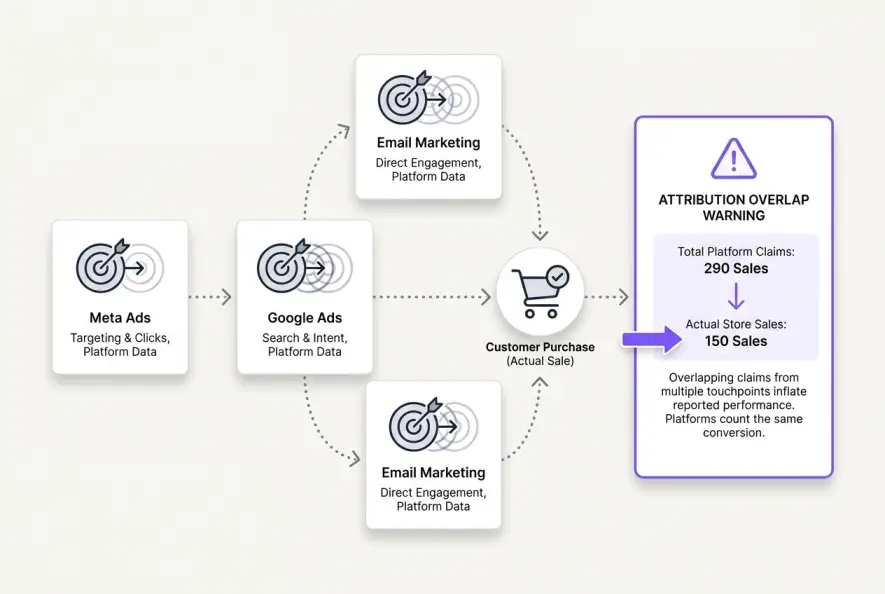
You open your weekly growth dashboard and notice something that seems physically impossible. Meta Ads claims responsibility for 140 purchases this month. Google Ads reports 90 conversions from search campaigns. Meanwhile, your email marketing software proudly takes credit for another 60 completed orders. You add those numbers together and get 290 total sales. But when you check your bank account or payment processor, only 150 orders were actually processed.

Where did those extra 140 sales come from? They do not exist. You are staring directly at the core failure of modern channel measurement.
Mastering digital marketing attribution requires recognizing that native ad platform dashboards are engineered to claim maximum credit for every customer conversion. When multiple marketing touchpoints interact with a single buyer, every platform claims 100% credit for the eventual transaction. Relying on these self-reported figures inflates your perceived return on ad spend (ROAS), misallocates campaign capital, and conceals which channels are genuinely driving bottom-line revenue.
The Over-Reporting Trap: Why Platform Silos Skew ROI
Self-attributed networks (SANs) like Meta, Google, and LinkedIn operate in complete isolation. Each platform places pixel trackers on your website and checks whether a converting visitor viewed or clicked one of their ads within an arbitrary window—frequently a 7-day click or 1-day view-through lookback.
If a prospect views an Instagram story on Monday, clicks a Google Search ad on Wednesday, opens a promotional email on Friday, and completes a purchase on Saturday, all three platforms report that exact same sale in their native dashboards.
This siloed reporting creates three structural hazards for growth teams:
- Double and Triple Counting: Aggregated channel reports regularly exceed real store transactions by 30% to 70%.
- View-Through Inflation: Platforms claim conversions for users who merely scrolled past an ad without engaging, even if those users were already on the verge of purchasing organically.
- Starving Top-of-Funnel Media: Teams double down on bottom-funnel retargeting ads that claim high ROAS on paper, while defunding early-stage awareness channels that actually create new intent.
Relying solely on native ad platform reporting to allocate budget. Ad networks use expansive view-through windows and aggressive last-touch rules to claim conversions that would have occurred without paid intervention.
This inherent conflict of interest explains why scaling ad spend based on platform dashboards often leads to flatlined overall revenue.
Privacy Sandboxes, Cookie Decay, and Signal Loss
If duplicated reporting were the only issue, growth teams could simply apply a manual discount factor to native reports. However, fundamental shifts in browser privacy have made standard client-side tracking increasingly inaccurate.
Apple’s App Tracking Transparency (ATT), Safari’s Intelligent Tracking Prevention (ITP), and evolving ad-blocking extensions have systematically shortened the life of client-side browser cookies. According to technical frameworks documented by IAB Tech Lab, first-party cookies set via JavaScript are frequently capped at 7 days or even 24 hours on modern mobile browsers. If a customer takes two weeks to move from initial research to final conversion, standard web analytics lose the connection entirely.
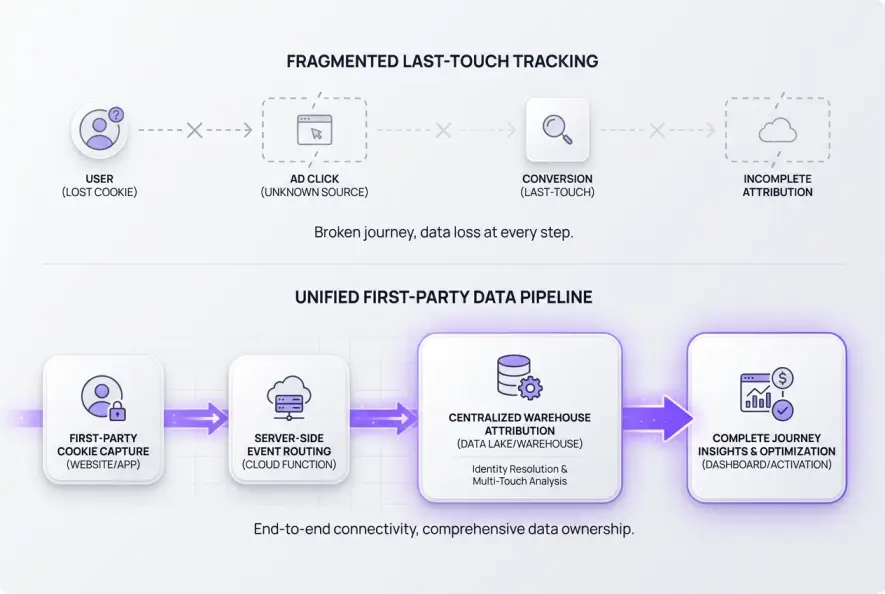
To overcome tracking gaps, modern digital marketing attribution strategies rely on first-party data collection rather than volatile browser sessions.
Furthermore, a significant volume of customer touchpoints occurs in unmapped spaces. When prospective buyers share product links via private messaging apps, team channels, or word-of-mouth recommendations, web analytics platforms strip the referral parameters and register those visits as unassigned direct traffic.
This visibility gap leads to distorted campaign evaluation. When users copy-paste URLs across private channels or mobile browsers, analytics tools misclassify those interactions as direct site traffic—a widespread tracking issue analyzed in depth within our guide to dark social traffic.
Transition from client-side browser pixels to server-side event tracking hosted on a custom first-party subdomain. Server-side event routing bypasses browser-level ad blockers and preserves cookie persistence for long consideration cycles.
Evaluating Attribution Models: Choosing the Right Framework
Selecting the right digital marketing attribution framework depends on your purchase cycle length, conversion volume, and paid channel diversity. No rule-based model is flawless, but matching the model to your sales reality prevents major analytical errors.
| Model Structure | Credit Distribution Method | Ideal Use Case | Primary Structural Limitation |
|---|---|---|---|
| First-Touch | 100% credit assigned to initial touchpoint | Evaluating top-of-funnel brand discovery campaigns | Completely ignores mid-funnel nurturing and closing offers |
| Last Non-Direct Click | 100% credit assigned to final non-direct link | Simple sales funnels with single-session purchases | Heavily overvalues brand search ads and retargeting |
| Linear / Equal Weight | Divided equally across all recorded interactions | Multi-touch B2B buyer journeys with long cycles | Gives minor ad impressions the same weight as high-intent clicks |
| Position-Based (U-Shaped) | 40% First, 40% Last, 20% split among middle | Balanced evaluation of acquisition and conversion | Can undervalue crucial mid-funnel education content |
| Data-Driven (DDA) | Algorithmic credit based on conversion uplift | High-volume sites with over 1,000 monthly transactions | Operates as a statistical black box requiring large data sets |
Documentation provided by Google Analytics Help highlights that data-driven attribution evaluates both converting and non-converting paths to measure the actual probability contribution of each touchpoint. However, for emerging brands with moderate traffic, combining position-based rules with strict incrementality tests often provides clearer decision metrics than complex machine-learning estimations.
How to Build an Actionable First-Party Tracking Architecture
Fixing your growth analytics does not require purchasing enterprise enterprise software overnight. By modernizing your digital marketing attribution setup, you move from guesswork to predictable growth through disciplined data infrastructure.
1. Enforce Standardized UTM Parameter Governance
Inconsistent campaign tagging creates chaotic data. Establish an organization-wide UTM convention across every paid campaign, partner link, email newsletter, and social post. Enforce lowercase text, eliminate spaces, and enforce standardized channel parameters across departments.
2. Implement Server-Side Conversion APIs
Replace standard browser pixels with direct server-to-server integrations, such as Meta Conversions API (CAPI) and Google Ads Server-Side Tagging. Transmitting conversion events directly from your server ensures compliance with evolving web standards managed by the W3C Standards organization while preventing data loss from browser restrictions.
3. Run Controlled Geo-Targeted Incrementality Tests
The ultimate measure of channel effectiveness is incrementality: Would these purchases have occurred if you turned off ad spend entirely? Execute geo-targeted holdout tests by pausing paid campaigns in selected regional markets while keeping spend active in control regions to measure net revenue impact.
4. Apply Marketing Mix Modeling (MMM) at Scale
When media spend spans offline channels, podcasts, content creator sponsorships, and paid social, deterministic click tracking collapses. Modern open-source Marketing Mix Modeling frameworks apply statistical regression to aggregate spend and sales data, measuring channel elasticity without relying on invasive user tracking.
- Replace browser pixel reliance with server-side event tracking APIs.
- Establish unified UTM parameters across all marketing touchpoints.
- Validate ad platform ROAS claims using regular incrementality holdout tests.
By replacing isolated platform statistics with a unified first-party measurement architecture, you gain true clarity on acquisition costs and can confidently deploy capital toward channels that build real enterprise value.
Artificial Intelligence
Intelligence without limits.
We believe great content deserves honest authorship—even when it's AI.
Frequently Asked Questions
Ad platforms use siloed tracking pixels that claim full credit for any conversion where a user viewed or clicked an ad within their lookback window. When a customer interacts with multiple channels before buying, each ad network reports 100% of that sale, leading to double-counted conversions across dashboards.
Click-through attribution grants conversion credit if a user clicks an ad and completes a purchase within a set timeframe. View-through attribution grants credit if a user merely sees an ad on screen—even without clicking—and subsequently converts later. View-through rules often artificially inflate ad platform ROI.
Server-side tracking sends conversion data directly from your website's web server to the ad platform's API, bypassing browser-level ad blockers, privacy extensions, and short cookie expiration limits imposed by modern browsers.
An incrementality test compares a target group exposed to ads against a holdout group that receives no ads (often split by geographic region). Measuring the true difference in revenue between the two groups reveals whether the ad spend actually generated new sales or simply paid for conversions that would have occurred organically.
Rule-based models (like position-based or last-click) work well for early-stage companies with low conversion volume. Once your business processes over 1,000 conversions per month across three or more paid channels, switching to algorithmic data-driven attribution provides deeper statistical accuracy.
Dark social occurs when prospective buyers share links through private messaging channels, mobile apps, or internal chat apps. Because these links strip UTM tracking parameters and HTTP referrer headers, web analytics tools misattribute these high-intent visits as generic 'Direct' traffic.