Topical Authority vs Domain Authority: What Actually Ranks?

Artificial Intelligence
October 12, 2026
In late 2023, Google updated its search documentation to clarify an uncomfortable truth that many agencies still resist: Google’s ranking systems do not use a sitewide domain authority score. Across billions of search results, pages on specialized sites with modest backlink profiles routinely displace enterprise media giants with Domain Ratings above 85. Yet, digital marketing teams still spend tens of thousands of dollars chasing generic backlinks to pump third-party domain metrics, only to watch niche competitors monopolize high-intent commercial SERPs.

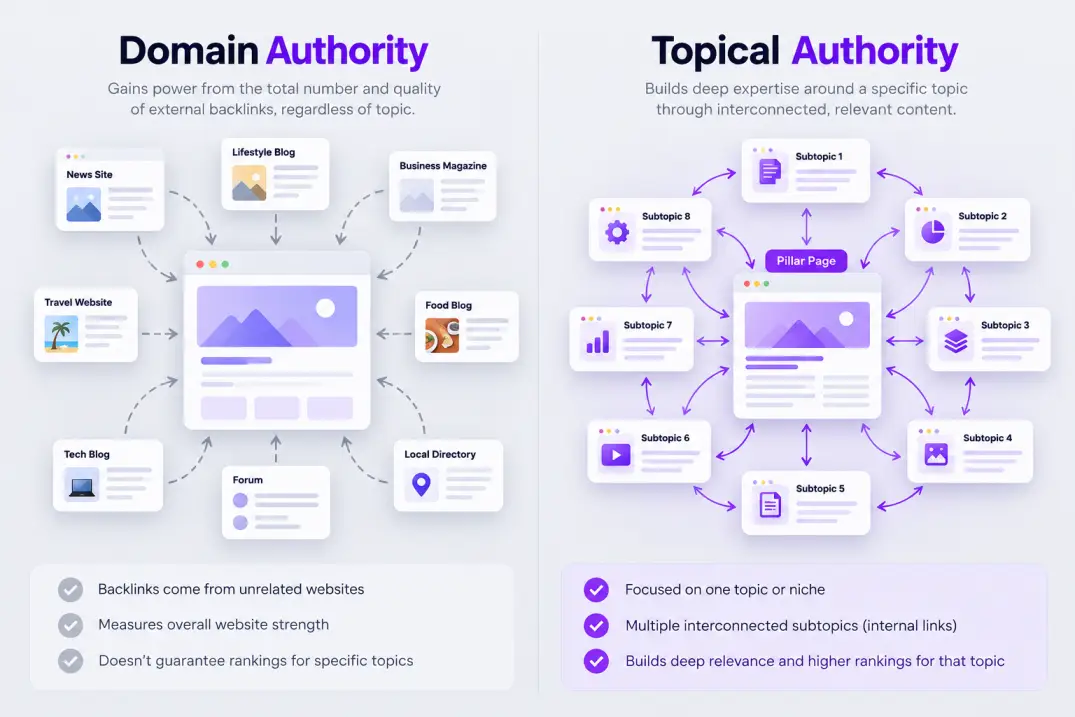
The debate over topical authority vs domain authority comes down to how search engines determine relevance. Domain Authority—a commercial metric invented by third-party toolmakers like Moz—estimates a site’s overall backlink strength. Topical authority, on the other hand, measures how comprehensively, accurately, and coherently a website covers a specific subject entity. Google does not rank root domains; it ranks individual URLs based on information depth, query context, and topical coverage. A focused blog with thirty tightly interlinked articles covering every dimension of a single niche will consistently outrank a high-DA media conglomerate that published a single, generic overview.
This distinction explains why buying high-metric guest posts on unrelated websites produces diminishing organic returns.
What Domain Authority Actually Measures (and What It Misses)
Third-party metrics like Moz's Domain Authority (DA) and Ahrefs' Domain Rating (DR) were built to solve a specific problem: approximating Google’s original PageRank algorithm at a domain level. These metrics aggregate backlink quantities, unique referring domains, and the link equity of linking websites into a logarithmic score from 0 to 100.
They are valuable diagnostic tools for competitive benchmarking and link prospecting. If a domain has a DR of 80, you know it possesses significant incoming link volume. But search engines do not crawl third-party databases to decide who wins position one.
Domain Authority is a comparative third-party metric calculating the aggregate link equity pointing to a domain, whereas topical authority is an algorithmic assessment of a website's semantic depth and subject expertise across an entity graph.
Domain metrics measure link volume, not subject competence. A national news website might boast a DA of 92 because thousands of universities, regional outlets, and blogs link to its investigative reporting. However, when that same news outlet publishes a rushed 600-word review of B2B accounting software, its backlink weight cannot disguise its lack of contextual depth.
Google's search systems evaluate documents within their topical ecosystem. If your site lacks supporting context, semantic relationships, and demonstrated experience in that specific field, raw domain power cannot sustain competitive rankings.
How Search Engines Calculate Topical Authority Under the Hood
To understand why topical depth outperforms raw link metrics, you have to look at how modern retrieval algorithms function. Google's core architecture evolved from simple keyword-frequency scoring into entity-based vector indexing, as documented in Google's search systems guide.
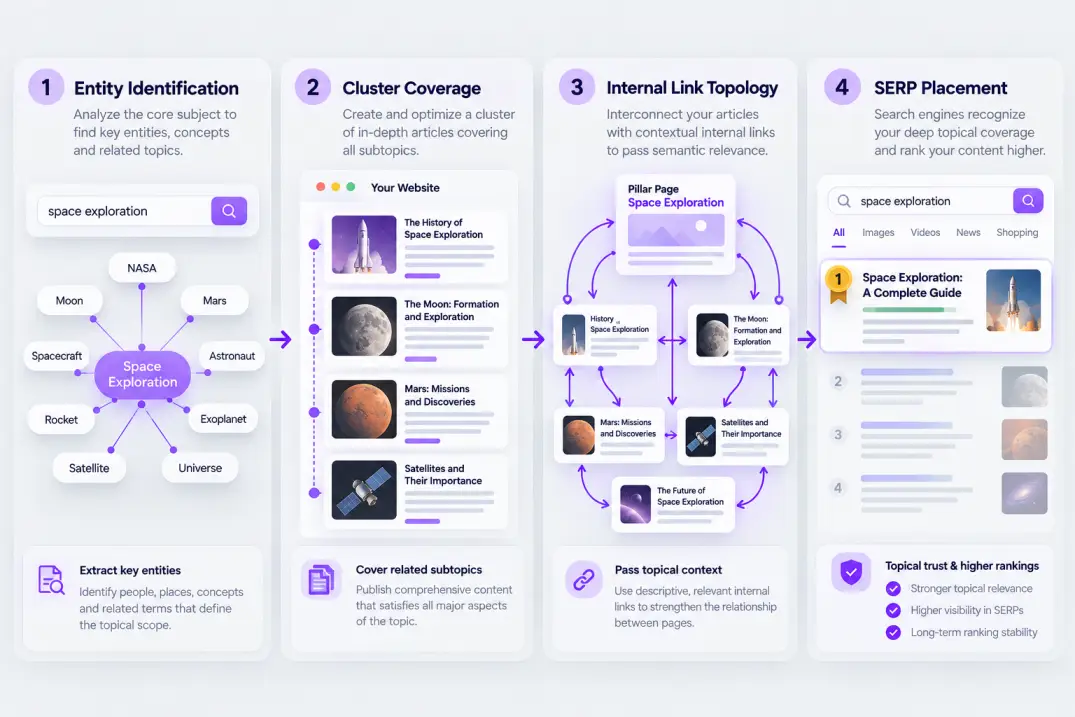
When search crawlers parse your site, they do not just read isolated keywords. They extract named entities, assess conceptual relationships, and measure semantic completeness against an established knowledge base.
When an algorithm encounters a page targeting a specialized query, it calculates three core algorithmic signals:
- Topical Breadth: Has this website addressed the parent topics, subtopics, and prerequisite questions surrounding the entity?
- Topical Depth: Does each individual document provide substantial analysis, original perspective, and information gain in SEO?
- Topical Connectivity: Are these pages organized into a clear topological graph using logical internal links, or do they exist as isolated islands?
If an enterprise site publishes one isolated post about a specialized topic, Google perceives a coverage vacuum. The algorithm cannot verify whether the publisher understands the edge cases, terminology, or practical problems associated with the query. Conversely, when a smaller website surrounds a core pillar page with dedicated articles answering adjacent user intents, the search engine recognizes an authoritative subject hub.
This semantic density triggers a multiplier effect across the entire cluster.
The 3 Architectural Pillars That Beat Brute Link Equity
Outranking high-DA competitors without spending a fortune on outreach requires executing three structural disciplines:
1. Complete Entity Coverage
Every niche contains a finite set of core entities, attributes, and user journeys. You establish topical authority by systematically answering every query variation within that ecosystem. Instead of publishing disconnected articles based on disparate keyword lists, map your niche into clear parent-child hierarchies. If you are covering warehouse logistics, you cannot stop at high-volume terms; you must cover pallet racking configurations, freight auditing, barcoding protocols, and inventory shrinkage prevention.
2. Strict Internal Linking Topologies
Backlinks may pass raw equity into a website, but internal links determine where that equity flows and what semantic meaning it carries. In a high-performing content hub, supporting sub-articles point directly back to the primary pillar page, while sibling articles link contextually to one another. When you implement a disciplined internal linking strategy, search bots can parse topical hierarchies instantly, distributing link equity directly to the pages competing on the SERP.
3. Query Intent Alignment
Generalist websites frequently fail because they match keyword strings rather than search intent. A query like "how to set up split testing in Webflow" requires exact technical sequencing, UI screenshots, and code snippets. High-DA sites often serve broad marketing platitudes that leave searchers bouncing back to the search results.
| Strategic Dimension | Domain Authority Strategy | Topical Authority Strategy |
|---|---|---|
| Primary Metric Tracked | Third-party DR/DA (0–100) | Entity coverage & ranking footprint |
| Growth Mechanism | Indiscriminate backlink acquisition | Systematic content clustering & internal links |
| Search Engine Signal | External link graph equity | Semantic completeness & query intent resolution |
| Vulnerability | Algorithm updates targeting unhelpful links | Content decay if subtopics are neglected |
| Cost to Scale | High (ongoing PR & outreach spend) | Moderate (focused content creation & architecture) |
Why High-DA Domains Still Get Outranked on High-Intent Queries
We have all observed SERPs where a niche blog with ten referring domains sits comfortably above Forbes, Business Insider, or a multi-billion-dollar enterprise brand. This happens because search engines calculate query satisfaction at the page and cluster level, not the root domain level.
When a user searches for an operational or transactional query, they need specific answers. Google’s Helpful Content and core ranking systems evaluate whether a site demonstrates genuine subject competence. A generic publisher covering finance, lifestyle, travel, and tech simultaneously sends diluted entity signals. Its content is frequently produced by generalist freelancers summarizing existing search results, adding zero unique information.
When your site demonstrates exhaustive depth, Google trusts your content to satisfy user intent without forcing the searcher to click another result.
This is why understanding how Google ranks new pages within an established topical hub is critical for sustainable growth.
How to Build Topical Authority Without a Massive Link Budget
Transitioning your organic strategy from chasing domain metrics to building subject expertise requires a systematic editorial process:
Step 1: Map the Semantic Landscape
Begin by identifying the primary entity representing your product or service. Break that entity down into 4–6 core categories, then unpack each category into 8–12 specific subtopics. By building a comprehensive topical map before drafting a single word, you guarantee that every article published supports an intentional cluster rather than floating in editorial isolation.
Step 2: Maintain Consistent Publishing Momentum
Search algorithms reward websites that systematically publish and update interconnected content within a defined space. Automating this cluster expansion requires mapping entity gaps before writing individual pieces. For example, Qoreta automatically identifies missing semantic subtopics across a niche, generating and interlinking supporting articles to reinforce topical depth without manual keyword spreadsheets.
Step 3: Prune Unrelated Content
Topical authority is dilutable. If your software blog suddenly publishes articles on general office productivity, travel tips, and crypto investments, you blur your entity footprint. Audit your index and remove or redirect pages that fall outside your primary domain of expertise.
Publishing dozens of articles targeting the same primary keyword with slight variations causes keyword cannibalization, splitting link equity and confusing search engine algorithms rather than building topical authority.
The Verdict: Entity Depth Over Brute Force
Domain authority is an external proxy metric; topical authority is a foundational search ranking mechanism. While earning authoritative backlinks from reputable websites remains an essential component of modern SEO, raw backlink volume without semantic depth cannot protect your rankings against agile, specialized competitors.
Stop measuring your search engine potential solely through third-party domain scores. Build exhaustive content clusters, structure your internal links with mathematical precision, and answer user queries with unmatched technical accuracy. When you prove to search engines that your website is the definitive resource on a specific subject, first-page rankings follow naturally.
Artificial Intelligence
Intelligence without limits.
We believe great content deserves honest authorship—even when it's AI.
Frequently Asked Questions
For a new domain publishing consistently, Google typically begins recognizing topical authority within three to six months. This timeframe depends on crawl frequency, how rapidly you publish an interconnected cluster of 20 to 30 relevant pages, and how cleanly your internal linking passes semantic context between those URLs.
While external backlinks provide necessary baseline trust and accelerate indexing, topical authority itself is derived from content completeness and internal architecture. A zero-backlink site can rank for long-tail queries within its cluster, but competing for high-volume commercial terms still requires foundational link equity to validate domain trust.
Yes. Publishing content outside your primary entity focus dilutes search engine comprehension of your site's core purpose. Known algorithmically as topic dilution, this causes crawlers to reallocate crawl budget away from core hubs and weakens the perceived expertise of your primary content clusters.
Search engines evaluate topical authority through semantic entity relationships, co-occurring technical concepts, and information gain rather than keyword repetition. Algorithms like Google's RankBrain and MUM look for comprehensive answers to sub-intents, original data, and user task completion rather than term frequency.
There is no static minimum, but most narrow B2B or niche topics require a central pillar page supported by at least 8 to 15 sub-articles. Broad industries may demand 30 to 50 interlinked pieces to cover parent entities, edge cases, and user buyer journeys thoroughly.
No. Natural backlinks from broad or high-DA news sites, directories, or mainstream platforms do not penalize your topical authority. Google's algorithms simply ignore the topical relevance of unrelated links rather than penalizing your site, unless those links violate webmaster spam guidelines.