Ahrefs vs KWFinder: Which Tool Fits Your SEO Strategy?

Artificial Intelligence
September 13, 2026
You sit with two browser tabs open, staring at two wildly different difficulty scores for the exact same search query. One dashboard tells you the phrase is an easy win you could rank for by next Tuesday; the other marks it as an ultra-competitive bloodbath requiring dozens of high-tier backlinks. When your entire editorial calendar rests on picking viable targets, conflicting numbers do not just create hesitation—they waste months of writing effort on content that never reaches page one.

In the debate between Ahrefs vs KWFinder, the right choice comes down to whether you need a dedicated, budget-friendly long-tail discovery engine or a comprehensive SEO operating system. Choose KWFinder if you run a blog, affiliate site, or boutique business and want an intuitive interface that surfaces attainable long-tail queries without overwhelming you with data. Choose Ahrefs if you manage an aggressive growth brand or agency that requires deep competitive gap analysis, multi-platform search volumes, and click-through metrics to combat zero-click search pages.
- KWFinder excels at rapid, low-friction discovery of long-tail terms with a beginner-friendly keyword difficulty formula.
- Ahrefs Keywords Explorer provides superior data depth, including historical SERP tracking, parent topic grouping, and click-stream estimates.
- KWFinder's difficulty score accounts for overall domain strength, while Ahrefs calculates difficulty strictly on referring domains to the top pages.
- Budget differences are stark: Mangools (KWFinder) starts under $35/month, whereas Ahrefs begins around $99/month with strict credit limits.
Both platforms are industry staples, but their underlying architectures serve fundamentally different content workflows.
Core Philosophy: Specialized Finder vs. SEO Powerhouse
To evaluate these platforms fairly, you must understand what each tool was built to accomplish. They are not simply two versions of the same product at different price points.
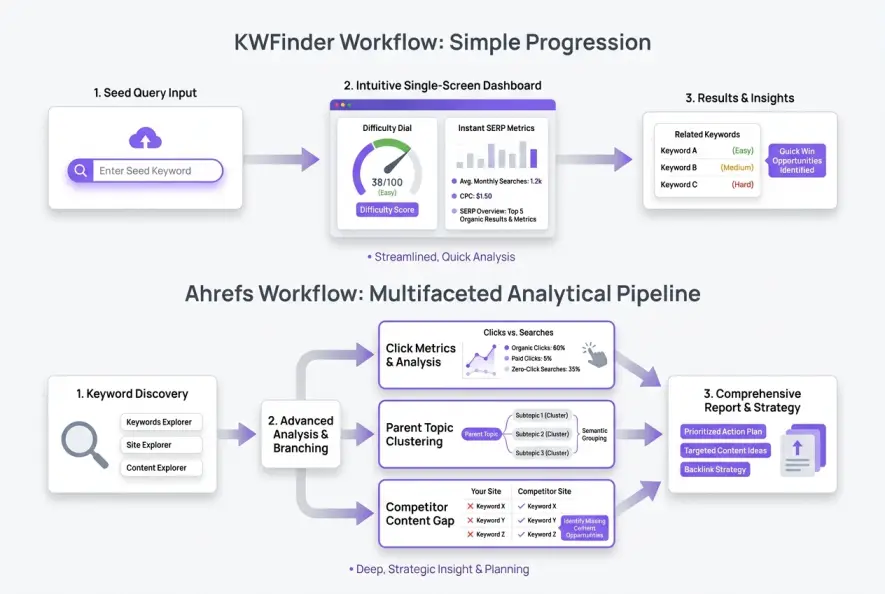
KWFinder is the crown jewel of the Mangools suite. From its inception, the developers designed it to do one specific job exceptionally well: make keyword research fast, visual, and accessible. You enter a seed query, and a single screen reveals search volume, a color-coded difficulty meter, 12-month search trends, and the current search engine results page (SERP) with immediate authority metrics. There are no convoluted multi-level menus or credit consumption warnings to distract you.
Ahrefs Keywords Explorer, by contrast, is one module inside a sprawling, enterprise-grade data intelligence suite. Powered by an active web crawler indexing billions of pages, Ahrefs tracks queries across Google, YouTube, Amazon, Bing, and several international engines. It treats keyword data not as an isolated list, but as an interconnected graph linked to backlink profiles, competitor traffic shares, and historical ranking movements.
This structural difference dictates your daily experience. If you open KWFinder, you can pull fifty viable content ideas during your morning coffee. If you open Ahrefs, you are embarking on an analytical deep dive that informs site architecture, link building targets, and competitive displacement campaigns.
When evaluating any keyword tool, never rely on search volume alone. Look for how effectively the interface helps you validate whether your specific domain has the topical relevance and link profile to compete for the top three positions.
Keyword Difficulty: Why the Scores Diverge
The most confusing aspect of running a side-by-side test between KWFinder vs Ahrefs is the variance in their Keyword Difficulty (KD) scores. It is common to see a term rated 28 (Easy) in Ahrefs and 45 (Possible) in KWFinder, or vice versa. This discrepancy happens because their proprietary algorithms measure competition from opposite angles.
How Ahrefs Calculates Difficulty
Ahrefs uses a calculation based purely on referring domains. Its scale (0–100) estimates how many backlinks pointing directly to the top 10 URLs are necessary to rank on page one. It does not measure the overall domain rating (DR) of the competing websites, nor does it factor in on-page content depth or search intent alignment.
This creates a specific blind spot. If a search query is dominated by mega-authority domains like Forbes, Reddit, or the New York Times, but those specific pages have zero direct external backlinks, Ahrefs may assign that keyword a KD of 2 or 3. If you launch a fresh blog expecting an effortless victory based on that score, you will hit a wall. Google often awards top positions to massive entities purely on brand trust and topical authority, even without page-level inbound links.
How KWFinder Calculates Difficulty
KWFinder builds its KD score using a blended metric derived from the overall link profiles of ranking pages. It evaluates the SERP using Moz metrics (Domain Authority and Page Authority) alongside Majestic metrics (Citation Flow and Trust Flow).
Because KWFinder factors domain-level strength into the equation, its difficulty scores frequently feel more realistic for newer websites and solo operators. If the SERP is packed with high-DA domains, KWFinder's dial pushes into the orange or red zone, warning you that unseating those giants requires more than just decent copy.
Understanding how these difficulty calculations work allows you to interpret the raw numbers instead of blindly following an arbitrary score.
Data Depth: Clicks, Intent, and SERP Real Estate
Where Ahrefs pulls far ahead in this comparison is in its granular search behavior telemetry. Modern search is no longer a simple equation where 1,000 monthly searches equals 1,000 potential visitors. With AI Overviews, knowledge panels, and local packs claiming prime visual real estate, many popular terms generate virtually no clicks to organic websites.
Ahrefs solves this by integrating extensive clickstream data directly into Keywords Explorer. For any given query, it displays:
- Clicks vs. Searches: The percentage of searches that result in an actual website visit versus those that terminate on the SERP.
- Clicks Per Search (CPS): How many distinct results an average searcher clicks before finishing their session.
- Parent Topic: The broader core query that Google ranks the top page for, preventing you from writing duplicate articles for minor variations.
- Traffic Potential (TP): An estimate of the total search traffic generated by the top-ranking page across all the secondary queries it captures.
Factoring in these secondary metrics is essential when clustering secondary keywords and protecting your production budget against zero-click search queries.
KWFinder does not provide click-through estimates or parent topic mapping. It displays Google's average search volume trends over the past 12 months, which helps identify seasonal spikes or dying trends, but it leaves you in the dark regarding SERP click cannibalization. If you target an informational phrase with a monthly volume of 5,000 in KWFinder, you must manually check Google to confirm whether an AI summary satisfies the query before anyone clicks an organic link.
| Feature & Metric | Ahrefs Keywords Explorer | Mangools KWFinder |
|---|---|---|
| Primary Focus | Full competitive & search data suite | Streamlined long-tail discovery |
| Keyword Difficulty Formula | Backlinks to top 10 URLs only | Blended SERP authority (DA/PA/CF/TF) |
| Click Telemetry (CPS / No-Click) | Yes (extensive clickstream modeling) | No |
| Parent Topic Identification | Yes (automated) | No (manual review required) |
| Supported Search Engines | Google, YouTube, Amazon, Bing, etc. | Google only |
| Starting Price (approx.) | ~129/month | ~49/month |
| Learning Curve | Moderate to steep | Near zero |
The Content Execution Gap: Moving from Data to Publishing
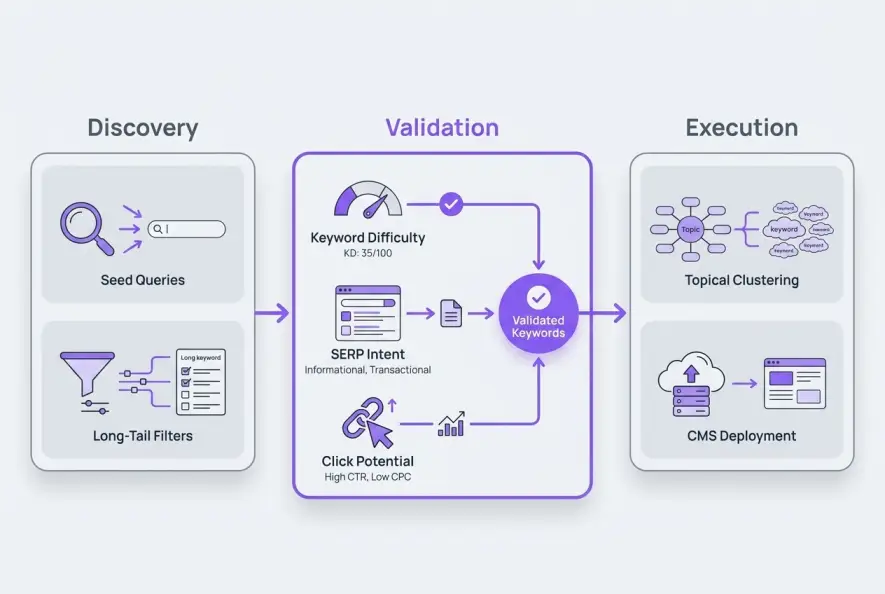
Selecting target terms is only the preliminary hurdle of search marketing. A common operational failure occurs when teams spend days comparing metrics between ahrefs kw explorer vs kwfinder, amass a spreadsheet of five hundred keywords, and then stall out at the drafting stage.
High search volume and an accurate difficulty score do not generate traffic until you produce an authoritative page that fulfills the query's core intent. According to Google's guidance on creating helpful content, search algorithms prioritize comprehensive, unique insights over pages that simply regurgitate basic keyword strings.
Bridging this gap requires connecting your keyword discovery directly to an efficient drafting and publishing engine. For example, autonomous platforms like Qoreta bridge this gap by taking low-competition targets identified during research, structuring comprehensive outlines, integrating citations and internal links, and publishing finished drafts straight to your CMS.
When your publication pipeline runs smoothly, the precision of your initial keyword research translates directly into compound organic growth instead of languishing in an unread spreadsheet.
Pricing, Usage Limits, and True Cost of Ownership
Budget considerations often make the final decision between these two platforms unmistakable.
Ahrefs operates on a software-as-a-service model tailored toward agencies and established companies. Its entry-level Lite plan hovers around 129 per month. More importantly, Ahrefs relies on a consumption-based credit system. Every time you open a report, apply an advanced filter, or view historical data, you consume credits. For an agency analyzing dozens of domains, these limits can force mid-cycle plan upgrades.
Mangools positions KWFinder at a fraction of that cost. Subscriptions typically range between 49 per month on annual plans. Furthermore, a single subscription grants full access to the other four tools in the Mangools ecosystem: SERPChecker, SERPWatcher (rank tracking), LinkMiner (backlink analysis), and SiteProfiler. While these companion tools do not match the depth of Ahrefs' Site Explorer or Site Audit, they provide more than enough data for solo webmasters and small marketing departments.
If you have a limited marketing budget, paying for Ahrefs just to check fifty keywords a month is an inefficient use of capital. You are paying for petabytes of backlink web crawlers and technical diagnostic tools that you may never touch.
The Final Verdict: Which Platform Should You Choose?
To make your decision straightforward, match your core business operational reality to the tool designed for it:
Choose KWFinder if:
- You are a solo creator, niche site owner, or small business focusing primarily on content marketing.
- You want a clean, distraction-free interface that shows volume, trends, and SERP competition on one screen.
- You prioritize targeting low-competition keywords without navigating intricate enterprise filters.
- Your monthly SEO software budget is strictly capped under $50.
Choose Ahrefs if:
- You manage an established site, an active SaaS product, or a digital marketing agency.
- You need to perform extensive competitor content gap analyses and reverse-engineer your rivals' top traffic sources.
- You require multi-channel intelligence across Google, YouTube, and Amazon to align with modern cross-platform discovery.
- You want clickstream insights to verify that the keywords you target still yield organic clicks in an AI-heavy search landscape.
Ultimately, neither tool writes the content or earns the rankings for you. KWFinder gives you the fastest path to discovering achievable topics, while Ahrefs gives you the complete data arsenal to dominate an entire niche.
Artificial Intelligence
Intelligence without limits.
We believe great content deserves honest authorship—even when it's AI.
Frequently Asked Questions
Both tools pull primary data from Google Keyword Planner, but Ahrefs pairs this data with extensive third-party clickstream modeling. This makes Ahrefs generally more reliable at unmasking lumped-together keyword volumes and revealing actual click-through rates, whereas KWFinder displays Google's traditional monthly search figures.
KWFinder itself is strictly for keyword research, but your Mangools subscription includes LinkMiner, a companion backlink analysis tool. While LinkMiner is solid for checking basic backlink profiles, Ahrefs' Site Explorer operates with a vastly larger crawl database and significantly more frequent index updates.
Ahrefs calculates its Keyword Difficulty score exclusively using the number of referring domains pointing to the specific ranking URLs on page one. If major authority domains rank using their site-wide domain authority without building direct links to that individual page, Ahrefs still rates the difficulty as low.
Yes, KWFinder is exceptionally well-suited for local SEO. It allows you to filter search volumes down to specific cities, states, and countries with precise local SERP previews, making it a favorite for local service providers and regional agencies.
Ahrefs does not offer a standard free trial for its full suite. It provides free access to limited reports via Ahrefs Webmaster Tools for verified website owners, but access to Keywords Explorer requires an active paid subscription starting at the Lite tier.
No. KWFinder exclusively analyzes Google search data. If your marketing strategy relies on finding search volume for YouTube video topics or Amazon ecommerce products, Ahrefs Keywords Explorer supports those alternative search engines natively.