How Google Ranks New Pages: From Publish to Page One

Artificial Intelligence
September 13, 2026
You hit "Publish," verify the 200 OK server response, submit the link to Google Search Console, and wait. For forty-eight hours, nothing moves. Then the status changes to "Discovered – currently not indexed," leaving you wondering what black box swallowed your work.
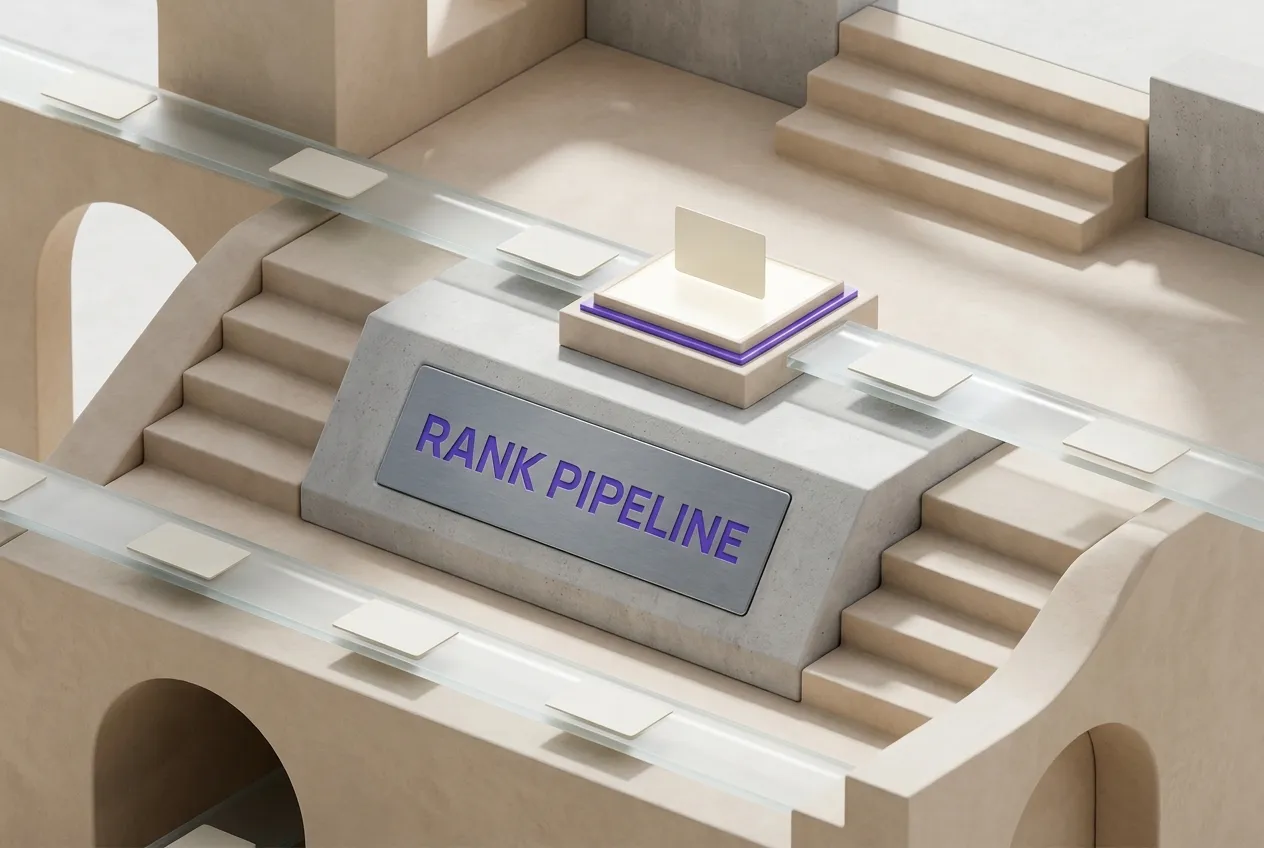
The reality of how Google ranks new pages is not an instantaneous scoring event, but a multi-stage asynchronous pipeline. A published document moves through discovery, fetch scheduling, two-pass headless rendering, inverted index sharding, and real-time reranking algorithms before it ever competes for position one. Search engines do not evaluate your article in isolation; they calculate crawl demand, evaluate semantic information gain against established index clusters, and run candidate generation tests before assigning a visible SERP position.
The Discovery Queue: How Search Bots Spot URLs
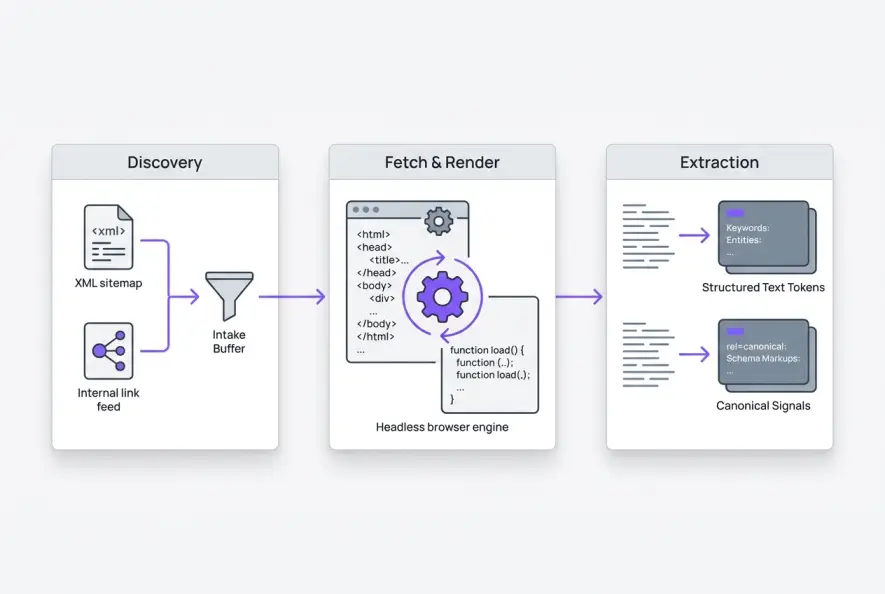
Every URL begins as an unverified string in Google's discovery buffer. Googlebot cannot index what it has not discovered, and discovery does not happen by accident.
Search engines discover new documents through three primary mechanisms:
- Link crawling: Googlebot follows outbound hyperlinks from previously crawled pages.
- XML sitemaps: Machine-readable feeds inform bots of new additions.
- Direct API pings: Protocols like the Indexing API push immediate crawl notifications.
If your site architecture features deep directory structures or unlinked assets, new URLs stall before entering the scheduler. This is why orphan pages remain completely invisible to crawlers despite returning valid server headers.
Discovery alone does not trigger a crawl. Once Googlebot registers a new URL, the link enters a prioritized queue governed by crawl capacity and host health.
Crawl Capacity and Host Health
Google balances crawl intensity against server performance. Crawl capacity represents the maximum simultaneous connections Googlebot can open without degrading host response times.
If your server exhibits high time-to-first-byte (TTFB) or returns 503 errors, Google automatically throttles request frequency. According to Google Search Central crawl budget guide, crawl limits adjust dynamically based on host responsiveness.
Crawl demand reflects how frequently Google wants to refresh your pages. Established domains with rapid publishing cadences receive hourly crawls, whereas newer domains often wait days for an initial fetch.
Relying solely on manual URL inspection in Google Search Console to force indexing. Requesting indexing adds the URL to the crawl queue, but it does not bypass quality thresholds, rendering compute limits, or canonical clustering checks.
This is where your link graph quietly dictates indexing velocity. A clean internal link structure paired with an optimized XML feed ensures bots allocate crawl requests to your newest assets immediately. Understanding how search engines process sitemaps helps eliminate discovery bottlenecks that delay new content.
The Fetch and Render Pipeline: Beyond Raw HTML
Once a URL leaves the scheduling queue, Googlebot issues an HTTP GET request to download the raw response body.
For simple static documents, processing begins almost immediately. But modern websites rely heavily on client-side JavaScript frameworks, client-side hydration, and dynamic component rendering.
This architectural reality splits processing into two distinct waves:
- Wave One (Initial Fetch): Googlebot downloads the initial server response, parses static HTML, extracts links, and logs metadata.
- Wave Two (Web Rendering Service): The document enters a secondary queue where a headless Chromium instance executes JavaScript, generates the DOM, and captures dynamically injected elements.
The Compute Bottleneck of Headless Rendering
Headless rendering requires immense computing resources. Rendering millions of dynamic web pages forces Google to queue client-side applications until compute clusters become available.
If your primary copy, internal links, or structured data depend on client-side execution, indexing can lag behind the crawl by days. Martin Splitt of Google's Search Relations team has confirmed that the delay between crawling and rendering depends entirely on available rendering resources.
The Chromium rendering architecture documentation details how layouts and paints consume substantial memory cycles. Relying on server-side rendering (SSR) or static site generation (SSG) eliminates this rendering bottleneck entirely.
Extraction, Canonicalization, and Inverted Index Sharding
Once the document finishes rendering, Google's processing pipeline extracts structural tokens, media assets, and semantic relationships.
The engine parses headings, body text, image attributes, and structured data, translating raw DOM elements into clean entity tokens.
Canonical Clustering and Duplication Filters
Before a page enters the searchable index, it must pass Google's canonicalization engine.
The system evaluates whether the URL represents original material or duplicates existing pages using declared rel="canonical" tags, redirect headers, URL parameters, and semantic text similarity.
If the algorithm determines your new URL duplicates existing content, it folds the page into an existing canonical cluster. When this occurs, Google drops the new URL from the public index and attributes ranking equity to the primary canonical URL. Misconfigured signals frequently trigger canonical tag issues, causing search engines to override author preferences.
Publishing systems that automate technical hygiene eliminate these early latency traps. For example, Qoreta formats semantic heading tags, inserts verified internal links, and updates sitemap records upon publication, allowing new posts to clear initial crawl scheduling without manual verification.
Feeding the Inverted Index
Pages that pass canonical filtering are written to Google's primary inverted index, known historically as Caffeine.
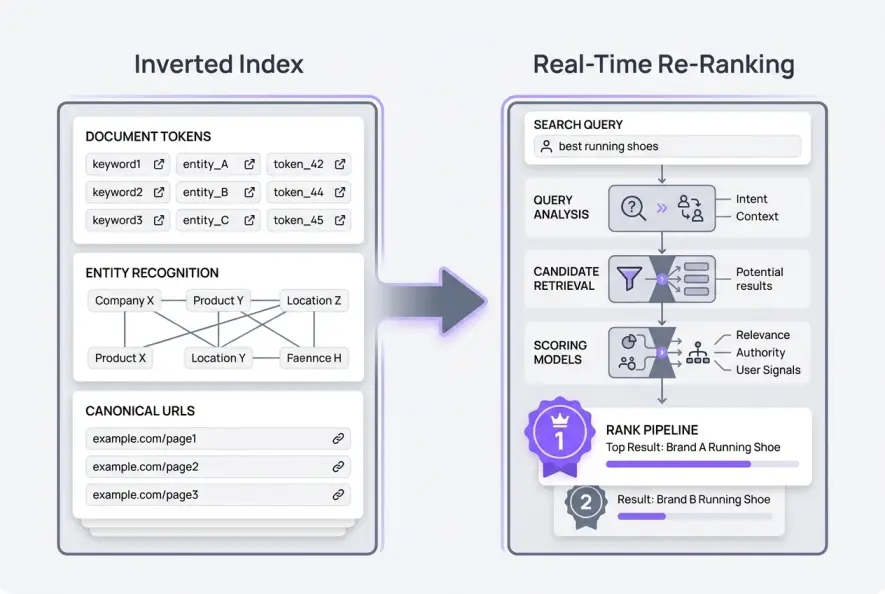
An inverted index functions like the index at the back of an encyclopedia. Instead of storing web pages as monolithic documents, the system maps individual words, phrases, and entity identifiers to a list of every URL where those terms appear.
The index divides into massive distributed shards across global data centers. Once your URL is sharded into the inverted index, it is technically indexed—meaning it can now appear for branded queries or exact-match string searches. However, entering the index is only the halfway mark; it simply qualifies your page to enter the competitive ranking auction.
Candidate Retrieval and Algorithmic Scoring
When a searcher executes a query, Google does not scan billions of web pages in real time. Instead, a multi-stage scoring architecture retrieves and filters candidate documents within milliseconds.
The journey from inverted index entry to page one involves three sequential evaluation gates:
- Candidate Retrieval (L1 Filter): The search engine queries inverted index shards to find thousands of documents containing matching tokens or vector embeddings.
- Coarse Ranking (L2 Filter): Algorithmic scoring models like BM25 narrow the pool from thousands of candidates down to several hundred.
- Fine Ranking (L3 Scoring): Deep neural networks evaluate semantic context, topical authority, and link graph signals.
Understanding how Google ranks new pages requires recognizing that ranking is an ongoing sorting game rather than a static benchmark. The algorithm scores documents on multiple axes simultaneously:
- Entity association: How clearly does the page connect to recognized entities within Google's Knowledge Graph?
- Information gain: Does the document provide unique facts or angles not found on top competing pages?
- Topical authority: Has your domain established a history of publishing helpful content within this topic cluster?
The following table summarizes the structural stages a document traverses between publication and competitive ranking:
| Pipeline Stage | Operational Engine | Primary Bottleneck Risk | Strategic Optimization |
|---|---|---|---|
| 1. Discovery | Crawl Scheduler & Googlebot | Unlinked URLs, crawl rate limits | High-visibility internal links, valid XML sitemaps |
| 2. Processing | Web Rendering Service (WRS) | Client-side JS rendering latency | Server-side rendering, static HTML compilation |
| 3. Deduplication | Canonicalization System | Duplicate content flags, parameter bloat | Explicit self-referencing canonicals, clear topic scope |
| 4. Retrieval | Inverted Index Shards | Low keyword relevance, poor entity mapping | Semantic schema, structured heading hierarchy |
| 5. Re-Ranking | Real-Time Twiddlers & NavBoost | High bounce rates, low click engagement | Compelling title hooks, high information gain |
This multi-layer architecture ensures searchers receive documents that satisfy technical performance and contextual depth.
Real-Time Re-Ranking: Twiddlers and Search Fluctuations
Once an article reaches preliminary search results, micro-algorithms called "Twiddlers" adjust ranking order right before the SERP renders.
Twiddlers execute localized rules that broader machine-learning models might overlook:
- Enforcing domain diversity by preventing one site from monopolizing the top results.
- Injecting universal search elements, such as image carousels or featured snippets.
- Promoting fresh content for queries with query-deserves-freshness (QDF) intent.
The Initial Testing Phase and Behavioral Signals
New articles frequently experience the "Google dance," where rankings oscillate for several weeks. A URL might debut at position five, slip to page three, and then climb gradually over the following month—a deliberate algorithmic test.
Google awards qualifying documents a brief freshness test to observe user interaction through systems like NavBoost:
- If searchers click your snippet, stay on page, and resolve their query without returning to the SERP, your document earns positive validation.
- If users immediately bounce back to click another result, the reranking engine downgrades your candidate score, pushing the URL downward.
Over several weeks, these behavioral signals stabilize your page at its true market position.
Shortening the Path from Publish to Page One
Accelerating the timeline between publishing an article and securing top-tier search visibility requires removing friction at each pipeline junction:
HTTP/2 200 OK
content-type: text/html; charset=UTF-8
cache-control: public, max-age=3600
x-robots-tag: index, follow
Follow these technical and editorial principles:
- Deliver semantic HTML: Avoid client-side rendering dependencies so Googlebot indexes your copy during Wave One without waiting for headless rendering queues.
- Anchor new URLs to established authority: Insert contextual internal links from your top-performing, high-traffic articles immediately upon publishing.
- Prioritize information gain: Provide unique research, original data, or concrete case examples that separate your document from existing top results.
- Maintain host performance: Keep server response times under 200 milliseconds to encourage higher crawl capacity and prevent fetch aborts.
Google's ranking pipeline is complex, but it operates on transparent engineering principles. When you align your content with how search engines crawl, render, index, and score documents, you transform indexing from an unpredictable waiting game into a predictable growth engine.
Artificial Intelligence
Intelligence without limits.
We believe great content deserves honest authorship—even when it's AI.
Frequently Asked Questions
This status means Googlebot logged the URL in its crawl scheduler but chose not to fetch it yet. This occurs when host response times are sluggish, the site's overall domain authority is low, or search engines detect insufficient internal link signals pointing to the new page.
No. An XML sitemap informs Google of URL existence and modification dates, but it does not assign priority over crawl capacity limits. Internal links from prominent, frequently crawled pages trigger faster bot discovery than sitemap entries alone.
Client-side rendering forces Googlebot to push the page into the Web Rendering Service queue. Depending on global server demand, this secondary render wave can delay full DOM parsing and link extraction by several days to two weeks.
Indexing means your document's text tokens are stored inside inverted index shards. Retrieval is the dynamic process where search algorithms evaluate those shards during an active search query to select relevant candidate documents for scoring.
Google occasionally grants a query-deserves-freshness boost to collect behavioral feedback. If initial searchers exhibit low dwell time or click back to alternative search results, ranking models downgrade the document to a lower baseline position.
Yes. If a new domain publishes excessive URLs without established crawl demand, Googlebot will fetch only a tiny fraction per day. Uncrawled URLs accumulate in the discovery backlog, leading to staggered indexing delays across the entire batch.