SEO Forecast Tool: How to Model Traffic and Pipeline ROI

Artificial Intelligence
September 10, 2026
Leadership asks for next quarter's organic revenue projections during your Monday planning session. If your response relies on multiplying keyword search volumes by a flat 3% click-through rate in a static spreadsheet, you are building your budget on quicksand. One algorithmic reshuffle, a seasonal demand drop, or a competitor launching programmatic pages can instantly wreck an uncalibrated linear model.

An SEO forecast tool eliminates this guesswork by processing historical search console data, seasonal search demand curves, and dynamic click-through rate (CTR) models to predict future search visibility, organic visits, and downstream revenue. Instead of static hunches, predictive search modeling generates probabilistic scenarios—typically base, conservative, and aggressive growth trajectories—that give executive stakeholders dependable numbers to allocate headcount, editorial budgets, and engineering sprints.
This is why understanding predictive search modeling transforms organic marketing from a speculative cost center into a measurable revenue engine.
Always strip branded navigational queries from your baseline data before feeding an SEO forecast model. Branded search behaves like direct traffic and will artificially distort your non-brand organic growth projections.
How SEO Forecasting Models Actually Calculate Future Traffic
Modern search forecasting moves far beyond naive linear extrapolation. In organic search, traffic growth is non-linear because ranking gains follow compounding authority curves and logarithmic click distributions.
Professional predictive systems rely on two distinct mathematical approaches to forecast organic performance:
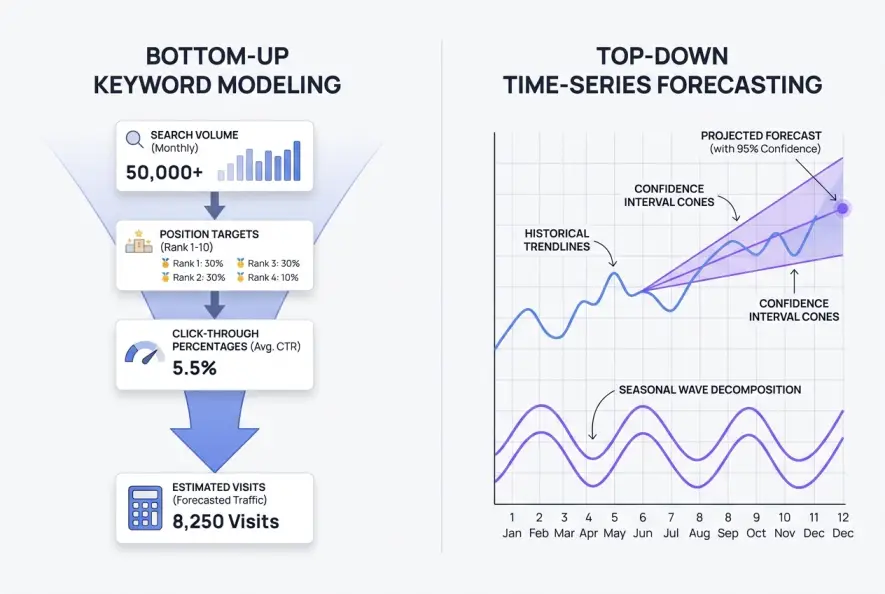
1. Bottom-Up Keyword-Level Modeling
Bottom-up forecasting calculates traffic by evaluating individual keyword clusters, expected ranking improvements, and position-based CTR decay curves. The core formula operates as:
Projected Visits = Search Volume × Target Position CTR × Search Intent Multiplier
This method excels for targeted content sprints, product launches, or site migrations where you target specific clusters of low-competition keywords. You identify where your pages currently rank, estimate achievable positions based on topical authority, and apply realistic click distributions to calculate incremental visits.
2. Top-Down Time-Series Decomposition
Top-down forecasting evaluates your entire domain's historical performance using statistical time-series models. Rather than inspecting individual keywords, it decomposes aggregated traffic into four mathematical components:
- Baseline Trend (): The underlying growth or decline trajectory of your domain.
- Seasonality (): Predictable cyclical swings across weeks, months, or quarters.
- Holiday & Event Shocks (): External calendar impacts, such as Black Friday surges or summer slumps.
- Residual Error (): Random variance and unaccounted volatility.
Open-source algorithms like Meta's Prophet library use additive regression models to handle missing data, abrupt trend shifts, and holiday effects without requiring manual curve smoothing.
| Forecasting Method | Primary Data Source | Best Use Case | Core Strength | Primary Limitation |
|---|---|---|---|---|
| Bottom-Up Keyword Model | Target keywords, SERP CTR curves | New content launches, cluster expansion | Highly actionable for editorial planning | Misses macroeconomic & seasonal shifts |
| Top-Down Time-Series | GA4, Google Search Console logs | Quarterly executive forecasting | Captures broad seasonal trends accurately | Cannot predict individual page-level wins |
| Causal Impact Analysis | Pre/post intervention time-series | Measuring site migration or technical fixes | Isolates true incrementality from noise | Requires historical pre-period stability |
The 4 Core Metrics a Modern SEO Forecast Tool Can Predict
An enterprise-grade SEO forecast tool bridges the communication gap between technical practitioners and commercial leadership by translating ranking improvements into financial metrics.
- Non-Brand Organic Impressions & Clicks: By tracking SERP visibility indices, the software isolates baseline brand demand from true market acquisition.
- Confidence Intervals (P10, P50, P90): Sophisticated models never provide a single static number. They output probabilistic bands representing conservative (P10), expected (P50), and optimistic (P90) outcomes.
- Downstream Conversion Pipeline: Layering average conversion rates over projected landing page visits predicts leads, demo requests, and e-commerce transactions.
- Estimated Organic Revenue: Multiplying projected conversions by your Average Contract Value (ACV) or average order value produces defensible ROI projections.
A B2B software company modeled a 12-month SEO expansion targeting mid-funnel comparison queries. Using a statistical time-series forecast with an 80% confidence interval, they projected 34,000 incremental quarterly visits generating $420,000 in new pipeline. Actual delivered revenue came within 6.2% of the P50 model.
Comparing the Leading SEO Forecast Tools and Frameworks
Selecting the right SEO forecast tool or framework depends on your team's technical depth, data infrastructure, and organizational scale.
Enterprise SEO Platforms (seoClarity, BrightEdge, Conductor)
Enterprise platforms provide automated forecasting engines that combine proprietary CTR curves with historical search trends. They pull competitor search share and calculate revenue potential across entire category taxonomies with minimal manual setup.
Specialized SEO Forecasting Software & Trackers (SE Ranking, Ahrefs Traffic Potential)
Tools like SE Ranking offer dedicated forecasting modules that calculate keyword-based traffic projections using customizable click models. Meanwhile, Ahrefs and Semrush provide traffic potential calculations by analyzing top-ranking page performance for every keyword query.
Custom Statistical Scripts (Python Prophet & Google CausalImpact)
For enterprise data teams, building custom Python pipelines remains the gold standard. By piping Google Search Console bulk export data into Google BigQuery, data analysts run custom Prophet models that account for multi-year seasonality and algorithm disruption shocks.
Step-by-Step: How to Build a Defensible SEO Forecast
Follow this structured 5-step framework to build projections that earn executive trust and survive scrutiny from finance teams:
Step 1: Clean and Segment Your Historical Baseline
Export 16 to 24 months of historical click and impression data from Google Search Console and GA4. Filter out branded searches, remove temporary URL tracking parameters, and group pages into topical clusters based on your topical map.
Step 2: Establish Position-Specific CTR Curves
Generic industry CTR averages (like assuming 30% for position 1) will ruin your forecast. SERPs dominated by AI Overviews, sponsored shopping carousels, or video packs capture vastly different click shares than clean organic SERPs. Calculate your domain's real CTR by query category directly from Search Console data.
Step 3: Factor in Content Velocity and Indexing Lag
Content does not generate traffic on the day you hit publish. There is a documented 60 to 120-day incubation period while search engines crawl, render, and evaluate new content clusters.
Factoring in publishing cadence and content velocity is essential for realistic forecasting. For example, autonomous publishing workflows like Qoreta model this pipeline naturally by maintaining consistent content velocity across targeted keyword clusters, allowing forecasters to map steady crawl acceleration and compounding topical authority rather than hoping for unpredictable traffic spikes.
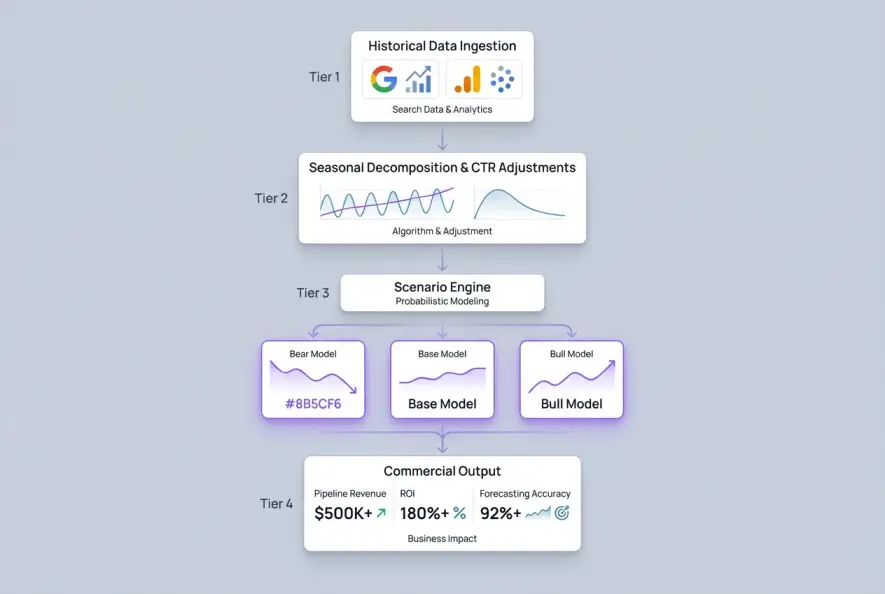
Step 4: Run Multi-Scenario Modeling (Bear, Base, Bull)
Never present a single static forecast to your leadership team. Deliver three scenarios:
- Conservative (P10): Minimal ranking gains; accounts for aggressive competitor moves or search volatility.
- Expected (P50): Standard execution where planned content updates and technical fixes meet benchmarks.
- Aggressive (P90): Accelerated ranking velocity across high-value commercial terms.
Step 5: Convert Traffic Projections to Business Pipeline
Tie projected search sessions to commercial conversion events. Use historical conversion rates specific to page types—product landing pages convert higher than top-of-funnel glossaries—and multiply by average contract value to prove expected ROI.
Never forecast organic traffic by applying a single company-wide conversion rate. A blog guide on definitions might convert at 0.4%, while an alternative-comparison page converts at 4.2%. Model conversion rates at the subfolder or URL-pattern level.
Three Costly Forecasting Mistakes That Invalidate Your Projections
Even experienced marketing teams make fundamental errors that derail their organic projections:
- Ignoring SERP Feature Compression: Search results with AI Overviews, paid ads, and local packs compress traditional organic CTR by up to 40%. A predictive model that ignores SERP layouts will drastically over-project click volume.
- Overlooking Historical Content Decay: Existing pages lose rankings over time as freshness signals degrade and competitors publish counter-content. A defensible forecast must subtract baseline decay (typically 5% to 15% annually) before adding projected new gains.
- Assuming Instant Rank Velocity: Modeling day-one ranking gains for newly published pages creates unrealistic near-term expectations. Always build in a 90-day ramp curve for new asset indexation.
By choosing a purpose-built SEO forecast tool or deploying structured statistical time-series models, search marketers can set realistic expectations, secure executive buy-in, and build organic growth programs backed by reliable mathematical rigor.
Artificial Intelligence
Intelligence without limits.
We believe great content deserves honest authorship—even when it's AI.
Frequently Asked Questions
Reliable SEO forecasts typically cover 3 to 12 months. Predicting beyond one year introduces compounding error margins due to algorithm updates, SERP layout changes, and competitor strategy shifts. For annual planning, update your rolling forecast every quarter.
Bottom-up forecasting models granular keyword search volumes, target ranking positions, and specific CTR curves for individual pages or clusters. Top-down forecasting uses aggregated historical traffic to evaluate seasonal cycles, baseline domain momentum, and macro trends through time-series regression.
AI Overviews push organic blue links down the page and satisfy zero-click informational queries directly in the SERP. To maintain accuracy, reduce historical CTR benchmarks by 20% to 40% for informational queries likely to trigger generative summaries.
Yes, if you use statistical programming libraries. Combining Google Search Console API data with Meta's open-source Prophet library in Python or R often provides higher mathematical precision than rigid SaaS tools, though it requires coding ability and data cleaning.
Present an 80% confidence interval split into three distinct scenarios: P10 (conservative/bear case, with 90% probability of meeting or exceeding), P50 (expected/base case), and P90 (aggressive/bull case). This prevents setting rigid, single-point expectations.
You cannot predict the exact timing or impact of unannounced core updates, so your model should incorporate historical volatility buffers. Review how your domain performed across the previous three core updates and factor that variance into your conservative P10 scenario.
Branded traffic reflects brand equity, offline marketing, and existing customer navigation rather than net-new acquisition. Forecasting blended traffic creates false correlations between SEO activities and revenue, masking whether organic search is actually acquiring new customers.