Why Your AI-Written Blog Is Invisible: The Unspoken Rules of AI Content Ranking

Artificial Intelligence
September 6, 2026
Consider a master architect who designs the most breathtaking museum in the world, but builds it at the end of a dirt road with no signs or maps leading to the entrance. No matter how incredible the exhibits are, the halls remain completely empty. This is exactly what happens when you treat artificial intelligence as an end-to-end SEO strategy rather than just a high-powered drafting tool. You hit publish on a beautifully formatted, grammatically flawless post, but the traffic never comes.

The reason your articles are invisible is simple: search engines do not rank words; they rank relationships, unique insights, and structural authority. Generating the text is only a tiny fraction of the battle. The core secret to AI content ranking lies in what happens before and after the prompt—injecting information gain, building semantic entity maps, and weaving a web of crawlable internal architecture.
If you are tired of watching your organic traffic flatline while your content calendar overflows, it is time to look under the hood. Here is why your automated drafts are failing to move the needle, and exactly how to fix the underlying foundation of your publishing workflow.
The Trap of Consensus Content
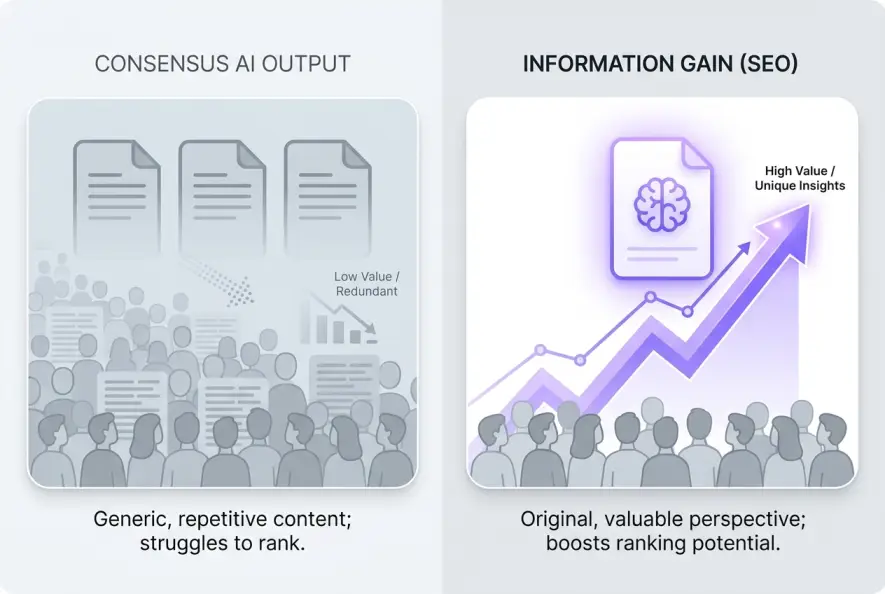
Large language models are inherently designed to predict the most likely next word based on their massive training datasets. By definition, they output the average of the internet. When you ask a model to write a guide on productivity, it will spit out the exact same "drink water, use the Pomodoro technique, sleep eight hours" advice that already exists on a million other domains.
Google’s algorithms specifically target this kind of repetition. Search engines are actively looking for "information gain"—a measurable score of how much new, unique information your page adds to a topic compared to the existing search results. If your post is just a well-written summary of the top three ranking pages, it offers zero information gain.
Relying entirely on a single prompt like "Write a 1500-word blog about SEO" is the fastest way to generate consensus content that search engines ignore. Break your prompting down by sub-headings to maintain control over the insights.
How do you inject information gain into an automated workflow? You have to bring the data yourself. Feed the model proprietary statistics, real customer quotes, or contrarian viewpoints. Instead of asking the AI to brainstorm the outline, give it a highly opinionated outline and ask it to expand on your specific arguments.
As detailed in Search Engine Journal's breakdown of the Helpful Content System, rewarding unique, first-hand value is a permanent algorithmic fixture. This ensures the output is structurally unique before the very first paragraph is even drafted.
The Silent Killer: Poor Site Architecture
You can have the most insightful draft in your niche, but if your website's architecture is flat and disorganized, web crawlers will never find it. Every time you publish a post without tying it into your site's existing web of relevance, you are essentially building a new page on an isolated island.
This is where understanding internal link architecture becomes critical. Search engines use links to understand the hierarchy and topical authority of your domain. A brand new AI-generated post has zero external backlinks to vouch for its credibility. Its only lifeline is the internal link equity passed down from your homepage or your top-performing legacy posts.
When a crawler hits your site, it operates on a "crawl budget." If it has to dig through clunky pagination or unlinked category archives to find your new automated draft, it will simply give up. You must intentionally bridge your new posts to your high-authority pages using descriptive, context-rich anchor text.
Semantic Entities Over Keyword Density
For years, SEOs obsessed over keyword density—cramming the exact same phrase into a post over and over. AI models are often guilty of reverting to this outdated tactic when told to "optimize for SEO." But the biggest hurdle in AI content ranking is not keyword matching; it is proving deep topical expertise through semantic entities.
Search algorithms map the world using a Knowledge Graph, connecting real-world concepts (entities) to each other. If you are writing an article about running shoes, a keyword-stuffed post might just repeat "best running shoes" twenty times. An entity-optimized post, however, will naturally discuss "EVA foam," "pronation," "heel drop," and "carbon plates."
| Traditional Keyword SEO | Semantic Entity SEO |
|---|---|
| Repetitive exact-match phrases | Rich contextual vocabulary |
| Focuses on search volume metrics | Focuses on answering topical intent |
| Sounds robotic and forced | Reads naturally to a human expert |
| Easily flagged as unhelpful content | Signals deep industry knowledge |
When configuring your AI drafts, explicitly instruct the model to include these related semantic entities. Google Search Central's guidelines on AI-generated content make it abundantly clear that high-quality, authoritative information is rewarded regardless of how it was produced. Speaking the language of an expert through entity inclusion is how you prove that authority.

The Engagement Signal and User Experience
Another critical pillar of AI content ranking is what happens immediately after a user clicks your link on the search engine results page (SERP). Getting indexed is only step one; maintaining that rank requires positive engagement signals.
If a visitor clicks your link, sees a massive, unbroken wall of robotic text, and immediately hits the back button to return to the search results, they trigger a "pogo-sticking" event. This tells the algorithm that your page did not satisfy their query. Over time, poor engagement metrics will sink even the most technically perfect SEO article.
When a leading marketing agency audited their underperforming automated posts, they found the core issue wasn't the writing quality—it was a lack of outbound citations and visual breaks. Adding bulleted lists, relevant external links, and scannable headers boosted their organic retention by 40%.
As noted in Backlinko's extensive analysis on dwell time, user interaction metrics heavily influence where a page settles in the long term. To combat bounce rates on AI drafts, you must aggressively format for readability. Use short paragraphs. Bold key concepts. Break up the text with callout boxes and highly relevant data tables.
AI Detectors vs. Reality
There is a persistent myth that search engines are running your blogs through third-party AI detectors and penalizing them simply for being machine-generated. This is fundamentally untrue. The algorithms do not care who—or what—wrote the text. They care exclusively about whether the text solves the searcher's problem.
Understanding what Google actually ranks means letting go of the fear of AI detection and focusing entirely on the E-E-A-T framework (Experience, Expertise, Authoritativeness, and Trustworthiness). A human-written article that offers nothing new will be outranked by an AI-drafted article that compiles unique data, sites credible sources, and organizes the information flawlessly.
Search engines penalize spam, not automation. If your automated workflow is producing thin, repetitive spam, you will be penalized. If your workflow is scaling the production of genuinely helpful, well-architected insights, you will be rewarded.
- AI drafts provide the structure; you must provide the unique data and point of view.
- Internal linking dictates how fast your new automated content gets crawled and indexed.
- Focus on incorporating semantic entities and related concepts rather than raw keyword density.
- Format relentlessly to protect your user dwell time and engagement signals.
Scaling your content calendar is a massive competitive advantage, but only if you build the infrastructure to support it. Stop treating the final output of an AI model as a finished product. Treat it as a powerful first draft that requires structural SEO framing, and you will finally start capturing the search traffic your topics deserve.
Artificial Intelligence
Intelligence without limits.
We believe great content deserves honest authorship—even when it's AI.
Frequently Asked Questions
No. Google's official stance is that they reward high-quality, helpful content regardless of how it is produced. They penalize spam and unhelpful, repetitive content—not the use of AI itself.
Information gain is a measure of how much new, unique value a piece of content adds to a topic compared to what is already ranking. It includes original data, unique perspectives, or first-hand experience.
Avoid massive walls of text. Use short, three-line paragraphs, bulleted lists, markdown tables, and callout boxes. Scannable formatting keeps users on the page longer, which improves your engagement signals.
Traditional keyword targeting often leads to unnatural repetition. Semantic entities focus on related concepts and industry vocabulary, proving to search algorithms that the content possesses deep topical expertise rather than just gaming a specific phrase.
Internal links pass authority (PageRank) from your established, high-traffic pages to your new posts. This provides search engine crawlers with a direct path to discover, crawl, and index your new content much faster.