Low-Competition Keywords: The Hidden Strategy for SEO ROI

Artificial Intelligence
September 1, 2026
According to Ahrefs search research, 94.74% of all search queries in search engine databases receive ten or fewer searches per month. Yet, the vast majority of marketing teams routinely waste over 80% of their organic budget competing for high-volume "head" terms where the first page of Google is dominated by media conglomerates and multi-billion-dollar SaaS domains.

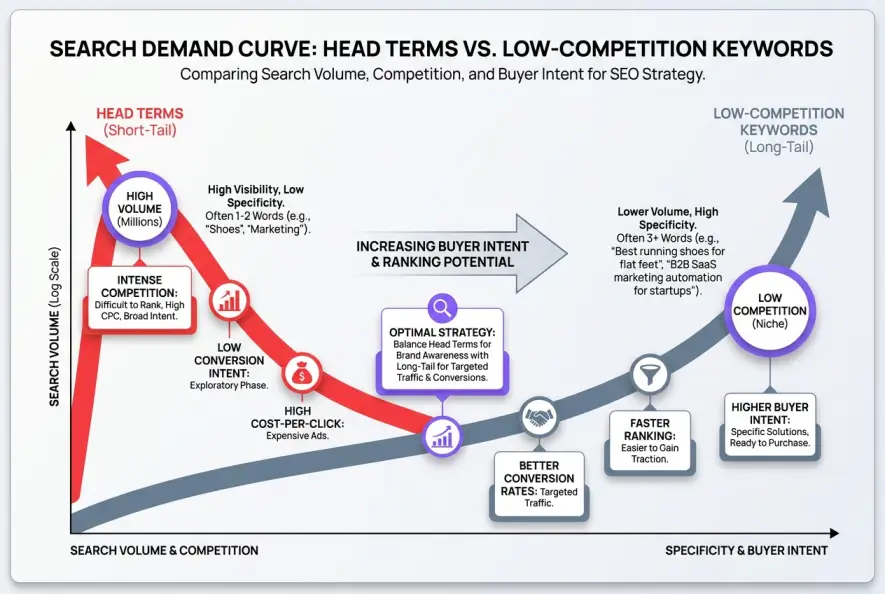
Targeting low-competition keywords yields superior organic ROI because these specific search terms align directly with high-intent decision stages, carry lower domain authority entry barriers, and aggregate into compounding traffic faster than competitive head terms. Instead of spending twelve months building backlinks to reach page four for a broad query, focusing on low-competition keywords allows growing sites to bypass domain authority barriers and convert qualified buyers immediately.
When you analyze how modern searchers behave, the appeal of high search volume vanishes quickly. High-volume keywords are almost always generic. A search for "CRM software" could come from a college student writing a paper, a job seeker reviewing industry terminology, or a casual browser looking for a quick definition. None of these users are ready to evaluate a product or make a purchasing decision.
Conversely, someone typing "best lightweight CRM for independent real estate agents" has a granular problem and an active budget. While third-party keyword tools might estimate that specific query at 20 searches per month, its commercial conversion rate is exponentially higher.
- Broad head terms carry high bounce rates and low commercial purchase intent.
- Low-competition queries match specific, transactional buyer needs.
- Aggregating twenty low-volume rankings often outperforms a single volatile high-volume position.
The Mathematical Reality of Organic Traffic ROI
To evaluate the true economic return of organic search, you must calculate Revenue Per Visitor (RPV) rather than raw traffic volume. Consider two contrasting content strategies:
-
Strategy A (High-Volume Focus): Target a broad head term with 25,000 monthly searches. After nine months of aggressive link building and content production, your page reaches position #8, capturing roughly 2% of total clicks (500 visits). Because the search intent is ambiguous, the page converts at 0.2%. Total result: 1 customer per month.
-
Strategy B (Low-Competition Focus): Publish ten dedicated articles targeting specific low-difficulty search queries with an average estimated volume of 150 searches each (1,500 total volume). Within six weeks, eight of these pages rank in the top three positions, capturing an average CTR of 28% (420 visits). Because the content addresses specific user pain points, the conversion rate reaches 3.5%. Total result: 14 customers per month.
Strategy B generates 14x more customer acquisitions with significantly lower production friction, zero paid backlink outreach, and a drastically accelerated payback period.
Why High-Volume Keywords Are an Expensive SEO Trap
Chasing competitive keywords creates a compounding resource drain that modern marketing teams can rarely afford. Over the last three years, Search Engine Result Pages (SERPs) for high-volume head terms have undergone a dramatic structural collapse for organic publishers.
According to recent SparkToro search data, zero-click searches and platform-owned SERP features now capture a growing majority of search sessions. On high-volume commercial queries, Google inserts top-of-page sponsored ads, local map packs, shopping carousels, and AI Overviews. By the time a searcher scrolls down to the first traditional organic result, they have already navigated past four screens of paid and algorithmically generated real estate.
+-------------------------------------------------------------+
| Typical High-Volume SERP Layout                             |
+-------------------------------------------------------------+
| [ Paid Google Ads (4 Sponsored Listings) ]                  |
| [ AI Overview Box / Direct Answer Snippet ]                 |
| [ People Also Ask (Interactive Accordion) ]                  |
| [ Aggregator / Directory Carousel ]                         |
|-------------------------------------------------------------|
| Position #1 Organic Result (Below the Fold)                 |
+-------------------------------------------------------------+
For low-volume, highly specific search terms, this SERP clutter largely disappears. Search engines rarely trigger sponsored ad auctions or elaborate AI summaries for long-tail queries that lack massive search volume. As a result, the top organic search result for a low-competition phrase sits near the top of the viewport, capturing click-through rates that often exceed 35% to 40%.
Furthermore, established authority sites rarely create dedicated content for low-volume queries because their editorial teams are structured around vanity metrics. This leaves a massive structural void for agile content teams to capture high-converting organic market share.
Don't judge keyword potential solely by third-party monthly volume estimates. Keyword tools routinely underreport low-competition traffic by 300% to 500% because niche search variants and conversational phrases escape standard search database sampling.
When you stop competing for saturated head terms, you can concentrate your publishing energy on building a topical map that establishes deep semantic relevance across your entire niche.
A 4-Step Framework to Uncover High-ROI Low-Competition Keywords
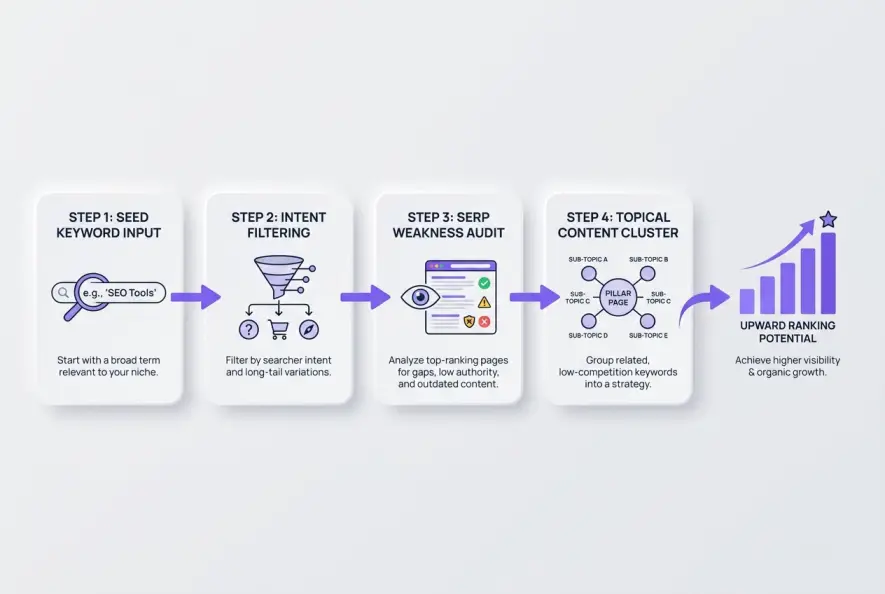
Finding low-difficulty, high-intent terms requires shifting away from basic keyword tools that simply order keywords by search volume. Here is the operational framework used by top growth teams to build predictable organic pipelines.
Step 1: Mine Primary Pain Points and Unstructured Community Search Data
Start where your target audience articulates unvarnished problems. Analyze customer sales calls, support tickets, product reviews, and community discussions on Reddit and niche forums. Search for recurring sentence structures such as:
- "How do I fix [specific tool error] when using [platform]?"
- "Alternative to [major competitor] for [specific team size/use case]"
- "Is [product category] worth it for [specific industry]?"
These phrases represent real human friction. When typed into search engines, they indicate a user actively searching for an immediate solution.
Step 2: Audit SERP Weakness Indicators
Once you compile a list of seed terms, evaluate page-one results manually or with automated scrapers. Look for clear structural signals that Google is struggling to find satisfying content:
- Page-one rankings occupied by user-generated content (Q&A forums, Reddit threads, Quora).
- Title tags that do not match the target query's search intent.
- Outdated articles that have not been refreshed in 2+ years.
- Low Domain Rating (DR) or low Domain Authority (DA) websites occupying top three positions.
If an unoptimized forum post or a five-year-old blog post ranks in the top five results, a concise, up-to-date article will rapidly outrank it.
Step 3: Cluster Topical Variants to Maximize Information Gain
Never target low-volume keywords as isolated, one-off blog posts. Instead, group 5 to 10 closely related queries under a unified semantic theme. For example, if your primary niche is email marketing, group low-competition queries around "abandoned cart emails for Shopify stores."
By offering unique insights, proprietary data, or concrete workflows across this cluster, you maximize information gain in the eyes of search algorithms. This cluster structure signals to search engines that your domain possesses comprehensive expertise on the subtopic.
Step 4: Systematize Content Velocity and Publishing Workflows
The primary advantage of low-competition targeting is speed. To capture meaningful total traffic, you need to execute content production quickly and consistently. Increasing your content velocity across low-difficulty terms creates a compounding traffic curve.
For instance, platforms like Qoreta automate low-competition keyword discovery and topical mapping by scanning real-time search patterns, allowing teams to build targeted content clusters without manual spreadsheet mining.
| Strategy Metric | High-Volume Head Terms | Low-Competition Keywords |
|---|---|---|
| Search Intent Precision | Low / Ambiguous | High / Transactional |
| Average Time to Rank | 6 to 18 Months | 2 to 6 Weeks |
| SERP Ad & AI Overcrowding | Extreme (3-4 Ad Units) | Minimal / Clean SERP |
| Conversion Rate (Lead/Sale) | 0.2% - 0.8% | 2.5% - 6.0% |
| Backlink Capital Required | High ($$$$) | Low / Zero Outreach |
Building a Sustainable Organic Growth Engine
Shifting your content strategy toward low-competition keywords is not a compromise—it is a competitive advantage. While your competitors burn capital fighting for saturated head terms that produce vanity traffic, you can quietly systematically capture every high-intent search query across your vertical.
Focus on depth over breadth. Build tightly interlinked content clusters, answer specific questions thoroughly, and publish at a steady velocity. Over time, as your domain builds topical authority across dozens of low-competition queries, search engines will naturally begin pushing your site upward for broader, higher-volume terms without requiring millions of dollars in paid outreach.
Artificial Intelligence
Intelligence without limits.
We believe great content deserves honest authorship—even when it's AI.
Frequently Asked Questions
For a site with low domain authority, well-optimized content targeting low-competition queries typically begins indexing and ranking on page one within 2 to 6 weeks, compared to 6 to 18 months for broad head terms.
Yes. While individual terms carry lower monthly volumes, targeting dozens or hundreds of clustered low-competition queries produces a high-converting, compounding traffic base that often outperforms single volatile head terms.
Examine search results for modifier words like 'best for,' 'alternative,' 'pricing,' or 'vs,' as well as CPC metrics in keyword tools. High CPC on low-volume terms indicates strong advertiser demand and buyer intent.
Yes, but treat them as long-term parent topics rather than immediate traffic targets. Create high-volume pillar pages, then interlink lower-competition supporting articles into them to build topical authority over time.
Relying exclusively on keyword tool volume estimates and failing to evaluate SERP intent. Many zero-volume keywords in tools actually receive hundreds of monthly visits from long-tail search variations.
Publishing 8 to 15 well-researched, clustered articles per month creates strong semantic signals and helps search engines map your site's topical authority within 60 to 90 days.