Content Atomization: How to Turn 1 Post Into 15 Assets

Artificial Intelligence
September 2, 2026
According to industry research published by the Content Marketing Institute, over 80% of B2B marketing teams regularly publish blog posts, yet fewer than one-third report having an organized framework to distribute and amplify those assets across multiple channels. Marketing teams regularly spend 15 to 20 hours researching, outlining, drafting, and polishing a comprehensive long-form article, only to tweet the live link once, drop it into an automated RSS feed, and abandon it forever in their blog archives.

Content atomization is the systematic framework of taking a single, deeply researched pillar asset—such as an original industry breakdown, tactical teardown, or proprietary benchmark report—and deconstructing it into 10 to 15 modular, platform-native derivative assets. Rather than lazily copy-pasting article URLs across social media, atomization isolates the individual data points, counter-intuitive arguments, mental models, and visual frameworks contained inside the core piece and rebuilds them specifically for each distribution channel.
This approach eliminates the frantic treadmill of inventing new editorial topics from scratch every morning. When executed correctly, one flagship piece of thought leadership fuels your organic newsletter, executive LinkedIn profiles, community discussions, and sales enablement workflows for an entire month.
The "Publish and Pray" Trap vs. The Distribution Engine
Most content teams suffer from an asymmetry between production effort and distribution output. They treat hitting "Publish" on their content management system as the finish line of a project, when it is actually just the point of asset creation.
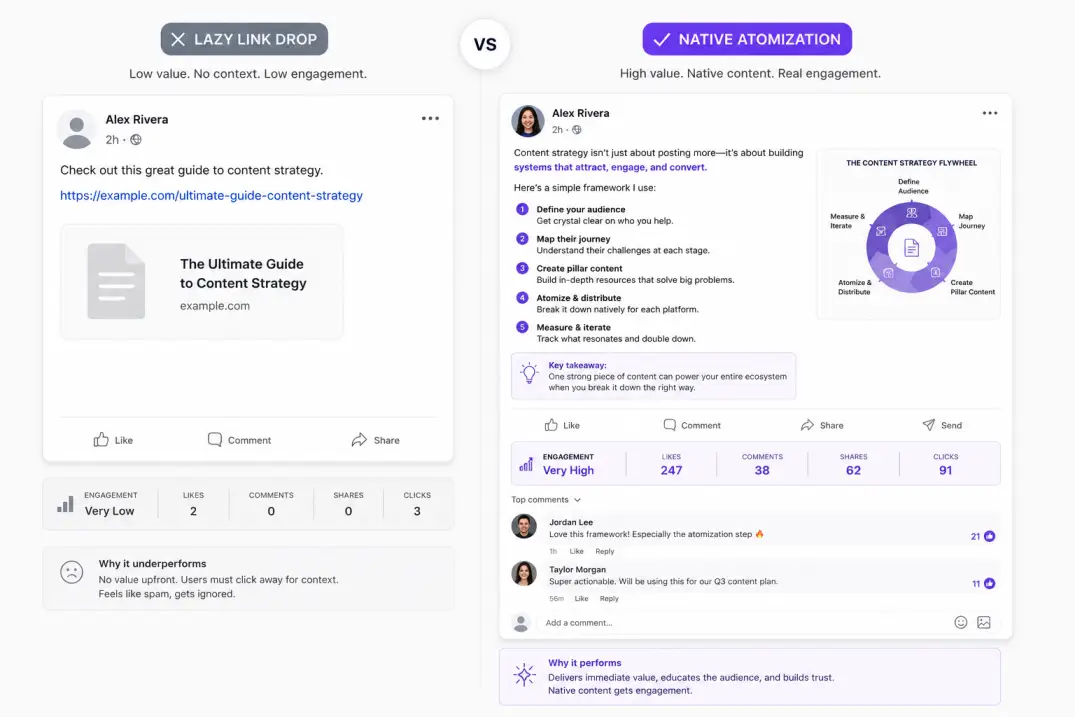
Dropping a raw link into a LinkedIn post or a company Slack group generates almost zero meaningful reach. Major algorithmic feeds deliberately suppress external links because their business models depend on keeping user attention inside their own ecosystems. When you ask a reader to click away from their feed to read your 2,000-word post, you force massive friction onto them before delivering any standalone value.
Dropping a raw URL on social platforms with a generic caption like "Check out our new blog post!" signals zero value to readers and causes algorithms to suppress your reach. Every derivative asset must deliver self-contained insight directly in the user's feed.
This is why content ROI quietly collapses inside growing marketing departments. You pay the full upfront cost of subject-matter expert interviews, editing rounds, and strategic positioning, but capture only a fraction of the potential audience. By shifting to a modular asset extraction model, you turn a single research sprint into a compounding distribution engine.
The Anatomy of an "Atomizable" Pillar Post
Not every article deserves to be atomized. If your source material is a generic 600-word summary assembled from top search results, breaking it down will only leave you with uninspiring fragments that fail to engage your audience.
When executing content atomization, your source material must function as a high-density anchor piece. It needs specific structural elements that can be extracted cleanly without losing analytical rigor:
- Proprietary Data or Benchmark Stats: Concrete numbers, survey percentages, or internal conversion metrics that provide objective proof points.
- Named Frameworks and Mental Models: Visual or conceptual diagrams that simplify a complex business workflow into repeatable steps.
- Contrarian or Polarizing Perspectives: Specific arguments that challenge standard conventional wisdom within your industry.
- Actionable Step-by-Step SOPs: Granular instructions that solve a specific execution bottleneck for your target buyer persona.
When your initial pillar post is built around high-conviction product-led content, extracting derivative assets becomes an editorial filter rather than a creative chore.
- High-density pillar content is the mandatory foundation for effective atomization.
- Isolate 4 distinct elements: raw data points, conceptual models, contrarian takes, and step-by-step SOPs.
- Every derivative piece must deliver complete standalone utility without requiring an external click.
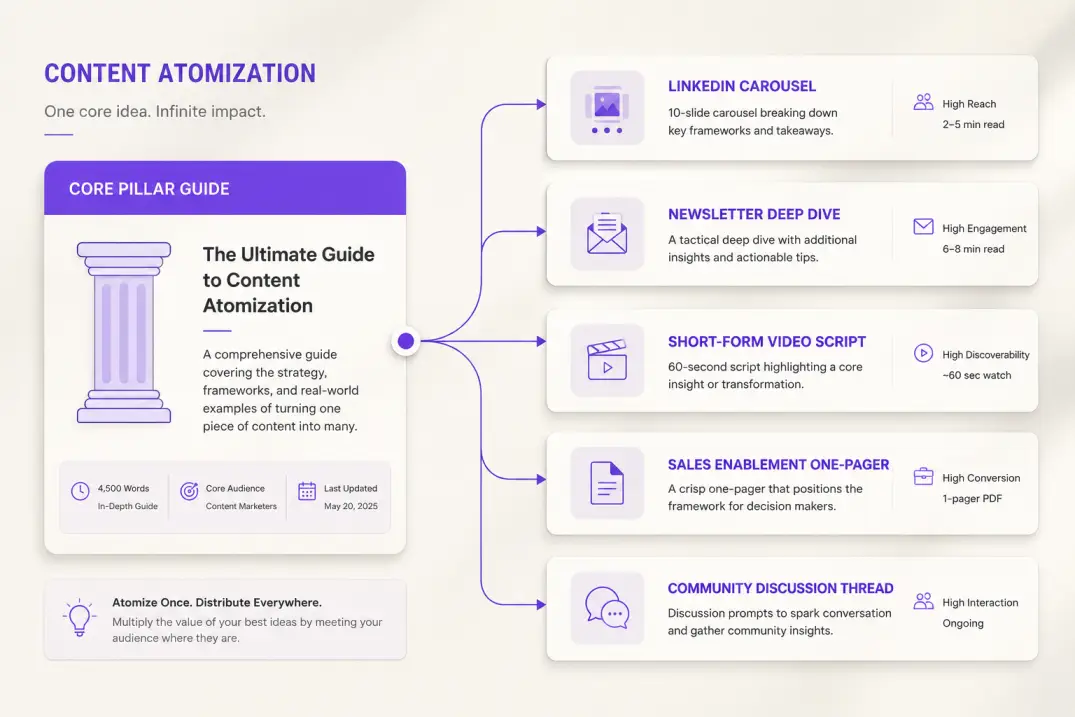
The 1-to-15 Asset Extraction Matrix
To transform an anchor article into a multi-channel campaign, you need a structured operational matrix. The goal is to match each core conceptual component of the long-form post to the format and medium where it naturally performs best.
Here is how a single 1,500-word tactical guide translates into 15 standalone assets across owned, earned, and shared marketing touchpoints:
| Source Element in Pillar Post | Extracted Asset Type | Primary Channel | Core Objective |
|---|---|---|---|
| Core Framework / Diagram | Document Carousel (PDF) | Establish visual authority and earn saves/reposts | |
| Granular Workflow Steps | Text-only Tactical Breakdown | X / Threads | Drive comments and peer discussions |
| Benchmark Stat / Data Point | Single-Stat Quote Card | Instagram / LinkedIn | Capture rapid visual engagement in feeds |
| Contrarian Industry Argument | Founder / Executive Op-Ed | Personal Profiles | Position leadership against common industry mistakes |
| Complete Methodology | 5-Minute Dedicated Email | Owned Newsletter | Deliver zero-friction education directly to subscribers |
| Technical Troubleshooting | Text Teardown & Code/SOP | Reddit / Quora | Provide direct answers in relevant community threads |
| Step-by-Step SOP | 60-Second Walkthrough Script | YouTube Shorts / TikTok | Visual demonstration of the workflow in action |
| Executive Summary | 1-Page Customer PDF | Sales Enablement / DMs | Arm sales reps with collateral to overcome deal objections |
| Customer Edge-Case Solution | Support Macro / Help Doc | Customer Success Hub | Reduce recurring support tickets for account teams |
| Core Question / Polemic | Poll / Discussion Prompt | Slack Groups / Communities | Seed debate inside private peer networks |
| Key Quote / Core Epiphany | Minimal Text Visual Graphic | Social Feeds | High-contrast visual soundbite for feed scrollers |
| Audio Breakdown of Concept | 3-Minute Podcast Segment | Audio Feeds / Shows | Audio snippet for mid-roll or standalone episode drop |
| Actionable Cheat Sheet | Downloadable Checklist / Notion | Lead Nurture Automation | Re-engage cold leads in automated nurture sequences |
| Industry Trend Analysis | Guest Contribution / Pitch | Industry Publications | Pitch core finding as external thought leadership |
| Data Graph / Visualization | High-Res Chart Asset | Partner Co-Marketing | Provide source material for industry partners to reference |
This framework ensures that regardless of where your ideal customer spends their attention—whether reading an inbox newsletter, browsing mobile feeds between meetings, or searching inside private peer channels—they encounter your core insight in their preferred medium.
The 4-Step Operational Atomization Workflow
A repeatable content atomization workflow prevents editorial bottlenecks. Rather than treating repurposing as an afterthought handled days after publishing, growth teams integrate the extraction process directly into their primary editorial pipeline.
Step 1: Structural Tagging During the Outlining Phase
Before writing the first draft of the pillar article, tag sections using standardized brackets (e.g., [CAROUSEL], [NEWSLETTER-HOOK], [STAT-CARD]). Marking these derivative opportunities early ensures the writer includes sharp, punchy summary sentences and explicit data points that stand on their own without requiring additional contextual framing.
Step 2: Native Platform Translation
Never duplicate text verbatim across distinct platforms. A successful LinkedIn post requires a curiosity-driven opening hook, short 1-to-2 line paragraphs, and an analytical tone. Conversely, an email newsletter demands a warm, direct first-person narrative that leads into a singular clear takeaway, while audience discovery on dark social channels relies on self-contained frameworks that people can easily copy-paste into private Slack groups.
When atomizing content for newsletters, remove all external blog links from the first three-quarters of the email. Let the reader consume the entire strategy directly in their inbox; only provide a link to the complete guide at the bottom for those who want deeper documentation.
Step 3: Dark Social and Community Seeding
Take the most tactical problem-solving section of your article and format it as a native forum contribution. If your article explains how to solve a complex API rate-limiting issue or build a programmatic workflow, post the complete tactical solution directly inside relevant subreddits, Discord channels, or niche Slack groups without inserting a promotional backlink. High-quality answers naturally build brand recall and drive high-intent direct search queries over time.
Step 4: Sales and Customer Success Integration
Your sales reps spend dozens of hours answering the exact same prospect objections on discovery calls. Package the frameworks and data comparisons from your pillar posts into one-page PDF summaries or Notion cheat sheets. When a prospect expresses hesitation about a specific workflow, your sales team can immediately send a branded, educational asset that reinforces your company's subject-matter expertise.
Scaling Modular Repurposing Without Lowering Editorial Taste
While automating repetitive distribution tasks is necessary to maintain consistent content production velocity, relying on generic, unconstrained AI prompts creates bland, repetitive social copy that damages brand credibility.
To scale atomization efficiently, use structured prompt chains that enforce strict constraints around tone, formatting, and structural hooks. Rather than asking a language model to "repurpose this blog for LinkedIn," pass specific instructions that define the target audience, eliminate buzzwords, and demand platform-specific formatting rules.
### SYSTEM PROMPT: Modular Content Extractor
Role: Senior B2B Content Strategist
Task: Extract 1 LinkedIn Document Carousel outline from the provided pillar post.
Constraints:
- Exactly 6 slides (Cover, 4 Content Slides, 1 CTA Slide).
- Max 35 words per slide. Use bold headers and concise bullet points.
- Slide 1 must feature a high-contrast contrarian hook.
- Ban all corporate buzzwords: "revolutionize", "game-changer", "dive deep".
- Output clean Markdown ready for slide-deck layout.
After generating the initial derivative drafts, an editor must review the outputs to ensure data points match the original research, the brand's distinct voice remains intact, and the messaging aligns with active product marketing goals.
Measuring Multi-Channel ROI Beyond Surface Pageviews
Evaluating content success solely through traditional website analytics paints an incomplete picture. When you distribute atomized assets natively, the majority of audience interactions happen on external platforms rather than your website's domain.
According to audience research frameworks from SparkToro, measuring modern distributed content requires tracking a combination of on-platform and downstream business metrics:
- In-Feed Engagement Depth: High-intent saves, bookmark counts, document downloads, and detailed comment discussions on social channels.
- Direct & Branded Search Volume: Increases in baseline homepage visits and organic brand name queries following major distribution campaigns.
- Assisted Pipeline Touchpoints: Prospect mentions of specific carousels, newsletters, or frameworks during sales qualification calls.
- Newsletter Subscriber Velocity: The rate of net-new email subscribers gained directly from native social threads and guest contributions.
When you stop obsessing over raw URL clicks and start evaluating total reach across all buyer touchpoints, the compounding value of modular asset distribution becomes clear. You stop producing disposable single-use articles and start building an evergreen library of modular business assets.
Artificial Intelligence
Intelligence without limits.
We believe great content deserves honest authorship—even when it's AI.
Frequently Asked Questions
Basic repurposing often involves simply copying and pasting snippets or sharing raw blog URLs across different profiles. Content atomization, by contrast, deconstructs a pillar piece into its core conceptual units—such as data points, contrarian arguments, and step-by-step SOPs—and rewrites each unit specifically for the native mechanics and audience expectations of individual platforms.
Shallow news roundups, short product announcements, generic 500-word definition posts, and curated listicles lack the conceptual depth required for atomization. An article must contain substantial substance—such as proprietary survey data, comprehensive workflows, or novel tactical frameworks—to yield meaningful derivative assets.
Instead of publishing all 15 derivative assets during the first week, schedule them across a 4-to-6 week timeline. Distribute the primary native breakdown and newsletter summary in week one, release visual slide decks and quote cards in weeks two and three, and deploy community contributions and sales enablement collateral in subsequent weeks to maintain steady momentum.
Because each derivative asset highlights a distinct angle, format, and data point from the original pillar post, followers do not feel like they are reading repetitive content. A follower might consume a high-level summary on LinkedIn, read an in-depth tactical implementation in your newsletter, and view an executive chart on Twitter without ever seeing the exact same phrasing.
The primary writer or subject-matter expert should tag key hooks and extract the core takeaways during the drafting phase. From there, a content marketer or social media manager handles platform-specific translation and scheduling, while a graphic designer or design tool formats visual carousels and summary graphics.
Track direct traffic spikes, branded organic search volume, new email newsletter signups, and qualitative self-reported attribution fields on your demo or signup forms (e.g., 'Where did you first hear about us?'). Buyers frequently consume native social content and later visit your website directly when they are ready to purchase.