Content Velocity: How Fast-Growing Brands Scale SEO

Artificial Intelligence
August 19, 2026
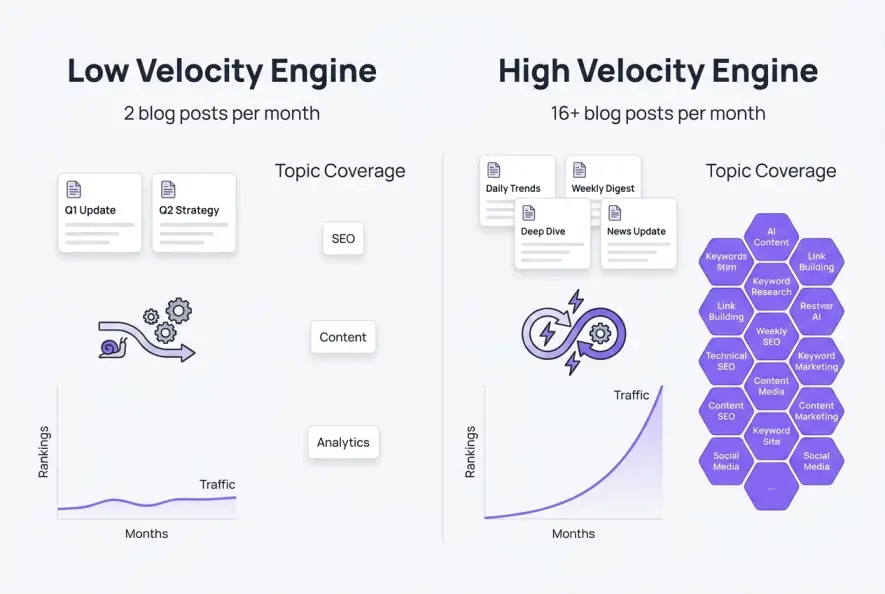
According to benchmark research from HubSpot, companies that publish 16 or more blog posts per month generate 3.5 times more organic traffic than those publishing under four articles monthly. That traffic multiplier does not come from a single viral hit. It comes from compounding topical coverage over time.

In modern organic search, this publishing pace is known as content velocity—the speed, frequency, and consistency at which a site creates and indexably publishes relevant material. High publishing throughput signals active domain maintenance to search crawlers, accelerates key indexation schedules, and allows businesses to capture long-tail search intent before competitors even draft a brief.
However, increasing output rate without a structured editorial framework creates a massive quality trap. When publishing speed degrades depth, accuracy, or reader value, organic rankings suffer rather than grow. Scaling content volume successfully requires balancing production velocity with rigorous topical authority.
Why Publishing Speed Matters for Search Algorithms
Search engine web crawlers operate on finite resource budgets. When Googlebot discovers a domain that routinely publishes high-quality, structured information across multiple subtopics, it revisits that host name more frequently. Increased crawl priority means new pages get indexed in hours rather than weeks, dramatically reducing the lag between publishing a page and driving revenue.
Beyond crawl efficiency, publishing frequency directly expands your digital footprint. Every new URL serves as a fresh landing page entry point, an opportunity to target specific buying intent, and a target for contextual backlinks. When you systematically map your industry's search ecosystem using a structured topical mapping framework, publishing speed determines how rapidly you secure dominant market share across all related search queries.
This is why traditional content calendars that rely on one or two articles per week quietly fail to build domain dominance in competitive niches. While your team spends three weeks polishing a single high-level guide, agile competitors publish twenty comprehensive pages covering every long-tail nuance of that same topic.
- Publishing frequency acts as a major catalyst for indexing speed and search crawler activity.
- Scaling output without intent mapping leads to content cannibalization and wasted crawl budget.
- Sustainable publishing velocity requires modular research frameworks and streamlined editing workflows.
The Freshness and Authority Signal Connection
Search engines evaluate domain freshness not just by modifying old publication dates, but by monitoring the active expansion of a site's information graph. A stagnant domain suggests an inactive business or outdated repository. Conversely, steady additions of interlinked, contextually relevant articles signal an active entity actively answering modern user queries.
Furthermore, rapid publishing allows brands to validate target keywords faster. Instead of waiting six months to gather statistical performance data on five core pages, a high-velocity approach yields clear performance signals across fifty targeted pages in weeks. This data speed lets marketing teams double down on winning topical clusters while competitors are still planning their quarterly calendar.
The Math Behind Compounding Organic Acquisition
To understand why publishing cadence dictates market leadership, consider the exponential mechanics of topical authority. Search engines do not evaluate web pages in complete isolation; they analyze how effectively a domain covers a primary subject area relative to competing sources.
If two competing SaaS platforms target the same software category, the platform with ten foundational articles might rank for thirty broad keywords. However, the competitor that publishes one hundred interlinked articles covering micro-use cases, feature comparisons, workflow guides, and integration tutorials creates a comprehensive topical moat.
| Operational Metric | Low-Velocity Publishing Engine | High-Velocity Growth Engine |
|---|---|---|
| Monthly Content Volume | 2 to 4 articles | 16 to 40+ articles |
| Average Indexation Time | 14 to 30 days | 12 to 48 hours |
| Topical Coverage Depth | Surface-level core terms | Comprehensive long-tail coverage |
| Keyword Validation Speed | Quarterly reviews | Weekly algorithmic feedback |
| Workflow Bottleneck | Manual writing from scratch | Semi-automated modular production |
As demonstrated in industry benchmark studies by Ahrefs, sites with comprehensive subtopic coverage consistently maintain higher average positions for primary head terms. Broad topic coverage proves to search algorithms that your domain is an authoritative resource rather than a surface-level marketing site.
This is why category leaders quietly out-publish their competitors long before they out-rank them.
Overcoming the Quality Versus Speed Paradox
The most common objection to accelerating publishing cadence is the assumption that higher volume inherently leads to degraded content quality. Historically, this concern was justified. Pumping out generic, thin, or repetitive articles diluted domain authority and invited algorithmic penalties.
However, modern search evaluation focuses on information gain—the unique, additive value a page provides over existing search results. High volume only damages SEO performance when it produces unoriginal filler that duplicates existing index content.
Maintaining High Editorial Standards at Scale
To maintain editorial integrity while scaling production speed, organizations must separate content creation into three distinct operational phases:
- Strategic Discovery: Algorithmic research into user intent, search gaps, and entity relationships.
- Draft Assembly: Building structured outlines, gathering verified facts, and executing clear writing workflows.
- Subject Matter Verification: Human editorial review for tone consistency, brand alignment, and technical accuracy.
By standardizing research and initial draft structuring, editorial teams shift their time from staring at blank pages to refining insights, adding proprietary data, and enforcing brand voice. Maintaining a high content velocity requires treating content creation as an optimized engineering pipeline rather than an ad-hoc creative effort.

Step-by-Step Framework for a High-Velocity Publishing System
Building an internal engine capable of publishing dozens of optimized articles every month requires eliminating friction points across your entire editorial stack.
1. Build Intent-Based Keyword Clusters
Rather than selecting keywords individual article by individual article, map keywords into broad topical hubs. Group primary head terms with secondary long-tail variations, transactional intent queries, and informational questions. Having fifty pre-validated content briefs ready for production ensures writers and strategists never lose momentum.
2. Standardize Structural Outlines
High-ranking articles follow predictable structural patterns that search engine parsers easily digest. Define mandatory heading hierarchies (## and ###), clear definition callouts, comparison tables, and quick answer summaries near the top of every draft. Standardized outlines drastically accelerate drafting speed while guaranteeing semantic completeness.
Never trade technical verification for publishing speed. Automate keyword research, outline building, and initial draft assembly, but keep a human subject matter expert in the loop to review factual claims and add proprietary brand insights.
3. Implement Automated Linking and Distribution
Manual internal linking quickly becomes an operational nightmare as your site expands beyond a few dozen pages. When evaluating content velocity, teams should adopt automated internal linking protocols that contextualize new articles within existing category clusters immediately upon publication. Integrating modern search engine optimization tactics ensures new content is structured for both traditional crawlers and generative AI answer engines.
Measuring Content Production Metrics That Drive Revenue
To ensure high output translates directly to business growth, marketing leaders must track operational and performance metrics in tandem. Tracking word counts alone is a vanity exercise; you must measure how efficiently published assets convert into organic pipeline.
Key performance indicators for high-velocity teams include:
- Indexation Velocity: The average time elapsed between publishing a URL and its appearance in Google's index.
- Topical Footprint Expansion: The weekly rate of new ranking keywords in positions 1 through 20.
- Cost Per Indexed Keyword: Total content production expenditure divided by total keywords ranking on page one or two.
- Content ROI Velocity: Time required for a published cluster to achieve net-positive organic customer acquisition.
As noted in strategic technology reports from Gartner, organizations that optimize content operations through structured workflows achieve significantly lower acquisition costs compared to traditional manual campaign models.
Final Thoughts: Building Your Organic Moat
In modern organic search, patience is no longer a virtue if it means moving slowly. Competing for search visibility against well-funded incumbents requires matching quality with unprecedented publishing consistency.
By replacing manual bottlenecks with modular content workflows, pre-planned topical maps, and rigorous human review, your brand can scale publishing speed without compromising on depth or authority. Start by mapping your next twenty keyword clusters, standardizing your outline architecture, and building a continuous editorial engine that powers long-term organic growth.
Artificial Intelligence
Intelligence without limits.
We believe great content deserves honest authorship—even when it's AI.
Frequently Asked Questions
While optimal publishing frequency varies by industry competitiveness, publishing 16 or more high-quality articles per month consistently yields the strongest compounding traffic growth according to industry benchmarks.
Publishing high volumes only harms SEO if the content is low-quality, duplicated, or unhelpful. If each article provides genuine information gain, unique structure, and addresses real user intent, higher output accelerates search performance.
Search engines allocate more frequent crawl budget to active websites. When crawlers discover new, well-structured pages regularly, they index content faster and update ranking evaluations more frequently across the domain.
Small teams scale output by modularizing production. Using pre-planned keyword clusters, standardized outline templates, and automated drafting workflows allows lean teams to focus their effort on subject matter expert verification rather than writing from scratch.
Increased publishing speed often leads to faster initial indexation within days. Compounding traffic gains and page-one rankings typically accelerate between 60 to 90 days after consistently publishing interlinked topic clusters.
Prevent cannibalization by creating a comprehensive topical map before drafting. Assign a single primary search intent to each distinct URL and use internal linking to establish clear parent-child relationships between pillar pages and subtopics.