Product-Led Content: Why Most SaaS Tutorials Never Convert

Artificial Intelligence
September 10, 2026
You publish a 3,000-word tutorial that quickly climbs to page one of Google, pulling in tens of thousands of organic visits every month. Analytics look incredible on your monthly marketing report, but when you check your product signups and sales pipeline, the conversion line is completely flat. Searchers arrive, scan the general advice, copy what they need, and bounce without ever clicking your product demo or exploring your solution.

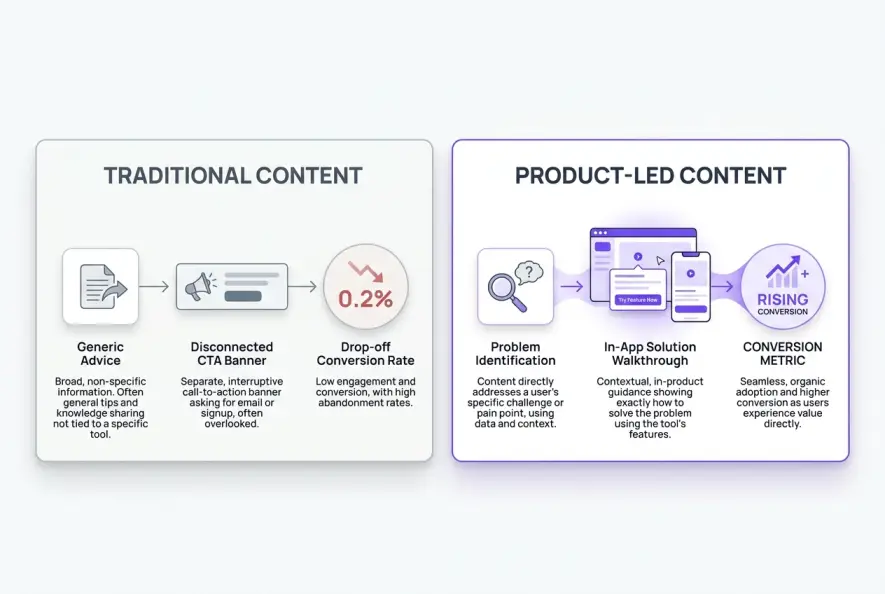
The core reason educational blogs fail to generate revenue is that they treat the product as an awkward afterthought tacked onto the bottom of a generic guide. Genuine product-led content bridges this gap by embedding your software directly into the tutorial as the practical, irreplaceable vehicle that solves the reader's problem. Instead of presenting abstract theory followed by a desperate CTA banner, it walks users through the exact UI steps and logic required to overcome their bottleneck. When readers see how effortlessly your tool eliminates manual friction, conversion transforms from an annoying sales pitch into an obvious next step.
The Disconnect Between Traffic Spikes and Free-to-Paid Conversions
Most B2B content marketing strategies are built on a flawed premise: maximize organic search volume first, then figure out monetization later. Marketing teams publish broad definitional articles like "What is Project Management?" or "How to Improve Team Productivity." While these top-of-funnel pieces generate impressive session numbers, the search intent is purely academic. The person searching has no immediate budget, no operational authority, and zero motivation to test software.
When your content strategy prioritizes raw traffic over commercial intent, your customer acquisition costs quietly climb while qualified pipeline stagnates. High traffic with zero conversions creates an illusion of marketing success that conceals an underlying distribution failure. To build a sustainable growth engine without bloating your marketing budget, content must attract users at the exact moment they experience a specific, painful operational bottleneck.
This dynamic represents the classic informational trap. When a reader searches for high-level theory, they want a fast definition to finish a slide deck or complete an assignment. When a practitioner searches for a tactical resolution to an operational roadblock, they are actively looking for a tool that gets the job done immediately. Capturing the latter audience yields dramatically higher customer lifetime value.
As growth researchers at Reforge have established, sustainable user acquisition relies on connecting user intent with immediate product value. When an article solves a conceptual problem with generic advice, the reader leaves satisfied with the answer but ignorant of your tool. You have educated a prospect for your competitors rather than activating a user for your product. Shifting from generic educational guides to product-integrated tutorials solves this attribution gap by qualifying visitors based on their desire for immediate execution.
The "Tacked-On CTA" Trap: Why Educational Content Fails to Convert
For over a decade, the standard SaaS blogging playbook followed an identical formula: write an exhaustive 2,000-word guide explaining how to do something manually, then slap a bright promotional banner at the bottom offering a 14-day free trial. This jarring transition breaks the reader's cognitive flow. Readers immediately recognize the disconnect between unbiased education and an unprompted sales pitch, triggering banner blindness.
The issue stems from treating the product as a commercial interruption rather than an editorial asset. When you relegate your software to footers and sidebar popups, you force the reader to make an unsupported leap of faith. They must imagine how your tool works, guess whether it fits their workflow, and convince themselves to create an account without any prior visual evidence.
Treating product screenshots like promotional billboards. If your screenshot does not directly show how to solve the exact sub-problem explained in the surrounding paragraph, readers view it as an intrusive ad rather than a helpful visual guide.
When you instead integrate your software directly into the problem-solving narrative, the product becomes the illustration itself. Rather than telling readers that your platform simplifies workflow automation, you demonstrate the exact workflow on screen. This approach mirrors the principles of product-led growth popularized by venture firm OpenView, where the product experience drives customer acquisition, activation, and retention from the very first touchpoint.
The 4-Tier Business Potential Framework for Topic Selection
Not every high-volume search term deserves a dedicated article. If a keyword has 50,000 monthly searches but your software cannot organically resolve the searcher's core query, publishing a guide is a waste of editorial bandwidth. To maintain high conversion rates while pursuing higher content velocity, you need a systematic scoring model.
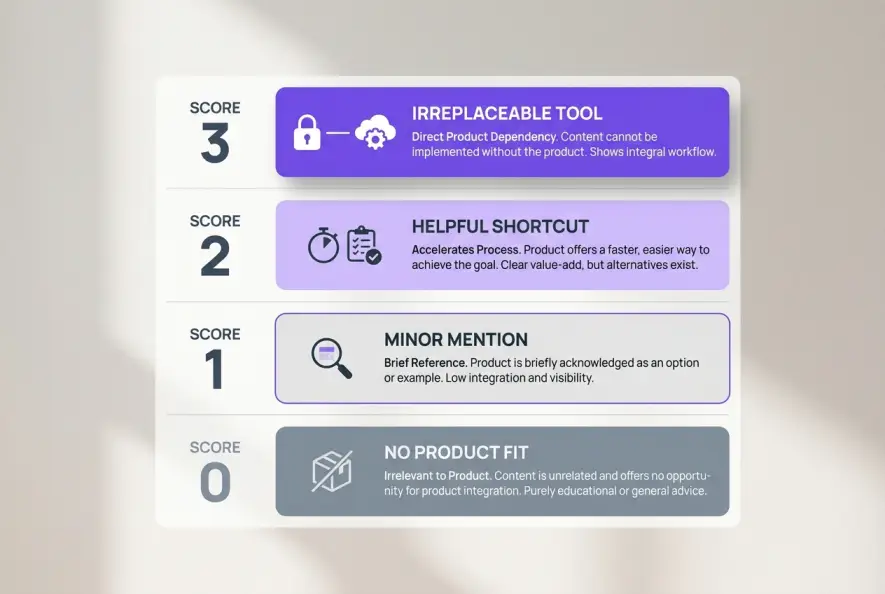
When evaluating target queries for a product-led content strategy, you must score each topic by its business relevance before writing a single word. A proven framework, originally popularized by SEO pioneer Ahrefs, categorizes topics into four distinct tiers based on product indispensability:
| Score Tier | Product Dependency | Conversion Potential | Editorial Strategy |
|---|---|---|---|
| Tier 3 (High) | The problem cannot be solved without your tool or category. | Maximum (Direct signups and trials) | Make the product workflow the central tutorial focus. |
| Tier 2 (Medium) | The problem can be solved manually, but your tool makes it 10x faster. | Strong (High assisted pipeline) | Compare manual friction against automated product execution. |
| Tier 1 (Low) | The product is loosely related and can only be mentioned briefly. | Moderate (Brand awareness) | Focus primarily on education with a subtle tool mention. |
| Tier 0 (Zero) | No natural product fit; mentioning the tool feels completely forced. | Poor (Zero conversion value) | Discard topic completely regardless of search volume. |
By filtering your keyword backlog through this matrix, your editorial team eliminates low-yield topics before investing writing resources. If an existing article scores a zero on this matrix, consider pruning or consolidating it so your crawl budget and editorial focus remain concentrated on high-intent conversion pathways.
Narrative Weaving: How to Showcase Product Features Without Pitching
The most difficult aspect of writing product-integrated tutorials is striking the right balance between helpful instruction and natural product demonstration. If an article reads like a glorified sales brochure, readers will bounce immediately. The goal is tactical utility: teach the foundational methodology first, then show how your product automates the tedious, error-prone execution steps.
To understand how narrative weaving works in practice, examine how the same advice changes between traditional copywriting and product-integrated instruction:
- Traditional Copy: "To optimize your database, you should periodically audit slow queries and adjust index configurations across your tables." (Vague, passive, zero product connection).
- Product-Led Copy: "To eliminate slow queries, open the Query Analyzer tab, sort by execution time exceeding 500ms, and click 'Auto-Index' to apply recommended schema optimizations in one click." (Actionable, tactile, directly showcases product value).
Follow these core editorial rules to weave software features into educational guides seamlessly:
- Focus on the Job-to-be-Done: Frame every feature around the user's objective, not your platform architecture. Explain what painful obstacle the feature removes rather than listing software specs.
- Demonstrate Tactile Steps: Use annotated interface images and clear step-by-step instructions. Show the specific buttons clicked, inputs configured, and output reports generated.
- Acknowledge Alternative Methods: Build trust by explaining how someone could accomplish the task manually using spreadsheets or terminal commands, then demonstrate why your software saves hours of manual labor.
- Maintain Objective Standards: Never claim your platform is magic. Highlight specific constraints, ideal use cases, and realistic edge cases to preserve editorial credibility.
Write your tutorial by performing the workflow inside your actual product in real time. Capture the exact input fields, filtering parameters, and data outputs so your instructions provide genuine tactile specificity that generic AI content cannot replicate.
The biggest difference between standard thought leadership and effective product-led content is visual proof. Maintaining this level of contextual precision across dozens of tutorials requires an editorial workflow that bridges keyword intent with real product features. For instance, Qoreta automates this process by analyzing audience queries and generating research-backed drafts that embed relevant workflow steps and citations naturally, allowing content teams to publish without losing tactical depth. This structure turns every post into an educational asset that also accelerates scaling organic revenue.
Measuring Real Acquisition: Signups, Product Activation, and Assisted Pipeline
Traditional blog analytics rely on vanity metrics: total sessions, bounce rate, and average time on page. While these data points indicate whether search engines are indexing your articles, they tell you nothing about business revenue. When your editorial output is tied directly to software adoption, your measurement framework must evolve.
To understand the true commercial impact of your guides, align your reporting with product analytics platforms like PostHog, Mixpanel, or Amplitude. Track how many readers sign up for an account within 24 hours of viewing an article, but more importantly, measure product activation. Did the reader complete the specific in-app action highlighted in the tutorial they just read?
- Generic educational traffic rarely converts unless the product is woven directly into the problem-solving workflow.
- Score topics using a business potential matrix from 0 to 3 to ensure every guide has a genuine product use case.
- Focus content metrics on product activation, assisted conversions, and trial quality rather than raw pageviews alone.
Beyond inbound acquisition, product-integrated guides serve as powerful sales enablement and customer onboarding assets. Account executives can send specific tutorials to prospects during deal negotiations to prove technical capabilities, while customer success teams use them to resolve support tickets and reduce early-stage churn.
Furthermore, because B2B software purchasing cycles often involve multiple touches across weeks, configuring first-touch and multi-touch models is essential to digital marketing attribution. When you evaluate content by its ability to generate high-intent trials and accelerate onboarding milestones, you stop justifying marketing expenses with meaningless traffic graphs and start proving direct revenue contribution.
Turning Search Traffic into Long-Term Customer Retention
Content marketing in modern B2B SaaS is no longer a volume game of pumping out generic definitions. When you replace disconnected CTA banners with step-by-step product integration, every piece of content functions as both an organic acquisition channel and an automated onboarding asset.
Readers do not sign up for software because a marketing headline told them to—they sign up because a tutorial demonstrated exactly how to eliminate their most frustrating workflow bottleneck in three simple clicks. Prioritize business potential over raw search volume, weave your interface into practical solutions, and transform your publication into a reliable pipeline engine.
Artificial Intelligence
Intelligence without limits.
We believe great content deserves honest authorship—even when it's AI.
Frequently Asked Questions
Product documentation is written for existing users who already understand what the software does and need instructions on specific settings. Product-led content is written for searchers facing an operational problem who may not know your tool exists, framing the product as the optimal solution within a broader strategic tutorial.
Top-of-funnel educational articles focus on broad definitions and theoretical advice without connecting steps to a specific tool. Product-led content focuses on tactical execution, demonstrating step by step how software eliminates manual friction for a defined workflow.
Yes. Instead of showing software interfaces, agencies and service providers can showcase proprietary audit templates, internal intake frameworks, and workflow deliverables directly inside the guide to prove execution capability.
Keep the focus entirely on solving the reader's problem. Provide complete, objective methodology, acknowledge manual or open-source alternatives, and only introduce the software where it genuinely simplifies or automates the manual workload.
Prioritize product signups, trial-to-paid conversion rates, in-app activation milestone completions, and assisted pipeline attribution over raw traffic, bounce rate, or session length.
Include 2 to 4 contextual screenshots per article. Every image should directly depict the execution of the step explained in the surrounding text rather than serving as decorative branding.
No. Search engines favor first-hand experience and original demonstration (E-E-A-T). Walkthroughs containing unique workflows, real data points, and verified interface examples achieve significantly higher information gain scores than generic aggregate guides.