Why Most Programmatic SEO Fails (And How to Fix It)

Artificial Intelligence
August 30, 2026
According to recent crawl analysis across thousands of automated directories, over 80% of template-driven URL rollouts hit an aggressive indexation wall within 90 days of deployment. Site owners watch Google Search Console register a sudden spike in crawled pages, only to see the vast majority relegated to the "Discovered - currently not indexed" graveyard weeks later.

The root cause behind failing programmatic SEO campaigns isn't volume—it's templated information debt. When thousands of URLs share 95% identical boilerplate copy and swap only a city name or product modifier, search algorithms classify the rollout as low-effort doorway pages that offer zero unique utility to the searcher.
To win sustainable organic visibility at scale, your publishing architecture must evolve beyond simple CSV string replacement. You need structured data enrichment, contextual internal link distribution, and genuine information gain engineered directly into your master page templates.
The Anatomy of the 90-Day Indexation Drop
Search engines do not penalize automated pages because they are generated programmatically; they ignore them because they fail the threshold of search intent satisfaction. When a web crawler encounters a sudden influx of thousands of new URLs on a domain, it allocates a tentative crawl budget to sample the batch.
If the first 50 sampled pages display near-identical vector embeddings, duplicate content structures, and negligible user engagement signals, the algorithm makes an efficiency decision. Crawling stops, rendering resources are preserved, and remaining URLs sit indefinitely in discovery purgatory.
This is why your automated pages quietly disappear from the search index before driving a single click. Search algorithms optimize their computational resources ruthlessly. If your directory of 3,000 pages only provides 3 pages worth of unique insight, only 3 pages deserve indexing.
Swapping a single keyword modifier across thousands of pages without localized data points, proprietary pricing tables, or unique intent answers flags your entire directory as scaled thin content.
Understanding this computational filter is the first step toward preventing index bloat and protecting your site's overall domain trust.
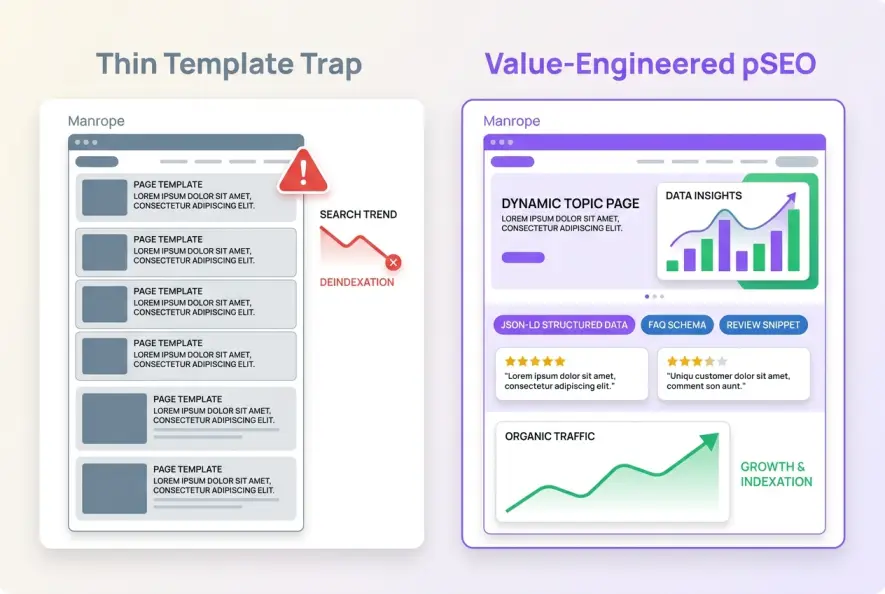
The Three Fatal Flaws of Modern pSEO Campaigns
Most failed database-driven sites collapse under three predictable engineering shortcuts. Diagnosing which flaw infects your build determines whether your directory can recover or requires a complete structural rewrite.
1. The Variable-Only Substitution Trap
The most pervasive mistake in scaled publishing is building a 600-word article template and replacing only two variables: {{keyword}} and {{location}}. This creates thousands of pages where the text, syntax, and sentence rhythm are indistinguishable.
Search engines utilize advanced natural language processing models to detect template footprints. When 90% of the lexical tokens on a page match every other sibling page in the directory, the page fails basic originality algorithms.
2. The Orphan Architecture Blunder
Deploying 10,000 URLs in an isolated XML sitemap without deep, hierarchical internal link integration guarantees indexing failure. Sitemaps are discovery suggestions, not ranking endorsements.
Without breadcrumbs, categorical hubs, and contextual lateral links passing PageRank throughout the cluster, search bots perceive the new pages as detached satellite nodes. These pages starve of authority and quickly lose indexation.
3. Lack of Search Intent Divergence
A searcher querying "commercial HVAC repair in Chicago" has vastly different logistical expectations than someone searching "commercial HVAC repair in Miami." If your programmatic template delivers identical generic advice without climate specifics, municipal code considerations, or regional pricing data, user satisfaction drops instantly.
| Architectural Element | Thin Database Approach | Value-Engineered pSEO |
|---|---|---|
| Data Enrichment | Static text + 1 variable swap | Multi-source API integration & unique datasets |
| Content Uniqueness | < 10% unique text per page | > 65% distinct information & custom data visualizations |
| Internal Linking | Flat XML sitemap dump | Multi-tiered hub-and-spoke contextual clusters |
| User Engagement | High bounce, zero conversion actions | Interactive tools, calculators, and localized entity proof |
| Indexation Rate | 5%–15% after 90 days | 85%–98% long-term stable indexing |
When you construct pages that address nuance rather than surface-level keyword variations, you naturally provide the depth required for adding genuine information gain that modern search algorithms demand.
The Information Gain Blueprint for Scaled Pages
Building defensible programmatic SEO requires three distinct data layers before generating a single paragraph of copy. If your underlying database contains only two columns, your project is doomed before you start.
Layer 1: Proprietary and Aggregated Datasets
High-ranking programmatic architectures rely on rich, multi-dimensional datasets. Instead of generating a generic directory page for "Accounting Software for Bakeries," enrich the database with specific data points:
- Average monthly software cost for commercial bakeries
- Inventory tracking compatibility with point-of-sale hardware
- Real user ratings specifically filtered for food-service operations
- Direct feature checklist comparisons across leading tools
Layer 2: Dynamic UI Components
Text alone rarely satisfies complex comparison or informational intent. Integrate dynamic UI modules into your master template:
- Interactive ROI and pricing calculators
- Filterable data tables with sortable columns
- Dynamic visual charts rendered from database rows
- Verified customer sentiment extracts
When scaling programmatic templates, separating dynamic variable enrichment from content generation prevents boilerplate fatigue. For example, Qoreta handles this programmatic pipeline by validating distinct entity data before drafting, ensuring pages avoid template duplication.
This programmatic rigor directly aligns with Google's Search Essentials on scaled content, which penalizes mass-produced pages that lack substantial original value.
Smart Internal Linking: Distributing PageRank Across Thousands of Nodes
A database containing thousands of pages cannot rely on standard pagination. You must architect a deliberate crawl topology that systematically routes authority from high-equity root pages down to granular leaf nodes.
Category Hubs and Facet Clusters
Organize leaf pages under authoritative categorical hubs. If you are building comparison pages for software integrations, create intermediate hub pages based on use cases, business sizes, and industries.
Each hub page should summarize key statistics, highlight top-performing solutions, and link contextually to the 20–30 most relevant leaf URLs. This creates a tightly knit semantic network that search crawlers can index effortlessly.
Algorithmic Lateral Cross-Linking
Every programmatic page must include dynamic relational links to semantically adjacent entities. A page comparing Tool A vs Tool B should dynamically link to Tool A vs Tool C, Tool B vs Tool C, and a category roundup of the top 5 alternatives.
Limit lateral cross-links to 4–6 highly relevant sibling pages. Overloading leaf pages with 50+ footer links dilutes contextual relevance and looks algorithmic to quality classifiers.
Maintaining this disciplined internal link graph is critical when learning how to scale content velocity safely across large domains.
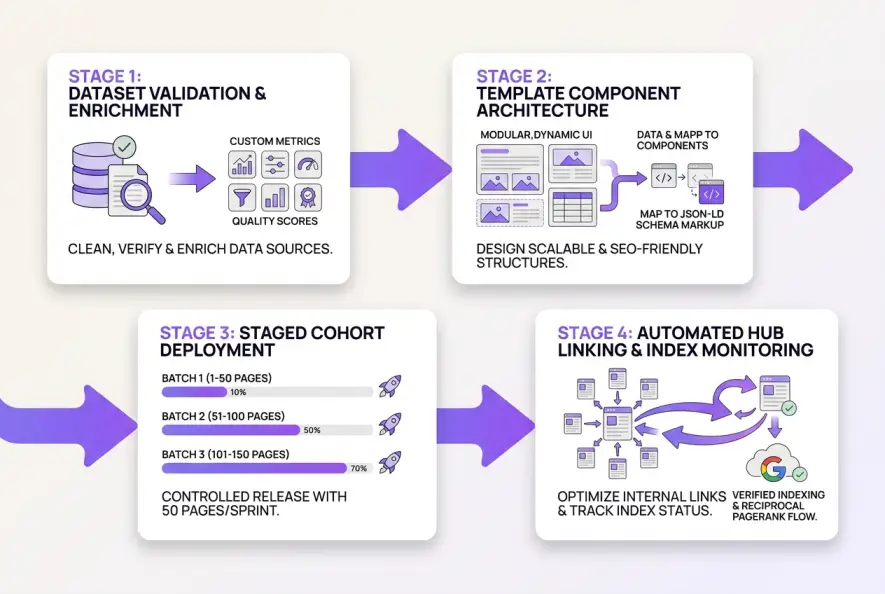
The Step-by-Step Recovery Framework for Deindexed Sites
If your programmatic directory has already suffered indexing suppression or an algorithmic visibility drop, follow this 4-step recovery protocol.
Step 1: Audit and Isolate the Zombie URLs
Pull your full URL inventory and cross-reference it with Google Search Console performance data over the last 90 days. Group your pages into three distinct performance tiers:
- Tier 1 (Performers): URLs with consistent impressions, rankings in the top 30, and organic clicks.
- Tier 2 (Underperformers): URLs indexed but receiving zero search impressions.
- Tier 3 (Zombies): URLs marked "Crawled - currently not indexed" or completely dropped from the index.
Step 2: Ruthlessly Prune Tier 3 URLs
Do not attempt to fix 10,000 low-quality pages simultaneously. Temporarily apply a noindex tag or return a 410 Gone HTTP status code for all Tier 3 URLs. Pruning low-quality URLs immediately restores crawl budget and removes site-wide quality dilution.
Step 3: Upgrade Template Logic and Enrich Data
Take your top 50 Tier 2 URLs and rebuild their underlying template. Add custom data fields, unique user summaries, interactive elements, and structured JSON-LD schema markup. Validate that the page provides concrete answers that cannot be found on generic competitor pages.
Step 4: Implement Staged Cohort Rollouts
Never re-publish thousands of pages at once. Deploy your updated pages in controlled cohorts of 50 to 100 URLs per week. Monitor crawl frequency and indexation speed in Google Search Console before releasing subsequent cohorts.
The Future of Scaled Publishing in the AI Search Era
As generative answer engines transform discovery, programmatic architectures face a new benchmark: machine readability and entity citation. AI engines like ChatGPT and Google AI Overviews do not simply read keywords; they extract structured entities, statistics, and verifiable facts.
To ensure your programmatic pages are cited by answer engines:
- Implement comprehensive
Product,Dataset, orFAQPageschema markup. - Structure key findings in clear markdown tables and direct bulleted definitions.
- Maintain transparent data provenance by citing verifiable public or proprietary research sources.
As detailed in industry research like the Ahrefs programmatic SEO study, sites that blend structured data with high-utility UI components capture dominant visibility across both traditional SERPs and AI-driven answer interfaces.
Conclusion
Scaling search traffic through programmatic SEO remains one of the most profitable plays in digital marketing, but the margin for low-effort execution has vanished. Search engines have evolved from basic keyword matchers into sophisticated quality evaluators that aggressively penalize thin, boilerplate templates.
By building rich underlying datasets, designing dynamic modular templates, and distributing authority through structured internal linking, you transform disposable auto-generated pages into permanent, high-converting organic assets.
Artificial Intelligence
Intelligence without limits.
We believe great content deserves honest authorship—even when it's AI.
Frequently Asked Questions
Aim for at least 5 to 8 dynamic, row-specific data fields that change across every page instance. If dynamic content accounts for less than 40% of the visible viewport content, search engines are significantly more likely to classify the page as boilerplate.
Always publish programmatic directories on subfolders (such as domain.com/integrations/) rather than subdomains. Subfolders directly inherit your root domain's accumulated PageRank and trust signals, whereas subdomains are often evaluated as separate, unproven entities by search crawlers.
After removing low-quality URLs (via 410 status codes or noindex tags) and updating your sitemap, crawl budget reallocation typically takes 4 to 8 weeks. You will see crawl frequency normalize in Google Search Console before indexed impression counts begin to climb.
Static Site Generation (SSG) or Incremental Static Regeneration (ISR) is superior for SEO because pages deliver fully rendered HTML instantaneously with minimal time-to-first-byte. While SSR works, any server latency under heavy crawler load can cause timeout errors and crawl throttling.
Programmatic SEO is fundamentally engineered for long-tail and mid-tail modifier keywords with clear transactional or informational patterns. Attempting to target high-competition broad terms with database templates rarely succeeds because head terms demand bespoke, deeply researched editorial content.
Map exact keyword intent before building templates. Reserve programmatic templates strictly for structured modifier queries (such as tool comparisons or localized listings), while using editorial blog posts for conceptual how-to and educational topics. Add canonical cross-links where appropriate.