Dark Social Traffic: How to Measure Hidden Conversions

Artificial Intelligence
August 4, 2026
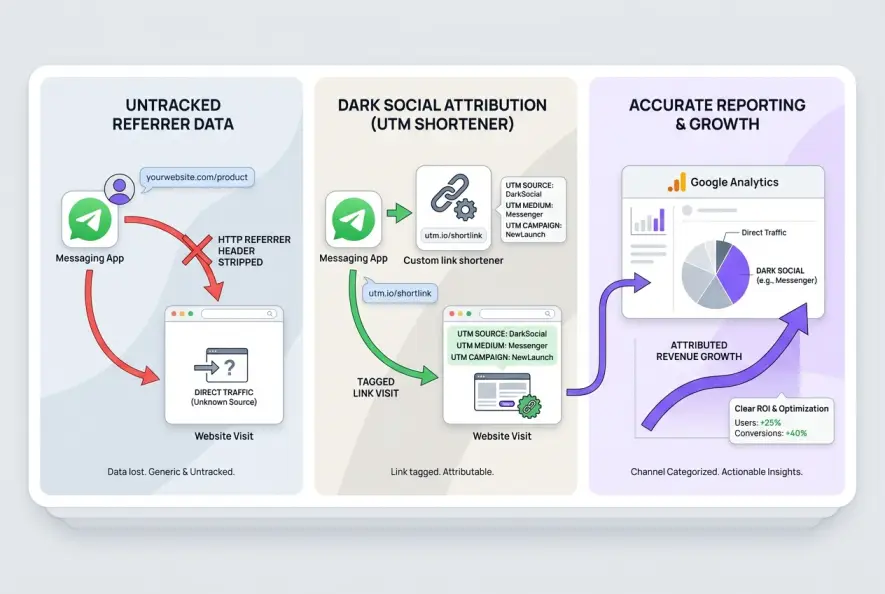
According to modern research, upwards of 80% of all online content sharing occurs within private channels like Slack, WhatsApp, iMessage, and email. When a prospective buyer copy-pastes a blog link into a team chat, traditional web analytics software cannot read the original source and simply logs that visitor as direct traffic.

Dark social traffic refers to website visitors arriving through non-public, untracked referral channels that hide their HTTP header information. To measure and convert this audience, digital marketers must combine targeted UTM tagging frameworks, self-reported attribution surveys on lead forms, and advanced path exploration inside Google Analytics 4.
Without a concrete tracking framework, digital marketing teams systematically undervalue their highest-performing content assets while over-investing in paid social ads that merely act as dynamic billboards. When executive leadership looks at Google Analytics, they see an oversized direct traffic bucket that provides zero context on what actually drove the sale.
Understanding how to measure untracked social sharing changes how you allocate marketing budget. Instead of guessing which blog posts drive enterprise deals, you gain full visibility into the invisible distribution loops that propel modern buyer decisions.
Dark social traffic is web traffic originating from private messaging apps, email clients, dynamic mobile apps, or secure HTTPS-to-HTTP redirects where referrer header data is stripped prior to landing on a website.
Why Traditional Analytics Platforms Fail to See Private Sharing
Web analytics platforms were built for an internet where people discovered content on search engines and clicked hyperlinked text on public blogs. When a browser navigates from one public site to another, it sends an HTTP referrer header—a small packet of metadata telling the destination site exactly where the user originated.
Private messaging networks and modern privacy protocols completely break this basic mechanism. When someone shares a link inside a private Slack workspace, a Discord server, an encrypted SMS message, or an internal enterprise email, no referrer data is passed. The user's browser opens a fresh window, connects directly to your web server, and presents itself as a user who manually typed your URL into the address bar.
The problem is further exacerbated by secure web transitions. When a user transitions from a secure HTTPS domain to an unsecured HTTP domain, security protocols intentionally strip the referrer header to protect user privacy. Similarly, mobile applications like LinkedIn, X, and Instagram frequently open links in sandboxed in-app browsers that purge attribution parameters.
This technical breakdown creates a severe tracking blindspot for growth leaders. When a potential customer spends six weeks discussing your product inside an invite-only executive community, their final conversion appears in your CRM as a cold visitor who randomly typed a 60-character landing page URL into their browser.
Never assume direct traffic means brand awareness. If a user lands directly on a deep, complex blog post URL or technical documentation page, they almost certainly arrived via dark social traffic channels.
The Four Pillars of Capturing Untracked Social Reach
To regain visibility into private distribution networks, growth teams must transition from passive analytics tracking to active, multi-point attribution capture. Relying on a single analytics pixel is no longer sufficient in a privacy-first web landscape.
A complete tracking framework relies on four complementary pillars designed to intercept metadata at different stages of the user journey:
| Attribution Pillar | Implementation Method | Primary Data Captured |
|---|---|---|
| Advanced UTM Frameworks | On-site link shorteners & copy buttons | Exact source, campaign, and medium parameters |
| Self-Reported Attribution | Open-text form fields on conversion forms | Qualitative human context and platform names |
| GA4 Deep-Link Filtering | Segmenting direct traffic by landing page URL | Quantitative volume of unmapped deep links |
| Community Signal Tracking | Tracking social listening keywords and mention velocity | Brand sentiment and dark community reach |
1. Dedicated Copy-to-Clipboard Buttons
Standard browser share buttons encourage users to share content to public channels like Facebook or LinkedIn. However, over 80% of actual shares happen when users simply highlight a URL or click copy link. By installing customized copy-to-clipboard buttons on your blog posts, you can automatically append custom tracking parameters (such as ?utm_source=share_button&utm_medium=clipboard) whenever a user copies your link.
2. Form-Based Qualitative Attribution
Quantitative analytics tools capture where a click originated, but they fail to capture why or where the initial recommendation occurred. Adding a simple, non-required open-text field to your sign-up forms—asking "How did you first hear about us?"—yields surprisingly accurate insights. Prospects will frequently type responses like "A peer posted your article in a private CMO Slack group" or "Recommended in a private WhatsApp podcast thread."
According to attribution studies published by Reforge, combining qualitative self-reported attribution with software-based tracking reveals that up to 40% of pipeline originally credited to organic search actually originated in dark social traffic channels.
How to Isolate Dark Social in Google Analytics 4
While Google Analytics cannot retroactively restore stripped referrer headers, you can configure custom exploration reports to separate genuine brand direct traffic from masked referral traffic.
Humans rarely type long, complex URLs into their mobile or desktop web browsers. If a visitor arrives on your homepage, there is a strong probability they typed your brand name into their search bar or clicked a bookmark. However, if a visitor lands directly on a specific, deeply nested blog post without any referrer data, that visit is almost certainly private referral traffic.
Setting Up the GA4 Dark Social Filter
To isolate these visits inside GA4, follow this tactical framework:
- Navigate to Explore and create a new Free Form Exploration.
- Set Landing Page + Query String as your primary dimension.
- Add Sessions, Conversions, and Engagement Rate as your metrics.
- Apply a filter where Session Source / Medium exactly matches
(direct) / (none). - Apply a second filter excluding your homepage (
/), pricing page (/pricing), and main login screens.
The resulting report isolates all deep-page direct traffic. Marketers who execute this exercise routinely discover that 30% to 60% of their direct traffic is actually high-intent content consumption driven by private peer recommendations.
- Direct traffic landing on deep blog URLs is almost always unmapped dark social traffic.
- Open-text form fields bridge the gap between analytics data and human interaction.
- Tagging on-site share buttons with clipboard parameters captures links before they enter private chats.
Structuring Content for Dark Social Distribution
Measuring hidden traffic is only half the battle; the ultimate goal is designing content specifically engineered for private distribution. Content that gets shared in private Slack channels or executive WhatsApp groups looks very different from content designed purely for search engine algorithms.
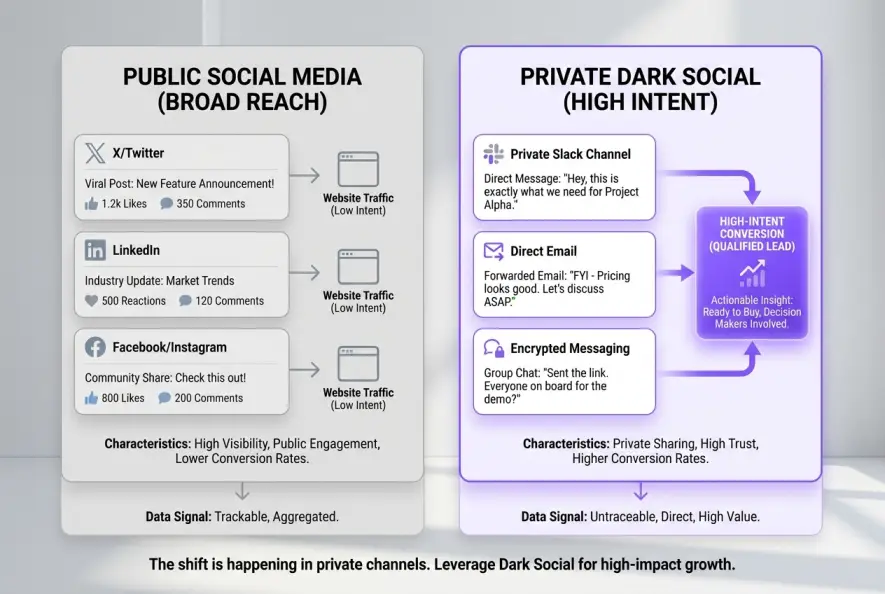
When professionals share content privately with peers, they are risking their personal reputation. They do not share generic top-10 listicles or surface-level summaries. They share proprietary research, highly detailed frameworks, counter-intuitive opinions, and actionable templates.
When planning your content creation strategy, focus heavily on information density and topical depth. As detailed in our guide on building a topical map, organizing content around comprehensive entity hierarchies naturally establishes authority. When your content presents original data or definitive diagrams, readers naturally save and forward those visual assets directly to colleagues.
Key Features of High-Shareability Assets
- Data Density: Original benchmark reports, survey results, and industry statistics.
- Visual Clarity: Clear diagrams and step-by-step workflows that can be screenshotted and pasted into pitch decks.
- Unpopular Insights: Well-reasoned arguments that challenge standard industry consensus.
- Practical Artifacts: Ready-to-use code snippets, downloadable spreadsheet templates, and checklist blueprints.
Measuring the Business Value of Dark Social Traffic
To secure buy-in from executive stakeholders, digital marketing leaders must translate private sharing metrics into core business outcomes. It is not enough to show that unmapped traffic exists; you must prove that this traffic converts at a higher rate than traditional public channels.
Industry benchmark data published by market research firms like Gartner indicates that peer-to-peer recommendations carry up to four times higher conversion velocity than standard search or paid social touchpoints. When a peer sends a link inside a private chat, it comes pre-validated with high trust.
By connecting your self-reported attribution data to CRM opportunities inside platforms like Salesforce or HubSpot, you can track closed-won revenue back to dark referral channels. Marketers who track dark social traffic consistently find that dark social leads exhibit higher average contract values (ACV) and shorter sales cycles because the prospect was introduced via trusted peer advocacy.
Artificial Intelligence
Intelligence without limits.
We believe great content deserves honest authorship—even when it's AI.
Frequently Asked Questions
Direct traffic occurs when a user manually types a web address or opens a browser bookmark. Dark social traffic is referral traffic from private channels (like Slack, WhatsApp, or email) where referrer tracking headers are stripped, causing analytics tools to misclassify the visit as direct traffic.
Custom copy buttons append dynamic tracking parameters (like UTM tags) to the URL automatically when a user copies it from your page. When that link is pasted into a private chat and clicked, your analytics tool reads those UTM parameters instead of losing referrer data.
No, GA4 cannot automatically detect stripped HTTP referrer headers. However, you can create custom exploration reports in GA4 that filter for direct traffic landing on deep blog or product URLs, effectively isolating dark social visitors.
Software analytics can only track web technical parameters, which are frequently blocked or purged by privacy settings. Self-reported attribution ('How did you hear about us?') captures qualitative human interactions, such as word-of-mouth recommendations in invite-only communities.
Indirectly, yes. While dark social clicks do not pass traditional backlink PageRank, dark social traffic drives high-engagement visitors, longer session durations, and brand searches, all of which signal search engines that your content is valuable.
Proprietary data studies, technical step-by-step guides, original visual diagrams, and opinionated industry breakdowns perform best because users share content that offers high utility and credibility to their professional peers.