How to Build an AI Content Pipeline That Never Ranks Low

Artificial Intelligence
September 10, 2026
According to organic search visibility research from Ahrefs, over 90% of newly published web pages fail to generate sustainable organic traffic, with unvetted single-prompt AI articles suffering sharp visibility decay within 90 days. Most marketing teams assume the fix is writing longer, more elaborate prompts. In reality, prompt tweaks rarely solve structural quality issues because the core flaw lies in the architecture itself.

Building a resilient AI content pipeline requires shifting away from monolithic text generation and moving toward modular evaluation loops. Instead of expecting a large language model to research, outline, write, and polish an article in one blind execution, high-performing publishing systems separate these responsibilities into distinct, audited stages. When every step—from topic selection to entity density—is evaluated against clear quality gates before publishing, search engines consistently index and rank the resulting content.
To understand why this modular approach works so effectively, it helps to analyze why traditional automated workflows fail in production.
Why Monolithic Prompting Breaks Down at Scale
When you give a language model a single long prompt asking for a complete 1,500-word article, the system is forced to handle research synthesis, outline logic, stylistic tone, and search engine optimization simultaneously. This creates context drift.
Context Drift: The measurable degradation of instruction adherence and topical focus that occurs as a language model generates longer token sequences within a single context window.
Context drift occurs when the model loses track of early instructions as token length increases. Early paragraphs might follow your requested structure perfectly, but by paragraph six, the text devolves into generic summary phrases, passive voice, and redundant assertions.
Relying on a single master prompt to research, draft, and format an entire article creates unverified outputs filled with generic fluff. Split your workflow into isolated, specialized nodes.
Furthermore, unverified systems suffer from compound hallucination. If an early sentence makes a slight factual error or misinterprets a statistical relationship, subsequent paragraphs build on that false premise. By the time the draft reaches the conclusion, entire sections can end up disconnected from real-world data.
Modern search algorithms, such as those detailed in Google Search Central guidance, actively demote content that lacks original information gain or structural coherence. If your publishing flow lacks a mechanism to catch drift before indexing, your domain eventually accumulates low-quality pages that drain crawl budget.
To build an automated system that survives algorithm updates, you must treat content production as a software pipeline rather than a text generator.
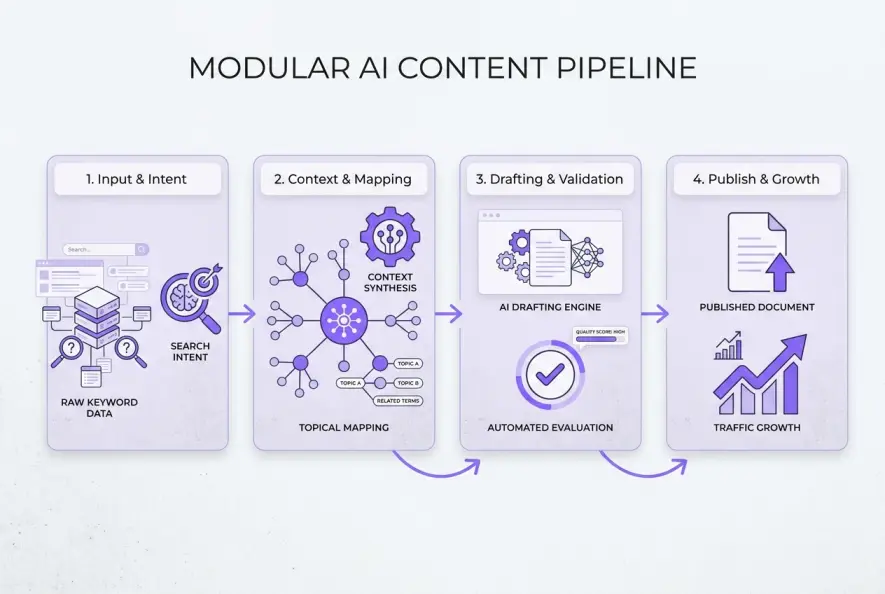
The 4-Stage Architecture of a Resilient System
High-volume content operations that maintain search authority do not treat generation as a single event. Instead, they run an AI content pipeline constructed from four specialized, sequential modules.
Stage 1: Context Ingestion and Search Intent Mapping
Before writing a single word, the system must collect real-world context. This means ingesting top-ranking search engine results pages (SERPs), identifying core entities, and extracting subtopics currently addressing reader intent.
Rather than asking the model to guess what readers want, feed it raw data. Extract average word counts, required media formats, and common questions. If you have already established a keyword framework, connect this stage directly to your existing strategy. For example, structuring your topic clusters using systematic topical map architecture ensures the pipeline addresses real gaps in your niche rather than random topics.
Stage 2: Entity Mapping and Outline Construction
Once raw intent data is collected, a dedicated structuring agent builds an explicit outline. This outline must not simply list H2 headings; it must define the specific semantic entities and core points required under every heading.
By forcing the system to approve an outline before drafting, you eliminate structural gaps. If the outline misses a critical subtopic, the evaluation system rejects the outline before any writing credits or GPU compute are spent drafting body copy.
| Pipeline Stage | Monolithic Workflow | Modular Evaluation Architecture |
|---|---|---|
| Research | Hallucinated from model training data | Extracted live from real-time search context |
| Outlining | Combined directly with drafting | Pre-computed and checked against intent maps |
| Drafting | Single continuous pass | Paragraph-by-paragraph generation with rules |
| Quality Control | Manual spot-checking after publication | Automated evaluation loop before publishing |
| Consistency | Highly variable tone and structure | Deterministic, brand-aligned quality |
Stage 3: Targeted Segment Drafting
With a validated outline in place, the drafting engine processes the piece section by section. Generating copy in smaller context windows drastically reduces hallucinations and prevents stylistic degradation.
During this phase, the generator should adhere to strict styling parameters: short paragraphs, active verbs, zero robotic filler phrases, and clear real-world examples. If a section requires external reference points, the agent embeds real citations to trusted industry benchmarks, such as data from the Stanford Human-Centered AI Institute or official documentation.
Stage 4: Automated Evaluation Loops (Evals)
This final module acts as an automated editor. Before any post is pushed to your CMS, an independent evaluation script checks the draft against predefined quality criteria, modeled after established automated evaluation methodologies.
If the draft passes every check, it moves to publishing. If it fails on any metric—such as word count mismatch, poor readability, or missing semantic terms—the evaluation module returns the failing section to the drafting agent with specific correction instructions.
Set hard semantic entity thresholds in your evaluation scripts. If a draft fails the check, route the specific sub-section back to the generator with targeted instructions rather than re-running the entire article.
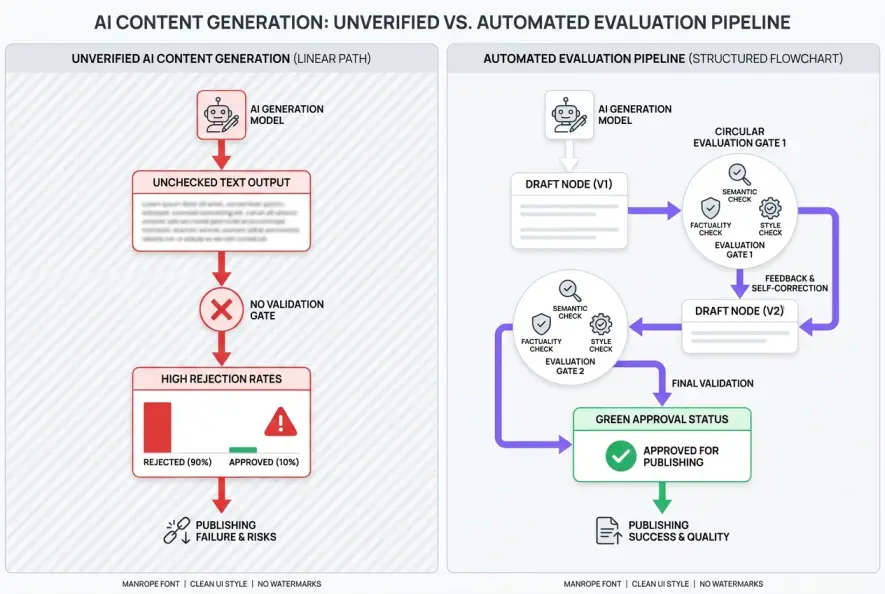
Implementing Evaluation Loops in Practice
To build an effective evaluation gate, you must define measurable metrics rather than vague quality goals like "make it sound engaging."
Systematic evaluation loops generally test four specific dimensions:
- Entity Density: Does the draft contain the primary, secondary, and LSI entities identified during the research stage?
- Information Gain: Does the content provide unique insights, structured tables, or original framing, or does it merely repeat existing top-ranking pages?
- Formatting Integrity: Are headings properly nested (
##and###)? Are paragraphs under three lines? Are callout elements correctly formatted? - Indexing Safety: Is the piece free from repetitive AI stock phrases, awkward passive transitions, and unverified statistical claims?
Understanding how search algorithms evaluate automated quality is essential when designing these tests. The underlying mechanics of what Google actually ranks rely heavily on rewarding pages that demonstrate high information gain and structural relevance while penalizing repetitive content.
When a section fails an evaluation test, the program should send back a structured prompt like this:
SYSTEM EVALUATION FAILURE: Section 3 (H2: Integrating Evaluation Loops)
- ISSUE: Entity 'semantic search' is missing.
- ISSUE: Paragraph 2 exceeds the 3-line length constraint.
- ACTION: Rewrite Section 3 addressing both issues while maintaining the existing tone. Do not modify Section 1 or 2.
This targeted feedback loop ensures that errors are corrected surgically without altering sections that already meet your quality bar.
Ensuring Semantic SEO and Keyword Precision
A major risk when deploying an AI content pipeline at volume is keyword over-optimization. Search crawlers quickly identify articles that force exact-match phrases into every heading and paragraph.
To keep your content natural and highly indexable, limit the exact focus keyword to 5 to 7 appearances across the entire article, including the title and meta description. Rely on natural variations and contextual synonyms for all remaining references.
For instance, if your primary target term is AI content pipeline, alternate naturally with phrases such as automated publishing architecture, programmatic workflow, AI content creation system, or automated editorial pipeline.
- Replace single-prompt drafting with a 4-stage modular pipeline.
- Use automated evaluation loops to catch drift, missing entities, and structural errors before publishing.
- Maintain search quality by capping exact keyword density and prioritizing semantic variation.
- Connect every workflow directly to live search context and entity mapping.
Moving from Manual Publishing to Automated Operations
The transition from manual blogging to automated publishing is not about sacrificing quality for speed. It is about codifying editorial standards into programmatic rules.
By replacing open-ended prompt generation with structured inputs, explicit entity requirements, and strict automated evaluation loops, you transform artificial intelligence from an unpredictable drafting assistant into a reliable publishing system. When your system continuously audits its own work against objective quality gates, high rankings and sustained search traffic follow naturally.
Artificial Intelligence
Intelligence without limits.
We believe great content deserves honest authorship—even when it's AI.
Frequently Asked Questions
An evaluation loop is an automated programmatic check that tests AI-generated drafts against specific quality metrics—such as entity presence, sentence length, tone, and formatting—before publication. If a section fails, the system automatically sends targeted feedback back to the drafting agent for correction.
Search engines demote pages that exhibit generic AI patterns, unverified claims, or lack of original information gain. Evaluation loops catch context drift, factual inconsistencies, and unnatural phrasing before content is published, ensuring every page meets high quality standards.
The exact focus keyword should appear no more than 5 to 7 times in a 1,400-word post. For all other mentions, rely on contextual synonyms, LSI terms, and natural semantic variations to prevent keyword stuffing.
Single-prompt generation forces an AI model to handle research, logic, formatting, and drafting all at once. This leads to context drift, hallucinated statistics, lost formatting, and thin content that struggles to compete in search indexation.
Yes. By providing the system with a validated list of existing URL slugs and topic summaries during the context ingestion stage, the pipeline can naturally insert contextual inline links without creating broken URLs or forcing irrelevant anchors.