What Does a Business Growth Strategist Actually Do?

Artificial Intelligence
September 30, 2026
Consider two companies with nearly identical revenue, in the same industry, both stuck at roughly the same number for over a year. One hires a growth strategist. Within two quarters, growth resumes — not because of a clever new ad campaign, but because the strategist found that 40% of "lost" customers weren't lost at all; they were stuck in a broken renewal process nobody had audited in three years. The other company hires a second marketing agency instead, doubles its ad spend, and stays exactly as stuck as before.

That's the real function of a business growth strategist, stated plainly: someone whose job is to find the actual bottleneck holding revenue back, then build a focused plan around fixing that one thing — instead of adding more tactics on top of a problem nobody has diagnosed.
The title gets used loosely. "Growth strategist," "growth consultant," "growth coach," and "growth marketer" all show up in job postings and agency pitches, often describing four different jobs. This guide untangles what a growth strategist specifically does, when hiring one actually makes sense, what it costs, the questions worth asking before you sign anything, and a realistic look at what the first 90 days of a good engagement looks like.
What Is a Business Growth Strategist?
A business growth strategist is a specialist who diagnoses the specific bottleneck limiting a company's revenue growth, then designs and oversees a prioritized plan to fix it — distinct from a marketer who executes campaigns or a generalist consultant who advises across the whole business.
The distinction that matters most is between diagnosis and execution. A growth strategist's core output isn't a campaign, a piece of content, or a redesigned page — it's a decision: which single lever, pulled hard, will move revenue the most, given the specific constraints of this business right now.
That decision then gets handed off, or co-executed, through whatever channel fits: pricing, retention, a new acquisition channel, a sales process fix, or a product change. The strategist's value isn't in doing the work of every channel. It's in correctly identifying which one deserves the resources in the first place.
What a Growth Strategist Actually Does, Step by Step
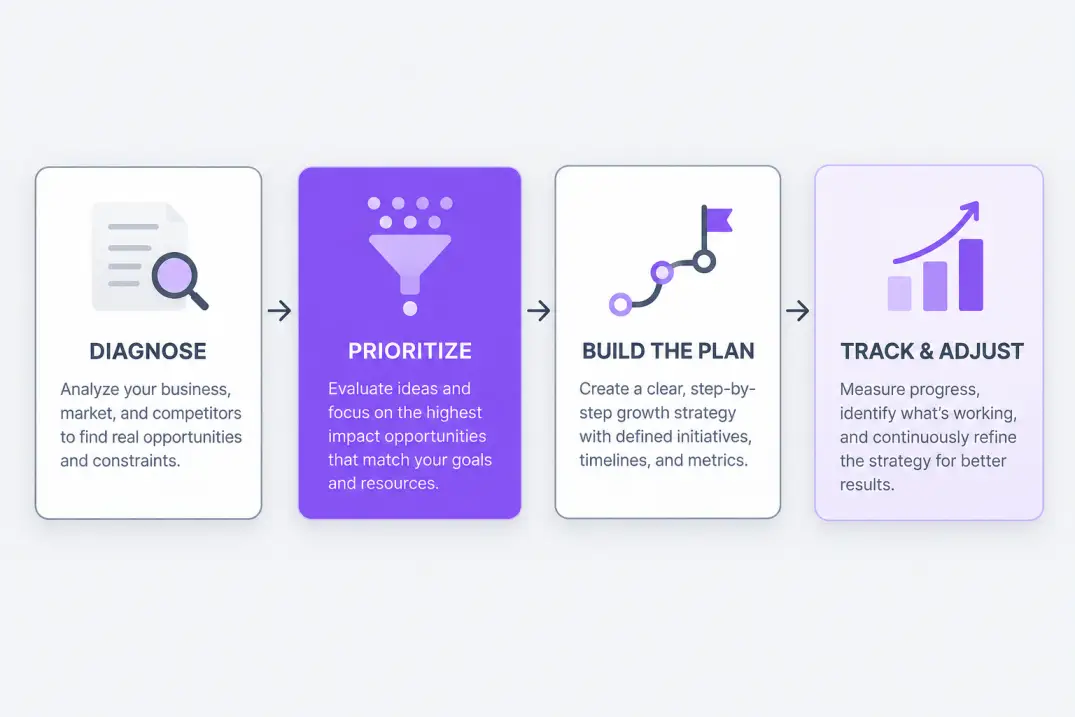
Strip away the job-posting language and the work breaks into four repeatable stages, almost regardless of industry.
1. Diagnose the real bottleneck
This starts with a structured audit: revenue by segment and channel, retention and churn cohorts, customer acquisition cost trends, sales cycle length, and often a handful of direct customer interviews. The goal is finding the actual constraint, which is frequently not the one leadership assumed.
A common pattern: a company blames "not enough leads" when the real problem is a 60% drop-off between trial and paid conversion. More leads into a broken funnel just produces more wasted spend, faster.
2. Prioritize one or two levers
Every business has a dozen things it could improve. A strategist's job is picking the one or two with the highest ceiling relative to effort, and explicitly deprioritizing the rest for now. This is uncomfortable for teams used to running every idea at once, which is exactly why an outside perspective often helps enforce it.
3. Build a written, time-bound plan
A real growth strategy plan names a specific target, a primary lever, the assumptions that have to hold true, who owns each piece, and a timeline — usually structured in 90-day cycles rather than an annual plan that goes stale by month two.
4. Set up tracking and revise on a cadence
Without a way to measure the chosen lever weekly or monthly, nobody can tell a slow-working plan from a failed one. Good strategists build a small, specific dashboard — not a sprawling one nobody checks — and set a review cadence before work even starts.
A 14-person e-commerce brand hired a growth strategist assuming they needed more paid ad spend. The diagnosis found the opposite problem: their best channel, email, was being sent to a list that hadn't been segmented in two years, so most emails went to buyers who'd already churned. Fixing segmentation alone lifted email revenue 22% in six weeks, before any new spend was added anywhere.
This is why the vetting questions later in this guide lead with process, not portfolio. A strategist who skips straight to tactics skipped the part of the job that actually creates the value.
Growth Strategist vs. Consultant vs. Coach vs. Agency: Who's Who
These four roles get used interchangeably in pitches, and picking the wrong one for your situation is one of the most common ways hiring budget gets wasted. Here's the real distinction.
| Role | Primary focus | Typical engagement | Best fit |
|---|---|---|---|
| Growth strategist | Diagnose the bottleneck, prioritize one lever, build a focused plan | Project or retainer, 90 days to a year | Revenue has plateaued and the priority is unclear |
| Business/management consultant | Broader operational, financial, or organizational advice | Project-based, often longer | Structural issues beyond marketing or sales alone |
| Growth coach | Teaches the founder or team to run their own growth process | Ongoing sessions, weekly or biweekly | Team has capability but lacks a framework or accountability |
| Growth or marketing agency | Executes campaigns across one or more channels | Monthly retainer, ongoing | Strategy already exists and needs hands-on execution at scale |
A useful way to decide: if you don't yet know what to fix, start with a strategist or consultant. If you know what to fix but need someone to actually do the channel work, an agency fits better. If you have the answer and the capacity but want someone holding you accountable to it, a coach is often the cheaper, right-sized option.
In practice, these roles frequently overlap inside a single engagement. A solo growth strategist might act as a part-time coach for your internal team while also handing off specific execution tasks to a freelancer or agency they've worked with before. Larger growth consultancies sometimes bundle diagnosis, planning, and execution into one retainer, which can be convenient but makes it harder to tell whether the plan itself was good or whether results simply came from more hands doing the work. Asking upfront which parts of the engagement are strategic thinking versus hands-on execution helps you evaluate the actual value you're paying for, rather than judging the whole package on outcomes alone.
Hiring an agency before the strategy exists. Agencies are built to execute a known channel well — paid ads, SEO, email — not to diagnose which channel deserves the budget in the first place. Skipping the diagnosis step means paying for expert execution of the wrong priority.
When Hiring a Growth Strategist Actually Makes Sense
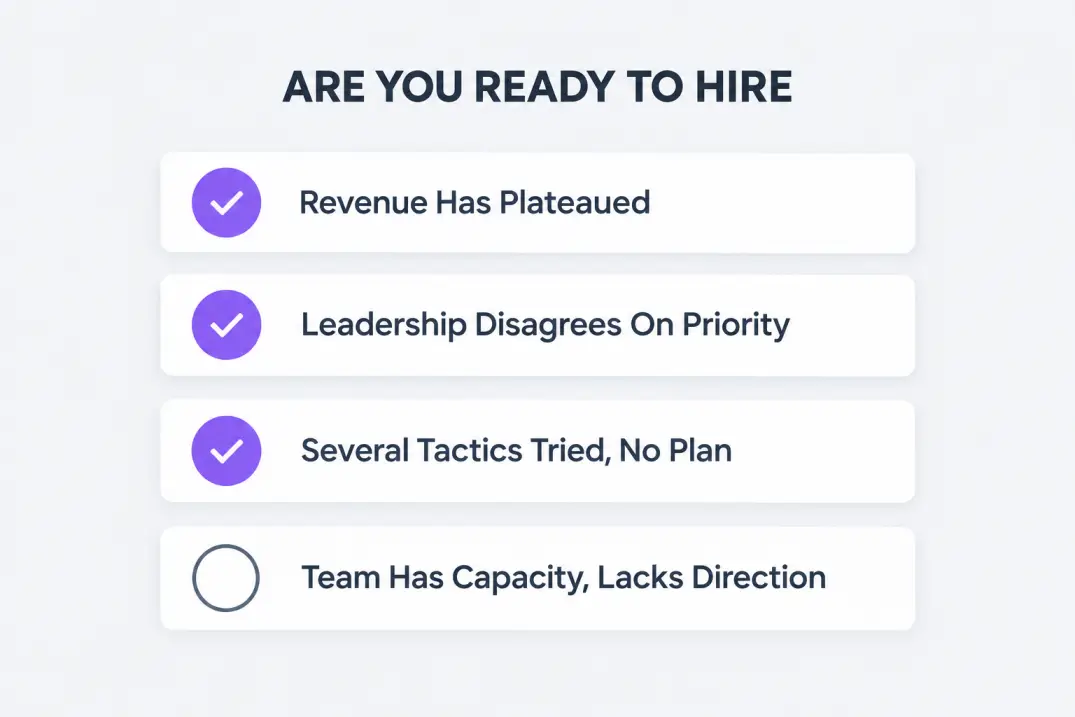
Not every stalled business needs outside help, and not every growth problem calls for this specific role. Hiring tends to pay off when most of the following are true:
- Revenue has plateaued despite consistent effort — the team is working hard, activity hasn't dropped, but the topline number hasn't moved in two or more quarters.
- Leadership disagrees on the priority. If the founder wants more ads, the sales lead wants better leads, and the product team wants new features, an outside diagnosis can settle the disagreement with data instead of opinion.
- Several tactics have been tried without a unifying plan. A company that's run five different "growth experiments" in a year with no clear thread between them usually needs prioritization more than another experiment.
- The team has execution capability but lacks direction. If you already have writers, sales reps, or developers who are simply pointed at the wrong priority, a strategist's job is mostly redirection, which is often a shorter, cheaper engagement.
Hiring too early. If the core product hasn't found repeatable demand yet — no consistent pattern of customers buying and staying — a growth strategist has nothing reliable to diagnose. That stage calls for product and customer discovery work first, not a growth plan built on shaky footing.
The video above walks through the practical differences between a growth strategist, a consultant, and a coach from the hiring side, which pairs well with the comparison table above if you're still narrowing down which role actually fits your situation.
How Much Does a Business Growth Strategist Cost?
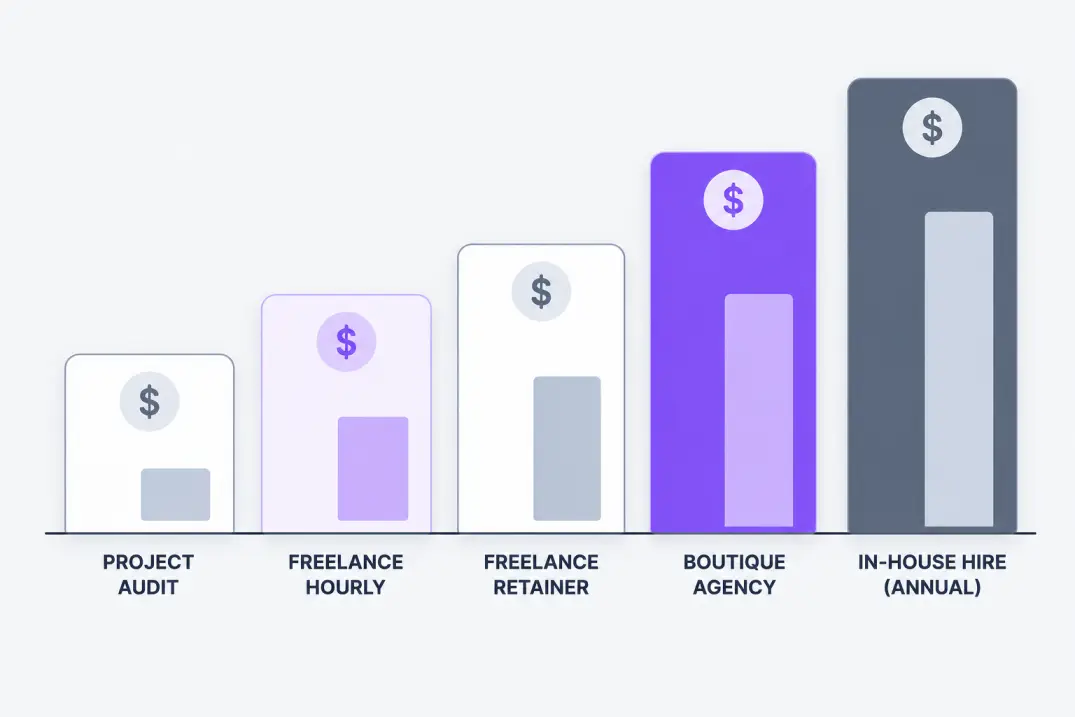
Pricing varies widely based on experience, scope, and whether you're hiring an individual or a firm. These ranges reflect what's typically quoted across the market.
| Engagement type | Typical cost | Best fit |
|---|---|---|
| Freelance strategist, hourly | 300/hour | A focused audit or one-time diagnosis |
| Freelance strategist, retainer | 10,000/month | Ongoing strategic direction without full-time headcount |
| Boutique growth agency | 20,000+/month | Strategy plus hands-on execution support |
| Full-time in-house hire | 180,000+/year base | Companies that need growth strategy as a permanent function |
| Project-based growth audit | 25,000 one-time | A single diagnosis and roadmap you'll execute yourself |
A quote significantly below these ranges is worth extra scrutiny. Diagnosis work — the audits, interviews, and data analysis that make the rest of the plan worth anything — is usually the first thing cut to hit a low price, which produces a strategist who jumps straight to generic tactics instead of your specific bottleneck.
- Before agreeing to a rate, confirm:
- What the diagnosis phase actually includes, and how long it takes
- Whether the fee covers strategy only, or strategy plus hands-on execution
- How often you'll see reporting, and against what specific metric
- Whether the engagement has a defined end point or renews automatically
How to Vet a Growth Strategist: 7 Questions Worth Asking
The answers to these questions tell you more in twenty minutes than a polished case study deck will.
1. "Walk me through how you'd diagnose our situation before recommending anything." You want to hear about data review, customer interviews, and a defined audit process — not "we'll figure it out as we go." A strategist without a structured diagnosis process is really just offering opinions.
2. "Can you show me a real growth plan from a past client?" A redacted plan — the chosen lever, the target, the assumptions, the timeline — tells you far more than a results-only case study. If they can't produce the planning document, they may not actually build one for you either.
3. "How do you decide which lever to prioritize?" Listen for a reasoned framework: current data signal, cost to test, size of opportunity. Be wary of an answer that defaults to whatever channel happens to be trendy.
4. "What's realistic for a 90-day engagement, honestly?" An honest strategist sets modest, specific expectations for the first quarter — often diagnosis plus one early test — rather than promising a transformed business in 90 days.
5. "What do you need from us to do this well?" Good strategy work needs your data, your team's time for interviews, and often access to systems like your CRM or analytics. A strategist who claims to need nothing from you is likely working from a generic template.
6. "What happens if the first lever doesn't move the needle?" Expect a real answer about revisiting the diagnosis, not just trying a second tactic blindly. Growth work is iterative, and a good strategist treats a wrong first guess as information, not failure.
7. "Who exactly will be doing the work, day to day?" Some firms sell a senior strategist on the pitch call, then hand the actual engagement to a junior team member. Confirm who you'll actually be working with before signing.
Ask for a sample diagnosis on a narrow, low-stakes piece of your business before committing to a full retainer. How they handle a small diagnostic says a lot about how they'll handle the real engagement.
Red Flags to Walk Away From
A few warning signs show up consistently across bad engagements, and they're worth checking before any contract gets signed.
- Guaranteed results or specific revenue numbers. Nobody can guarantee a growth outcome before diagnosing your specific business. A guarantee is a sales tactic, not a credible forecast.
- No discovery or audit phase. If the proposal jumps straight to a list of tactics before reviewing your data, the "strategy" is really a template applied to everyone.
- Vague or missing metrics. "We'll grow your brand awareness" is not a metric. A real engagement names a specific number tied to revenue, retention, or pipeline.
- Case studies with no numbers attached. Polished testimonials without actual before-and-after figures are easy to produce and prove very little.
- Reluctance to name a single priority. A strategist who recommends doing everything at once hasn't actually prioritized anything, which defeats the entire purpose of hiring one.
Judging a strategist purely on how confidently they talk. Confidence is cheap. Ask for the specific reasoning behind a past recommendation — what data led to it, what alternative they ruled out, and why. A strategist who can't explain their reasoning was probably guessing.
A Sample 90-Day Growth Strategist Engagement
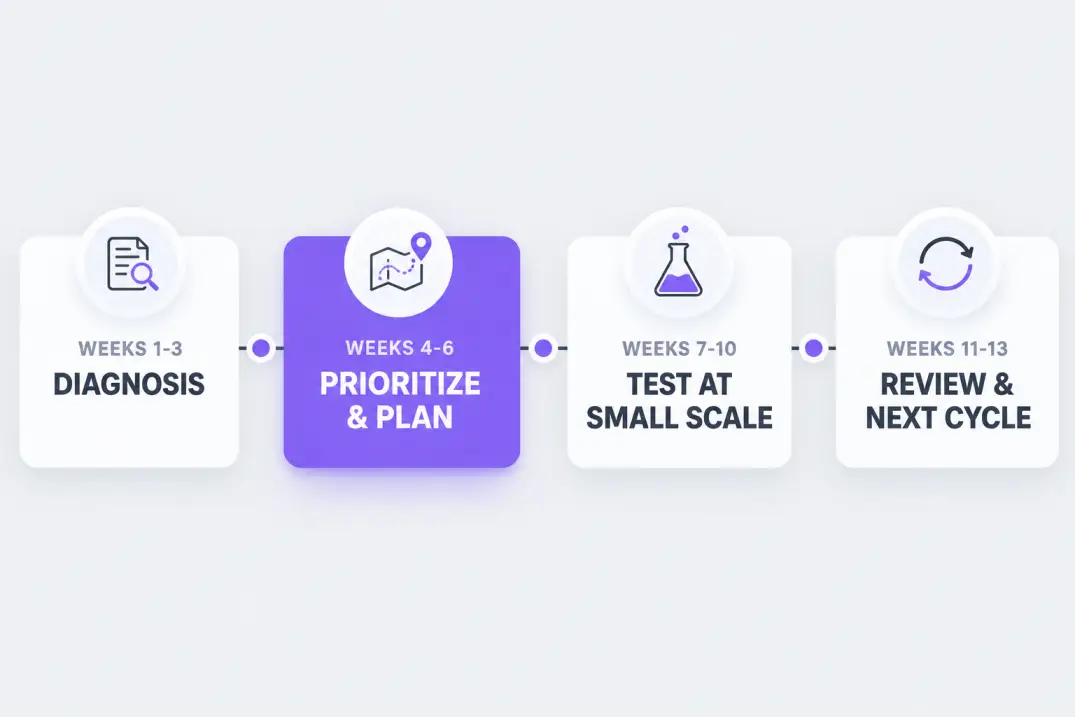
Seeing a realistic timeline makes the abstract version concrete. This is a simplified version of how a solid engagement typically unfolds.
Weeks 1–3: Diagnosis. Data review across revenue, retention, and acquisition; customer interviews; a competitive scan. Output: a written diagnosis naming the actual bottleneck, not just symptoms.
Weeks 4–6: Prioritization and planning. The strategist proposes one or two levers, with reasoning, and builds the written plan — target, assumptions, owners, timeline, and the metrics that will prove it's working.
Weeks 7–10: Early execution and testing. The chosen lever gets tested at a small, controlled scale rather than a full rollout, so the plan can be corrected cheaply if the first hypothesis is wrong.
Weeks 11–13: Review and next cycle. Results get reviewed against the original target. A working lever gets scaled up; a weak one gets revised or replaced, and the next 90-day cycle is scoped based on real data instead of the original guess.
This cadence matters as much as the tasks inside it. Three-month cycles are long enough to see a real signal and short enough to correct course before a bad bet compounds.
The video above breaks down a practical approach to building the growth strategy itself once the diagnosis phase is done, which is a useful companion to the 90-day structure above if you want to see the planning step in more detail.
The Growth Levers a Strategist Typically Chooses Between
Understanding the menu of levers helps you evaluate whether a proposed plan actually makes sense for your situation, rather than taking it on faith.
| Lever | What it targets | When it's usually the right call |
|---|---|---|
| Retention and churn reduction | Keeping existing revenue instead of replacing it | When churn is quietly offsetting new growth |
| Pricing and packaging | Revenue per customer | When the product is underpriced or poorly tiered for its value |
| New acquisition channel | Top-of-funnel volume | When one channel is maxed out and diversification is genuinely needed |
| Sales process and conversion | Deals that stall or leak | When leads are healthy but conversion rates lag behind benchmarks |
| New market or segment | Total addressable demand | When the current segment is genuinely saturated, not just underworked |
Most engagements start with retention and conversion, not acquisition, simply because fixing a leak is usually cheaper and faster than adding more volume into a leaky system. A strategist who jumps straight to "get more leads" without first checking what happens to the leads you already have is skipping a step that data consistently shows matters more.
This is also where the line between strategist and executor gets blurry in practice. A growth strategist typically defines the retention fix or the pricing change, then either implements it directly (if the engagement includes execution) or hands it to your team or an agency to build. Content and organic visibility often sit inside the acquisition-channel lever specifically, and how that gets executed matters: content velocity — how consistently a brand can publish without sacrificing quality — is frequently the bottleneck once content is chosen as the priority channel, and it's worth understanding before committing a budget there.
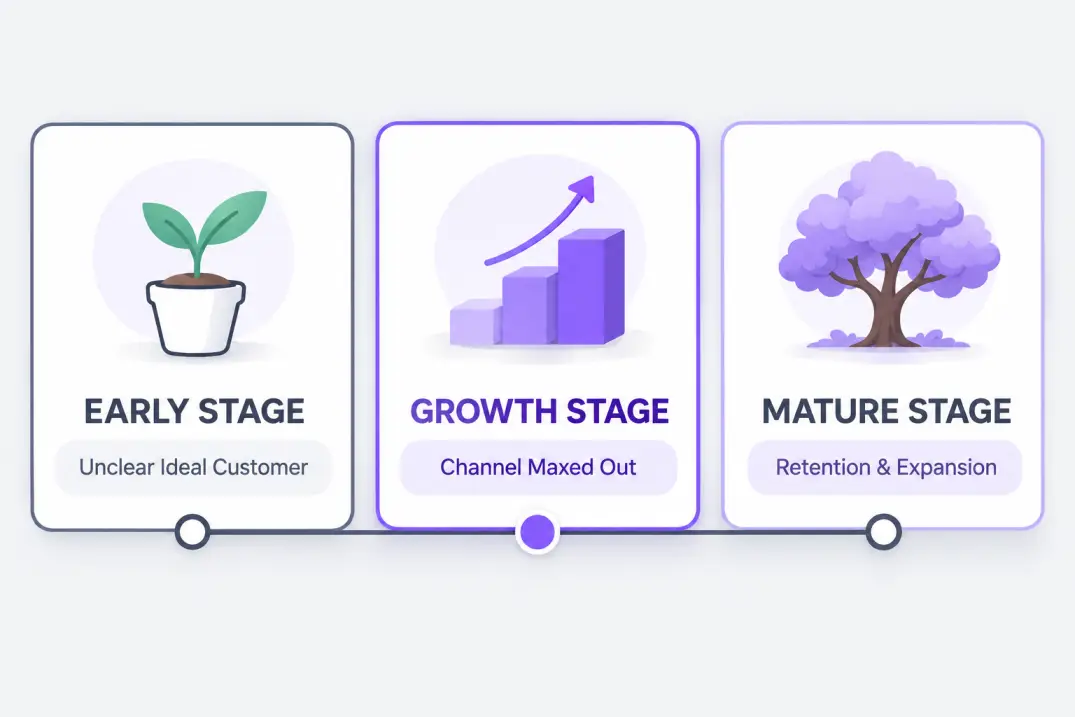
How Growth Strategy Changes by Business Stage
The right lever, and the right kind of strategist, shifts significantly depending on how mature the business is. Applying a growth-stage playbook to an early-stage company (or the reverse) is one of the quieter ways engagements underdeliver.
| Stage | Typical bottleneck | What a strategist usually prioritizes |
|---|---|---|
| Early-stage (pre or just past product-market fit) | Unclear who the best-fit customer actually is | Narrowing the ideal customer profile before scaling any channel |
| Growth-stage (repeatable demand, scaling spend) | One channel maxed out, or CAC creeping up | Diversifying acquisition or fixing the conversion funnel |
| Mature (established, slower organic growth) | Retention, expansion revenue, or market saturation | Upsells, new segments, or a genuinely new product line |
An early-stage company that hires a strategist expecting a scaling playbook is often disappointed, not because the strategist is bad, but because scaling isn't the actual problem yet — the problem is usually that the business hasn't nailed down who its best customers are. A good strategist says this plainly instead of running the growth-stage playbook anyway because that's what they're used to selling.
Many experienced growth strategists spend more of the first engagement talking a company out of scaling prematurely than talking them into new tactics — because scaling an unclear or unprofitable acquisition motion just multiplies the underlying problem faster.
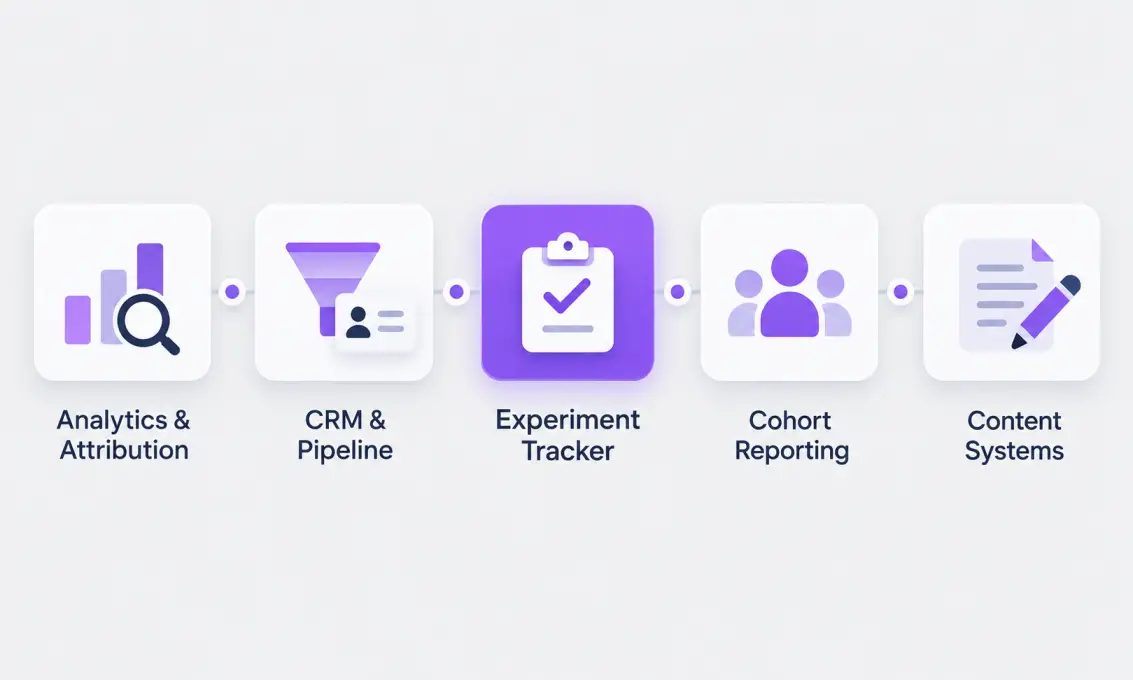
Tools and Systems a Growth Strategist Usually Sets Up
Part of a strategist's job, especially in the first engagement, is making sure the business can actually see whether the plan is working. That usually means putting a few specific systems in place, if they aren't already there.
| Category | What it solves | Examples to research |
|---|---|---|
| Analytics and attribution | Seeing which channels and actions actually drive revenue, not just traffic | GA4, Mixpanel, first-party tracking setups |
| CRM and pipeline tracking | Keeping sales and retention data in one place instead of scattered spreadsheets | HubSpot, Salesforce, Pipedrive |
| Experimentation tracker | A simple log of what was tested, when, and what happened — so learnings don't get lost between quarters | A shared doc or lightweight project tool, not necessarily specialized software |
| Cohort and retention reporting | Seeing churn and expansion by customer segment instead of one blended average | Built-in product analytics, or a finance/BI tool |
| Content and demand-gen tooling | Keeping the chosen acquisition channel running at a sustainable pace | Scheduling tools, SEO platforms, AI-assisted publishing workflows |
That last category matters more than it might seem, since content and organic demand are often the channel a strategist lands on for companies whose paid channels are already saturated — and a channel that needs constant manual production tends to slow down exactly when it needs to compound. This is part of why some teams pair a growth strategist's plan with an automated publishing workflow like Qoreta to keep content output steady without needing to grow a full content team in step with the plan's ambitions.
- Before a growth plan is considered "in motion," confirm the business can answer these without guessing:
- Which specific channel or cohort drove last month's new revenue
- What the current retention rate is, broken down by segment, not just blended
- What's been tested in the last 90 days, and what was learned from each test
- Who owns the next experiment, and by when
How to Measure Whether a Growth Strategist Is Actually Working
Revenue alone lags too far behind the work to be useful week to week. A handful of leading indicators show whether a plan is on track long before the topline number moves.
- Progress against the single chosen metric — not a dashboard of twenty numbers, but the one the plan was actually built around.
- Retention or churn trend, since a growth plan that ignores a leaking bucket will always look weaker than it should, however well the new initiative performs. Our breakdown of why churn quietly undermines otherwise-strong growth metrics covers a related blind spot worth checking alongside any growth engagement.
- Test velocity — how many hypotheses actually got tested in the quarter, since a strategist who talks a lot but ships few tests is producing strategy decks, not results.
- Clarity of the next 90-day plan. If a good strategist can't clearly explain what's next and why, based on what was just learned, the engagement isn't actually compounding.
A well-run engagement should leave you with more than a single lift in a number — it should leave your team with a repeatable way to diagnose and prioritize the next bottleneck on your own, which is often the real long-term value of the work.
Building the Skill In-House Over Time
Even companies that hire a strategist for a defined engagement often aim for the same end state: a team that can eventually run this diagnostic process themselves. A good strategist treats this as part of the job, not a threat to future retainers.
That usually looks like documenting the reasoning behind each decision, not just the decision itself, so the team can see why retention was prioritized over a new channel, not just that it was. It also means involving at least one internal person closely enough in the diagnosis phase that they could reasonably repeat the process on the next bottleneck, with the strategist available for a lighter-touch review rather than running the whole cycle again from scratch.
Companies that treat every growth question as a reason to hire outside help again tend to spend more over time than those that use an early engagement to build a repeatable internal habit, then bring in outside expertise selectively for harder or unfamiliar problems.
Final Thoughts
A business growth strategist earns their fee by answering one question well: out of everything this business could do, what's actually worth doing first? That's a smaller job than it sounds, and a much more valuable one than adding another tactic on top of a problem nobody has properly diagnosed.
Before hiring one, run the seven vetting questions above in a first conversation. A strategist who leads with diagnosis, names a specific metric, and can explain their past reasoning in detail is worth a serious look. One who jumps straight to tactics, guarantees results, or can't name a single priority is a sign to keep looking. And whichever way you go, the goal past the first engagement should be a team that needs less outside help to answer the same question next time, not more.
Artificial Intelligence
Intelligence without limits.
We believe great content deserves honest authorship—even when it's AI.
Frequently Asked Questions
A growth strategist focuses specifically on diagnosing the bottleneck limiting revenue and prioritizing one lever to fix it. A marketing consultant's scope is usually broader, covering brand, campaigns, or channel strategy without necessarily tying every recommendation back to a single measurable growth lever.
Freelance strategists typically charge $100–$300 an hour or $3,000–$10,000 a month on retainer. Boutique growth agencies run $5,000–$20,000+ a month, and a full-time in-house hire usually costs $90,000–$180,000+ a year in base salary, depending on seniority and market.
It's usually a good fit when revenue has plateaued despite consistent effort, leadership disagrees on what to prioritize, or several tactics have been tried without a unifying plan. It's premature if the core product hasn't yet found repeatable demand.
A realistic first 90 days includes a written diagnosis of the actual bottleneck, a prioritized plan naming one or two levers with clear targets and owners, and an early small-scale test of the chosen lever — not a fully transformed business.
It depends on the engagement. Some strategists only diagnose and plan, handing execution to your team or an agency. Others offer combined strategy-plus-execution retainers. Clarify this upfront, since it significantly affects both cost and what you should expect delivered.
The clearest red flags are guaranteed results, no discovery or audit phase before recommendations, vague metrics like 'brand awareness' instead of a specific number, and case studies with no actual performance figures attached.
Not quite. 'Growth hacking' historically implies fast, experiment-heavy tactics, often channel-specific. A growth strategist's role is broader and more diagnostic — deciding which lever deserves focus in the first place, which may or may not involve rapid experimentation depending on what the diagnosis finds.
Most honest engagements set expectations around a 90-day cycle for the first meaningful signal, with larger structural changes — like fixing retention or repositioning pricing — sometimes taking two to three cycles to fully show up in revenue.
If the team already has execution capability but disagrees on priorities or lacks a diagnostic framework, a short project-based engagement can often resolve that for less than an ongoing retainer. Full in-house hiring tends to make more sense once growth strategy becomes a permanent, ongoing function rather than a one-time fix.