llms.txt: Does It Really Help AI Search Visibility?

Artificial Intelligence
October 20, 2026
Imagine spending a Friday afternoon writing a tidy Markdown index of your best pages, uploading it to your site's root folder, and waiting for ChatGPT to start citing you. A month later, your server logs show the file was requested a handful of times, mostly by you.

Short answer: the llms.txt file is a proposed convention, not a ranking factor, and no major search engine or AI assistant has confirmed that it uses one to decide what to cite. It can help in narrow cases, mainly developer documentation read by coding tools. It will not lift your visibility in Google or AI answers on its own, so treat it as a cheap extra, not a strategy.
That distinction matters, because a lot of GEO advice quietly treats it as a must-have. Here is what the evidence says, and where your time pays off more.
What the File Actually Is
It's a plain Markdown file placed at /llms.txt on your domain. The idea came from Jeremy Howard of Answer.AI in 2024, and the llmstxt.org proposal describes the format: an H1 with the site name, a short blockquote summary, then H2 sections listing links with one-line descriptions.
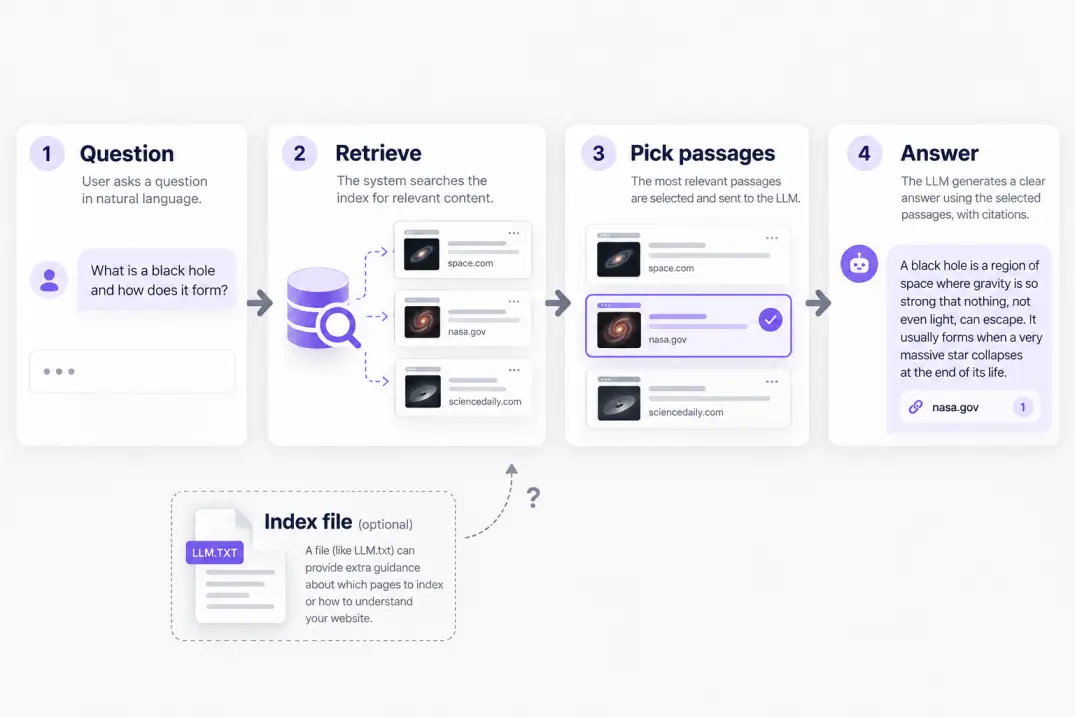
The goal is to hand a language model a clean, curated map of your site, so it doesn't have to wade through navigation bars, scripts, and cookie banners. An optional companion file bundles the full text of key pages in one place.
Think of it as a reading list for machines. Not a gate, not a rule, just a suggestion.
A proposed Markdown file at the root of a domain that lists a site's most useful pages with short descriptions, written for language models to read when they fetch a site. It is a convention, not a web standard, and nothing requires a crawler to honor it.
What Google and the AI Vendors Have Said
Here is where the hype meets the record. Google's Search Relations team said publicly in 2025 that Google doesn't use the file for search, and John Mueller compared it to the keywords meta tag: a signal anyone can add and nobody trusts.
Google's own documentation on AI features in Search points the same way. It says the same foundational SEO practices apply, with no special files or markup required to appear in AI Overviews or AI Mode.
The other vendors are quieter. As of this writing, the companies behind the major AI assistants haven't published documentation saying their retrieval systems look for the file or weight it. Absence of proof isn't proof of absence, but it's a thin base for a strategy.
That is the evidence gap: plenty of tutorials, very little confirmation.
Treating a few citation wins after adding the file as proof that it works. Sites that add it usually fix content, links, and structure in the same month, so the file gets credit it didn't earn.
Why the Idea Spread So Fast
It rhymes with robots.txt and sitemap.xml, so it feels official. It's cheap, it looks technical, and it gives site owners something concrete to do about a vague fear: being invisible to AI.
Plugins added one-click generators, and checklist articles followed. Popularity, though, is not evidence. Plenty of SEO rituals spread exactly this way before anyone measured them.
Where It Genuinely Helps
The strongest case is developer documentation. When someone pastes your docs URL into an AI coding tool, an agent can read a clean index of your pages instead of parsing menus and scripts.
That is why several documentation platforms generate the file automatically, and why API-heavy companies publish one. The benefit is convenience for tools that choose to read it, not a ranking boost.
It can also help a small knowledge base with messy navigation, where a curated list beats a sprawling sitemap.
If your site is a blog, a store, or a service business, the upside is much smaller. Your pages win AI citations the same way they win Google rankings: by being found, understood, and trusted.
What Actually Gets You Cited
AI answer engines don't browse like humans. They retrieve candidate pages through search indexes and crawlers, then pull the passages that answer the question most directly. So the levers are familiar ones, with sharper edges.
Be crawlable. If a bot you want is blocked in your robots rules, nothing else matters. Google's robots.txt introduction explains what blocking does and doesn't do.
Answer first. Put the direct answer in the first two sentences under each heading. Retrieval systems lift passages, not whole pages.
Describe entities. Clear naming, author pages, and structured data help systems understand who and what a page covers.
Connect your pages. Strong internal links show which pages matter and make sure bots actually reach them.
Add something new. Original data and firsthand detail give a model a reason to pick you over ten near-identical pages.
For the full picture, our GEO playbook and the breakdown of what gets you cited in ChatGPT go deeper on each lever.
Here is how the optional index file compares with the signals that are proven:
| File or signal | Who reads it | Job | Confirmed effect |
|---|---|---|---|
| robots.txt | Crawlers | Controls crawl access | Yes, widely honored |
| sitemap.xml | Search engines | Lists URLs for discovery | Yes, a discovery aid |
| Structured data | Search engines | Describes page entities | Yes, supports understanding and rich results |
| LLM index file | Some AI tools | Curated page list for models | Not confirmed by major engines |
This is why polishing an optional file loses to rewriting one weak page that nobody cites.
A Minimal Template
If you decide to publish one, keep it small and boring. Here is a working skeleton:
# Example Docs
> Guides and API references for the Example product.

## Getting started
- [Quickstart](https://example.com/docs/quickstart): Install and send your first request
- [Authentication](https://example.com/docs/auth): API keys and token scopes

## Reference
- [API reference](https://example.com/docs/api): Endpoints, parameters, and errors
Keep it to 10 to 30 links, include only pages you'd want quoted, describe each one in plain language, and update it when pages move or die. A stale index sends tools to dead ends.
A companion file with full page text can be useful for docs, but it only makes sense once the index itself is accurate. And skip the urge to stuff keywords into descriptions. Models read meaning, not density.
How to Test It Honestly
Because the evidence is thin, run your own experiment instead of trusting anyone's anecdote.
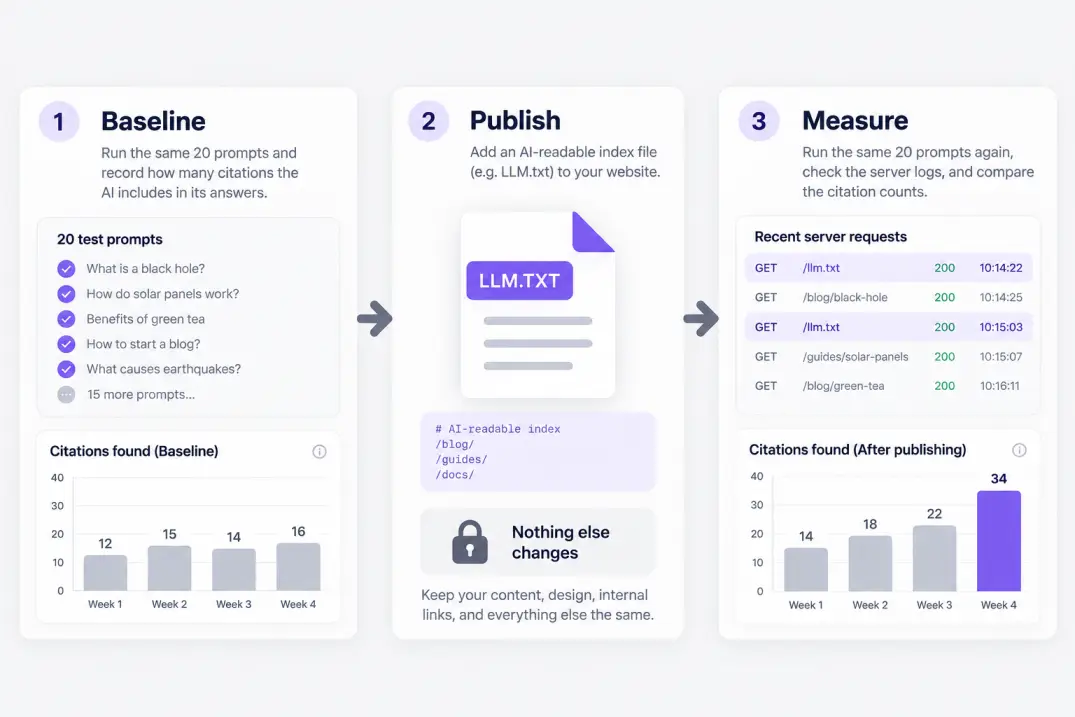
- Set a baseline. Ask the same 15 to 20 buyer questions in the major AI assistants every week for four weeks, and log which answers cite you.
- Publish the file and change nothing else. No new content, no link changes, so the file is the only variable.
- Check your server logs. Look for requests to the file's path and note which user agents made them.
- Re-run the prompts for four to six weeks. Compare citations against your baseline.
If the logs show no AI bot ever fetched the file, you have your answer for your own site. Keep in mind that one site's result is a data point, not a law.
The Bottom Line
Publishing the file costs an hour and carries almost no risk, so there's no strong reason to avoid it. There's also no strong reason to expect it to move your numbers.
If you run documentation, add it. Everywhere else, spend that hour on the work that retrieval systems demonstrably reward.
- The file is a proposal, not a confirmed ranking or citation signal.
- Google has said it doesn't use it for search.
- It helps most on documentation sites read by coding tools.
- Crawlable pages, direct answers, clear entities, and original information still drive citations.
- Test it with a baseline and server logs before believing any claim.
Artificial Intelligence
Intelligence without limits.
We believe great content deserves honest authorship—even when it's AI.
Frequently Asked Questions
No. Robots.txt controls crawler access and is honored by major crawlers. The AI index file is only a suggestion that lists pages for models to read. It blocks nothing and enforces nothing.
Unlikely, since it's a static text file. The real risks are stale links that send tools to dead pages and listing URLs you'd rather not surface. Never include private or staging URLs.
Only if you run documentation that tools benefit from reading in one pass. It duplicates content in a single large file and has to stay in sync with your pages, so skip it until the index itself is solid.
Filter your server or CDN logs for requests to the file's path, group them by user agent, and compare those against the crawler names each AI vendor documents. No matching requests over several weeks means nobody is reading it.
A plugin is fine for a first draft, but review the output. Many generators list every post, which defeats the point of curation. A hand-picked list of 10 to 30 pages works better.
Cornerstone pages you'd be happy to see quoted: definitive guides, product and pricing references, and documentation. Leave out thin tag pages, archives, and anything outdated.
Confirm your important pages are crawlable and indexed, rewrite weak intros so the answer comes first, add structured data, and link related pages together. Those changes affect retrieval directly.