AI Content Detectors vs Plagiarism: What Google Checks

Artificial Intelligence
September 10, 2026
I ran a 1,500-word draft through three popular AI detectors last week, and the results were absurd. One tool flagged the piece as 98% AI, while another declared it 100% human—on the exact same text. The core issue isn't that AI content detectors are flawed; it's that marketers confuse statistical pattern detection with actual plagiarism.

Google does not rely on third-party AI content detectors to rank or penalize web pages. Instead, Google evaluates content through search quality systems like Helpful Content signals, E-E-A-T (Experience, Expertise, Authoritativeness, and Trustworthiness), and traditional duplicate text checks to filter out spam and low-value commodity writing.
Understanding the distinction between AI content detectors vs plagiarism tools is essential for modern publishers. While plagiarism checkers scan web indices for stolen text, AI detectors merely guess mathematical predictability.
The Fundamental Difference: Predictability vs. Theft
Plagiarism is defined by attribution and origin. It occurs when a publication copies verbatim text, structural frameworks, or proprietary data from an existing source without proper credit. Plagiarism detection tools function by indexing billions of live web pages, academic journals, and documents, then running n-gram string matching algorithms to identify identical or near-identical passages.
AI detectors, on the other hand, do not look for stolen source material. They analyze token probability. When a large language model generates text, it calculates the most mathematically likely next word based on its training weights. AI detectors run those same text strings through secondary probabilistic models to evaluate how expected the phrasing appears.
This distinction explains why technical documentation, legal contracts, and medical summaries frequently trigger false positives on synthetic content scanners. Formal, highly structured prose naturally uses predictable word choices, making human-written compliance content look synthetic to simple statistical calculators.
Deterministic String Matching vs. Probabilistic Inference
Plagiarism checkers employ deterministic string matching. They break text down into overlapping n-grams (sequences of n words) and search giant web crawls for identical sequences. If three consecutive sentences match a published journal article word-for-word, the tool flags it deterministically.
AI detectors do not possess a database of original sources; they make an inference based on language probability distributions. They cannot tell you where text came from because it wasn't copied from anywhere—it was generated stochastically.
Confusing high AI detector scores with a search engine penalty. Google does not penalize text simply because it scores high on a third-party AI classifier; it penalizes content that offers zero unique value, copies existing pages, or fails to answer search intent.
How AI Detectors Function: Perplexity and Burstiness
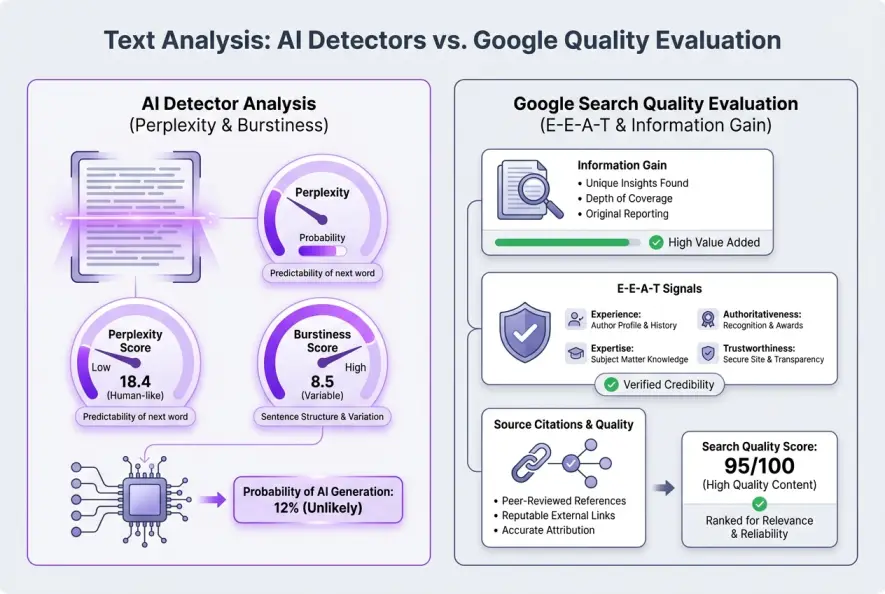
To understand why detection software yields inconsistent results, you have to look at the two primary metrics these tools measure: perplexity and burstiness.
Perplexity: The Predictability Metric
Perplexity measures how surprised a language model is by a sequence of words. If a text selection contains common collocations, standard grammar structures, and predictable transitions, its perplexity score is low. AI detection tools interpret low perplexity as evidence of artificial generation, assuming a human writer would choose more obscure vocabulary or unexpected phrase combinations.
However, low perplexity is also the hallmark of clear, concise, and accessible educational writing. Clear communication intentionally minimizes complexity so readers can digest information quickly. By penalizing low perplexity, detection tools effectively punish straightforward writing styles.
Burstiness: The Variation Metric
Burstiness evaluates sentence structure variance across a document. Human writers naturally alternate between short, punchy statements and longer, complex sentence structures. They vary rhythm based on emotion, emphasis, and context.
Large language models traditionally default to uniform sentence lengths and standard paragraph blocks. When an algorithm detects uniform sentence structures across multiple paragraphs, it flags high burstiness consistency, scoring the piece as synthetic.
Yet, editorial formatting guidelines—such as short paragraphs, uniform bullet points, and scannable headings—often force writers into structured layouts that mimic synthetic patterns. Consequently, clean, highly formatted content frequently gets misflagged by automated classifiers.
Furthermore, academic research has revealed significant bias in statistical detection algorithms. Studies show that non-native English speakers, who frequently rely on standard grammar frameworks and simpler vocabulary choices, are far more likely to trigger false positives on synthetic text checkers than native speakers.
What Google Actually Evaluates
While third-party software hunts for statistical predictable text, Google's ranking systems operate on an entirely different plane. Search engines care about search satisfaction, user engagement, and information gain.
According to Google's Search Central documentation, the primary mandate for search visibility is producing original, high-quality, people-first content. Search algorithms do not care whether a keyboard was tapped by human fingers or an automated pipeline, provided the final output delivers genuine value to the reader.
Information Gain and Vector Novelty
Google evaluates published content using information gain models. When a user searches for a query, the search engine compares new articles against existing index documents covering the same topic. If a new page merely rephrases information already available on top-ranking sites, its information gain score is near zero.
Pages with low information gain receive minimal organic reach because they add no fresh insights to the search index. This is where low-quality automated content fails—not because an algorithm detected AI patterns, but because the piece offered nothing new.
You can learn more about structuring differentiated articles in our detailed breakdown of information gain.
Demonstrating E-E-A-T
To establish search authority, content must demonstrate Experience, Expertise, Authoritativeness, and Trustworthiness. Google's quality raters look for verifiable sources, author credentials, real-world experience, and accurate data points, as outlined in Google's Search Quality Rater Guidelines.
Synthetic text generated without human oversight often lacks specific real-world examples, nuanced domain expertise, and accurate external references. When search algorithms demote such content, the cause is an absence of authoritative proof points—not the underlying technology used to draft it.
SpamBrain and Algorithmic Pattern Recognition
Google utilizes AI systems like SpamBrain to detect spam, scaled content abuse, and link manipulation. However, SpamBrain does not scan for AI writing styles; it identifies manipulative search behavior. Sites generated purely to hijack search queries through low-cost, repetitive text are demoted because they violate Google's spam policies, not because of the drafting tool used.
Real Plagiarism vs. Synthetic Pattern Matching
The confusion between plagiarism and synthetic writing leads many content teams to waste hundreds of hours editing text simply to pass arbitrary detection thresholds.
When analyzing AI content detectors vs plagiarism, it becomes clear that Google prioritizes factual original value over probabilistic sentence structure.
| Feature | Plagiarism Detection Software | AI Content Detection Tools | Google Search Ranking Systems |
|---|---|---|---|
| Primary Method | Index matching against web pages & publications | Perplexity and burstiness probability analysis | Information gain, user engagement, and E-E-A-T |
| Core Target | Stolen text, uncited copy, and stolen intellectual property | Statistically predictable phrase structures | Low-quality spam, duplicate pages, and thin content |
| Reliability | High (deterministic string matching) | Low (prone to high false-positive rates) | High (multi-stage algorithmic evaluation) |
| Actionable Outcome | Identifies specific source URLs needing attribution | Highlights arbitrary phrases based on likelihood | Determines search position based on overall page value |
Even major artificial intelligence research organizations acknowledge the inherent limitations of statistical detection. For instance, OpenAI's research notes on text classification highlighted that statistical classifiers regularly generate false positives, particularly on non-native English writing and highly structured technical documents.
The Problem with False Positives
Relying on third-party AI scanners creates severe operational bottlenecks. Content managers often force writers to rewrite perfectly clear, authoritative articles using awkward phrasing or unusual synonyms just to lower an arbitrary AI probability score.
This practice actively hurts SEO performance. By inserting unnatural phrasing to fool a detector, teams degrade readability, compromise topical clarity, and reduce user satisfaction signals—the exact metrics search engines use to judge quality.
How to Publish Original Content That Ranks
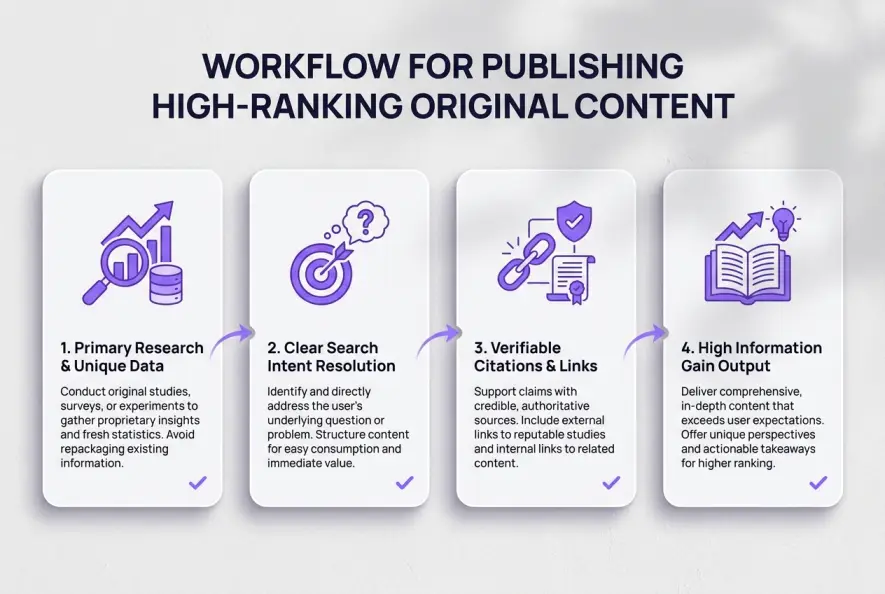
To build a sustainable publishing strategy that survives algorithm updates, focus on editorial quality rather than beating statistical scanners. Follow these foundational principles to ensure your content ranks consistently:
- Incorporate Primary Data and Unique Insights: Include internal survey data, proprietary case studies, or original quote commentary that cannot be found elsewhere on the web.
- Cite Respected External References: Link out to primary research papers, official technical documentation, and recognized industry authorities to ground your assertions.
- Optimize for Clear Search Intent: Answer the searcher's core query immediately in plain language before expanding into detailed subtopics.
- Maintain Rigorous Citation Standards: Ensure every stat, historical claim, and technical process is verified for absolute accuracy across reputable publications.
For a deeper dive into balancing publishing volume with quality guidelines, read our complete guide on automated blogging guidelines.
In modern publishing workflows, successful teams separate strategic research and factual verification from text generation. For example, platforms like Qoreta design automated drafting pipelines to run multi-stage quality checks, pulling verified external sources and structuring distinct viewpoints so the resulting content offers real depth rather than generic summaries.
Moving Beyond Statistical Scanners
The future of organic search performance belongs to brands that prioritize information value over artificial metrics. Content that teaches, clarifies, and solves problems will always outperform generic articles, regardless of how they were authored.
Instead of spending hours obsessing over third-party probability scores, invest that energy into gathering original insights, refining structural flow, and satisfying user intent. When your publishing workflow is rooted in factual accuracy and distinct perspective, search engine rankings naturally follow.
Artificial Intelligence
Intelligence without limits.
We believe great content deserves honest authorship—even when it's AI.
Frequently Asked Questions
No. Google has officially stated that it does not use third-party AI content detectors to evaluate or penalize web pages. Google's algorithms focus on content quality, search intent satisfaction, and information gain rather than whether text was drafted by AI or human hands.
AI detectors rely on statistical metrics like perplexity and burstiness. Plain, formal, or highly structured human writing—such as legal terms, technical guides, or academic papers—often features low perplexity and predictable sentence lengths, causing detectors to misidentify it as synthetic.
Plagiarism checkers perform deterministic string matching against an indexed database of web pages and published papers to find duplicate text. In contrast, AI detectors use probabilistic models to guess whether text matches the writing patterns of large language models.
Information gain measures the unique value, new facts, or original perspective a page provides compared to existing search results. Google rewards pages with high information gain because they offer fresh information rather than repeating existing top-ranking articles.
Yes, provided the content is helpful, accurate, well-structured, and meets user search intent. To rank consistently, ensure your AI-assisted drafting workflow includes factual verification, authoritative external citations, and original insights.
No. Rewriting articles using awkward phrasing or uncommon synonyms just to bypass AI detectors often degrades readability and user experience. Focus instead on adding expert insights, primary data, and clear explanations that genuinely serve the reader.