How to Choose a Content Strategy Agency (Without Guessing)

Artificial Intelligence
October 5, 2026
According to CMI and MarketingProfs' long-running B2B content marketing research, most organizations that document their content strategy report far greater success than those that don't — and most companies still don't write one down. That gap is exactly why so many businesses end up hiring a content strategy agency: not because they can't write content, but because nobody on the team has time to plan it properly.

So here's the direct answer: a content strategy agency is a team hired to research your audience, define what content to create and why, build a production system for it, and measure whether it's working — as opposed to a content mill that simply outputs blog posts on a schedule. The difference matters, because the second kind is easy to find and the first kind is who actually moves your numbers.
If you're evaluating options right now, the fastest filter is this: ask any agency to walk you through their process before you ever look at their portfolio. A strong content strategy service can explain, step by step, how they go from "we don't know your audience yet" to "here's a documented plan tied to a business goal." A weak one will skip straight to sample blog posts.
What a Content Strategy Agency Actually Does
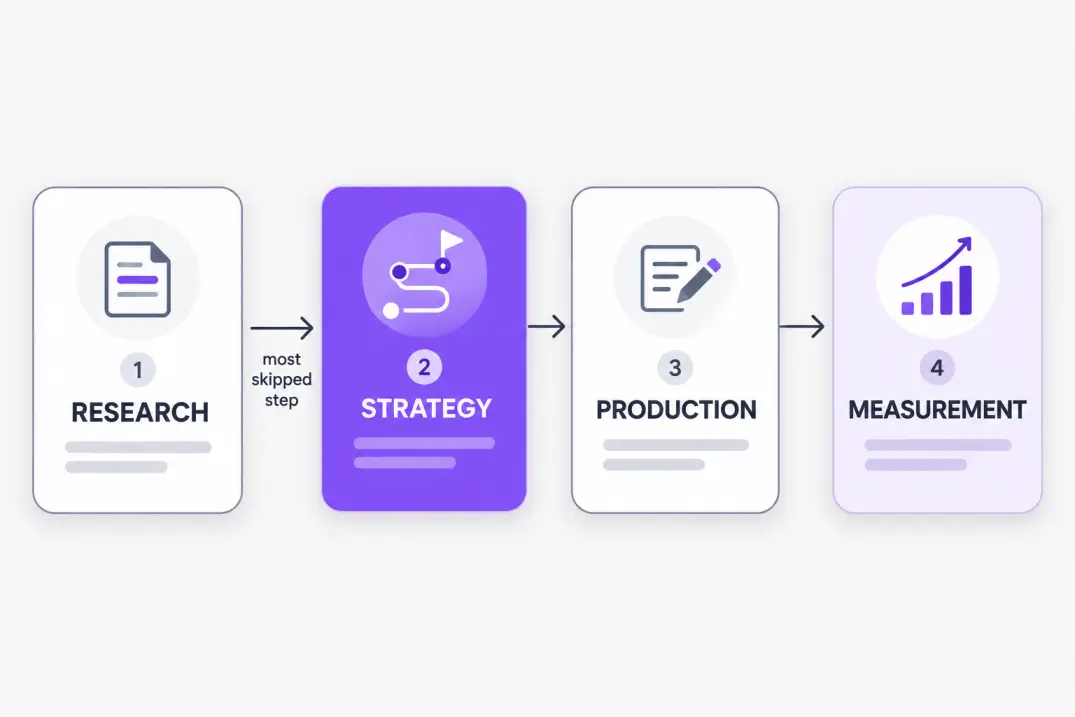
Strip away the sales language and the job breaks into four parts.
Research. Audience interviews, competitor content audits, keyword and topic gaps, and a look at what's already ranking or converting for you. This is the unglamorous work that most in-house teams skip under deadline pressure.
Strategy. A documented content strategy — not a spreadsheet of post titles, but a plan that states who you're writing for, what topics you own, what format each piece takes, and how success gets measured. If you want a deeper look at how this gets structured long-term, our guide on building a content roadmap covers the framework end to end.
Production. Writers, editors, and often designers turning the strategy into published pieces — blog posts, guides, landing pages, sometimes video or social content, depending on scope.
Measurement. Traffic, rankings, leads, or whatever metric you agreed on upfront, reported back on a schedule, with adjustments made to the plan based on what's actually working.
A content strategy is the documented plan behind your content: who it's for, what topics it covers, how it gets produced, and how success is measured. It's the blueprint. The blog posts, videos, and guides are the building.
Agencies vary in how much of this four-part job they cover. Some only do strategy and hand you the roadmap to execute in-house. Others run the entire pipeline from research to published post. Knowing which one you're hiring matters more than most people realize during a sales call.
The 'So What': Why This Distinction Costs You Money
Here's the real-world consequence of skipping this check. A business hires a "content agency," gets four blog posts a month, and six months later has forty posts and no meaningful traffic increase. Nobody did the research step, so the posts targeted topics nobody was searching for. The production quality was fine. The strategy was missing.
This is why the vetting process below leads with process questions, not writing samples. A skilled writer executing a bad plan still produces a bad result.
How to Vet a Content Strategy Agency: 7 Questions That Actually Matter
Ask these in the first call. The answers tell you more than any portfolio.
1. "Walk me through your process before you write a single word." You want to hear research, interviews, and a documented plan — not "we'll get started right away." Speed before strategy is the single biggest predictor of wasted spend.
2. "Can I see a real content strategy example from a past client?" A redacted strategy document — audience notes, topic clusters, a measurement plan — tells you far more than ten polished blog posts. If they can't show the planning artifact, they may not actually produce one.
3. "What's the content strategy framework you use, and does it flex per client?" Good agencies have a repeatable system but adapt it. A framework that looks identical across every client regardless of industry is a red flag for templated, low-effort work.
4. "How do you measure success, and how often do I see results?" Expect an honest answer: meaningful movement usually takes 3 to 6 months. Anyone promising fast rankings or guaranteed traffic within weeks is either inexperienced or overselling.
5. "Who is my actual point of contact, and who's doing the writing?" Many agencies sell you a senior strategist on the pitch call, then hand execution to a rotating pool of freelancers. Ask directly who touches your account day to day.
6. "What happens if a piece underperforms?" A strong agency treats this as expected and has a revision or repurposing process. A weak one has no answer beyond "we'll write another one."
7. "What do you need from us to do this well?" Good strategy work requires your input — subject matter expertise, customer data, product access. If an agency claims they need nothing from you, they're likely working from generic templates, not your actual business.
Judging an agency purely on writing samples. Clean prose is table stakes. The plan behind the prose — why this topic, for this audience, tied to this goal — is what you're actually paying for.
- Before signing with any content strategy agency, confirm:
- They lead with research and a documented plan, not immediate production
- You can see a real (redacted) strategy document, not just finished posts
- Reporting is tied to a business metric, not just post count
- You know your actual point of contact and who executes the work
- Timelines for results are realistic (3–6 months, not 3–6 weeks)
What It Costs: A Realistic Breakdown
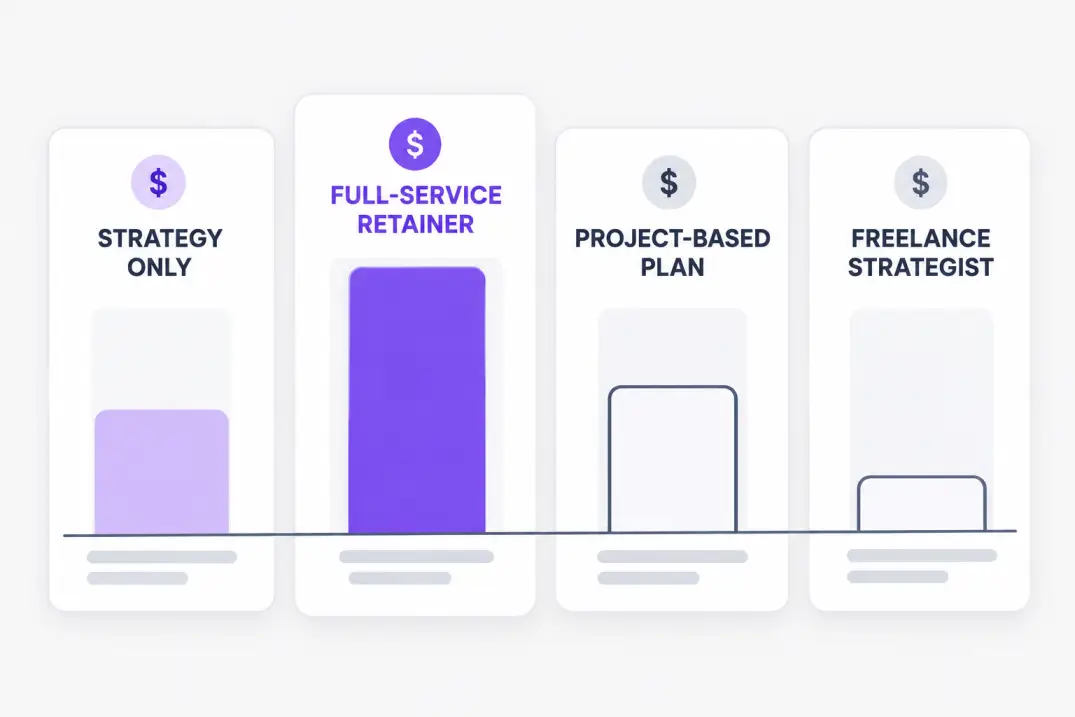
Pricing varies widely by scope, but the ranges below reflect what most businesses can expect to see quoted.
| Engagement type | Typical monthly cost | Best fit |
|---|---|---|
| Strategy-only (roadmap, no production) | 8,000/mo or 25,000 project | Teams with in-house writers who need direction |
| Full-service retainer (strategy + production) | 20,000+/mo | Businesses that want the whole pipeline handled |
| Project-based content strategy plan | 25,000 one-time | A single roadmap you'll execute yourself |
| Freelance strategist | 200/hour | Smaller budgets needing senior guidance without agency overhead |
Agencies with lower quotes than these ranges are worth extra scrutiny — ask specifically what research and reporting is included, since strategy work is usually the first thing cut to hit a low price.
Agency vs. Freelancer vs. In-House vs. AI-Assisted: Which Fits You
An agency isn't the only path to a working content strategy. Here's how the main options actually compare.
| Option | Strength | Trade-off |
|---|---|---|
| Content strategy agency | Full team, proven process, faster ramp-up | Highest cost, less day-to-day control |
| Freelance strategist | Senior expertise at lower cost | You still need writers to execute the plan |
| In-house hire | Full control, deep product knowledge | Slower to build the skill and process from scratch |
| AI-assisted publishing | Fast, consistent output at low marginal cost | Needs a real strategy behind it, or it just produces content faster with no plan |
That last option deserves a caveat, because it's the one most often misunderstood: automation speeds up production, it doesn't replace the strategy step. A platform like Qoreta, for instance, still needs a defined audience and topic direction feeding into its research stage — the automation makes execution faster once that direction exists, not instead of it.
Many businesses end up mixing these: an agency or freelance strategist builds the initial roadmap, and an in-house team or automated pipeline handles ongoing production against it. That combination often gets you senior-level planning without paying full-service retainer rates indefinitely.
Signs You Don't Need an Agency Yet
Not every business needs to hire out. Skip it, at least for now, if:
- You haven't published consistently for 3+ months and don't know if content works for your audience yet
- Your budget is under $2,000/month — most reputable agencies won't take engagements that small
- Nobody in-house can act as a point of contact to approve strategy and give product input
- You need one or two pieces, not an ongoing program — a freelancer is the better fit
In these cases, a lighter starting point — a self-built content strategy template, or a few months of consistent in-house publishing — gives you a clearer picture of what you'd actually be paying an agency to accelerate.
Final Thoughts
The agencies worth paying for are the ones that make you sit through a research phase before you see a single draft. That's frustrating when you want content live next week, and it's exactly why it works: a documented content marketing strategy built on real audience data outperforms fast output almost every time.
Before you sign anything, run the seven vetting questions above in your first call. The answers will tell you, faster than any portfolio, whether you're hiring a strategy partner or a content mill with better branding.
Artificial Intelligence
Intelligence without limits.
We believe great content deserves honest authorship—even when it's AI.
Frequently Asked Questions
Full-service retainers typically range from $5,000 to $20,000+ a month, while strategy-only engagements run $3,000 to $8,000 a month or $5,000 to $25,000 as a one-time project. Rates vary heavily by scope, industry, and how much production is included.
In practice the terms overlap heavily. Some agencies use 'content strategy' to emphasize the planning phase (research, roadmap, measurement) and 'content marketing' to emphasize ongoing production and promotion. Ask directly what's included rather than relying on the label.
Most honest agencies set expectations at 3 to 6 months for meaningful traffic or ranking movement, since content needs time to get indexed, ranked, and to build authority. Anyone promising results within a few weeks is either inexperienced or overpromising.
Not necessarily. If your team already produces content but lacks a documented plan for what to write and why, a strategy-only engagement or a freelance strategist can often fill that gap for less than a full-service retainer.
A real strategy document typically includes audience definitions, topic clusters or pillars, a keyword and content gap analysis, a production and approval workflow, and a measurement plan tied to specific business metrics — not just a list of blog titles.
AI tools can speed up research and production significantly, but they still need a defined audience and topic direction to work from. They're better understood as accelerating execution of a strategy than replacing the strategic thinking itself.
The clearest red flags are guaranteed rankings or traffic numbers, no discovery or research phase before production starts, no named point of contact, and case studies that show finished content but no actual performance data.
The underlying steps — research, planning, production, measurement — stay consistent, but a good agency adapts the framework to your industry, audience, and goals. A framework that looks identical across every client regardless of context is usually a sign of templated, low-effort work.